Amino Acids for Skin: The Building Blocks of Collagen and Cellular Repair
In our previous series, we established the critical importance of the dermal-epidermal junction (DEJ) and the power of peptides and antioxidants in a cleanser to protect and prime the skin. Now, we move to the next essential step in a truly regenerative skincare routine: the serum. This is where we deliver the active, high-concentration ingredients that drive profound cellular change. And at the very foundation of this change are the building blocks of life itself: amino acids.
While peptides and growth factors often steal the spotlight, they are, in essence, just chains of amino acids. Understanding the foundational role of these individual molecules is the key to unlocking the next level of skin health. This isn't just about adding a single ingredient; it's about providing your skin with the complete, synergistic toolkit it needs to rebuild, repair, and thrive in the face of daily environmental assaults.
Key Takeaways
- 🧬The Foundation of Skin: Amino acids are the direct building blocks of all skin proteins, including collagen and elastin, making them essential for skin structure and repair.
- 🤝Synergy is Key: Scientific research shows that combinations of specific amino acids (like BCAAs + Proline) are far more effective at stimulating collagen synthesis after UV damage than single amino acids alone.
- 💧More Than Structure: Beyond building proteins, amino acids are a critical component of the skin's Natural Moisturizing Factors (NMFs), essential for maintaining hydration, barrier function, and a healthy skin pH.
Amino Acids for Skin: The Building Blocks of Youth & Collagen Synthesis (A Quick Overview)
Before we dive deep into the science, watch this quick overview to discover the building blocks of youth and learn how a synergistic complex of amino acids fuels collagen synthesis and cellular repair.
In This Article:
- What Are Amino Acids? The Skin's Essential Alphabet
- The Science of Synergy: Why Amino Acid Cocktails Trump Single Ingredients
- The Powerhouse Players: A Deep Dive into 8 Essential Skin Amino Acids
- Amino Acids vs. Peptides: What's the Difference?
- Why Your Skin Needs a Complete Amino Acid Complex for True Repair
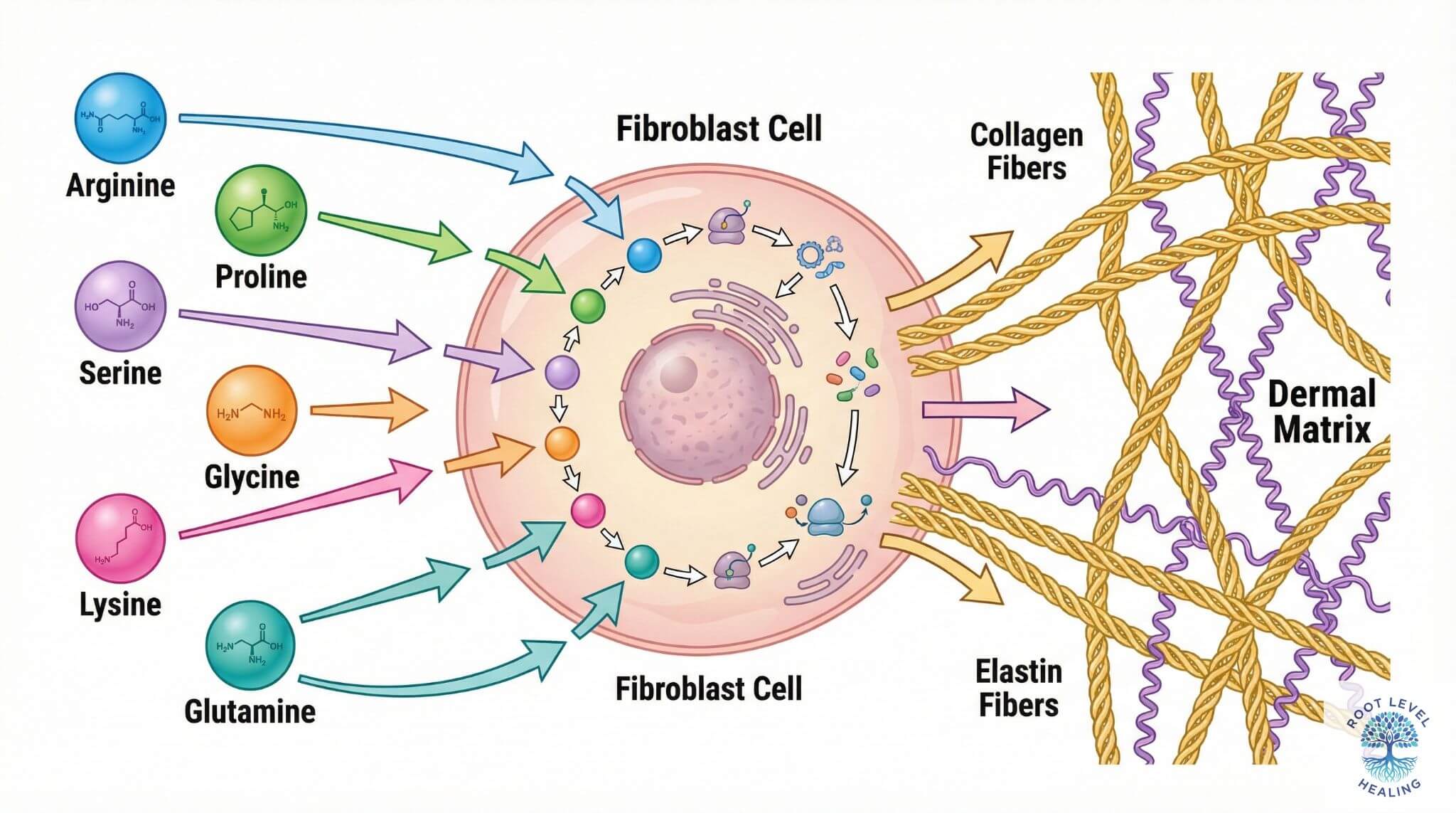
A complete profile of amino acids provides fibroblasts with all the necessary raw materials to construct resilient collagen and elastin fibers, effectively repairing the dermal matrix and restoring youthful structure to the skin.
What Are Amino Acids? The Skin's Essential Alphabet
Think of amino acids as the 26 letters of the alphabet. Individually, they have unique properties, but when combined in specific sequences, they form words, sentences, and entire languages. In the body, these "languages" are proteins. Collagen, the most abundant protein in your skin, is a long, complex "sentence" written with a specific sequence of amino acids, with Proline and Glycine being particularly frequent letters.
There are 20 primary amino acids, categorized into two groups: essential and non-essential. The nine essential amino acids cannot be synthesized by the body and must be obtained through diet or topical application. The other eleven are non-essential, as the body can produce them. For optimal skin health, providing a topical supply of a wide range of amino acids is crucial, as it ensures the skin has all the necessary building blocks readily available for repair and regeneration, bypassing the need for internal synthesis.
"Within skin’s uppermost layers, amino acids work as conductors, orchestrating an incredibly complex “concert” that allows our skin to thrive and to stay hydrated." [1]
Beyond their role as protein precursors, amino acids are a fundamental component of the skin's Natural Moisturizing Factors (NMFs). Found within the cells of the stratum corneum, NMFs are a complex mixture of substances that attract and bind water, maintaining skin hydration, pliability, and barrier integrity. Amino acids and their derivatives make up approximately 40% of the NMFs, playing a direct role in keeping the skin's surface smooth, supple, and hydrated [2].
The Science of Synergy: Why Amino Acid Cocktails Trump Single Ingredients
The skincare market is saturated with products highlighting a single hero ingredient. However, when it comes to amino acids, this approach is fundamentally flawed. Scientific evidence overwhelmingly shows that a synergistic cocktail of specific amino acids is far more powerful than any single amino acid in isolation, particularly when it comes to repairing UV-induced damage.
A landmark study published in the Journal of Agricultural and Food Chemistry investigated the effects of various amino acids on collagen synthesis in UV-irradiated mice [3]. The results were groundbreaking. When administered individually, key amino acids like Arginine, Proline, and even a group of Branched-Chain Amino Acids (BCAAs: Leucine, Isoleucine, Valine) failed to significantly increase the rate of collagen synthesis. The skin remained in a state of UV-induced suppression.
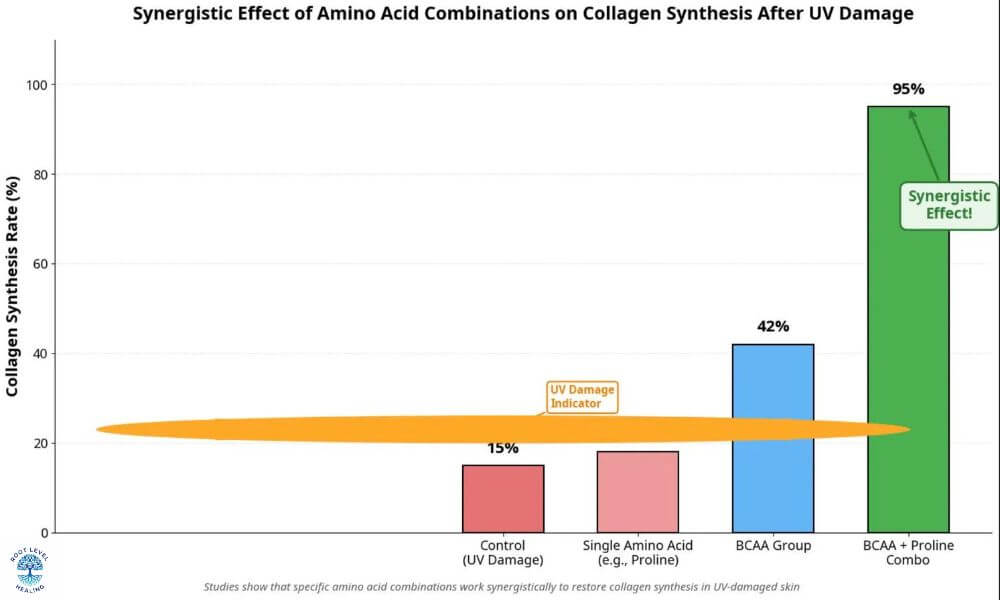
Scientific studies demonstrate that while single amino acids have little impact on repairing UV-damaged skin, specific combinations—such as BCAAs with Proline and Glutamine—work synergistically to significantly restore collagen protein synthesis.
However, when these amino acids were combined into specific mixtures, the results were dramatic. The study found that combinations such as BCAAs + Proline or BCAAs + Glutamine significantly increased the fractional synthesis rate (FSR) of skin tropocollagen, effectively reversing the UV damage. The researchers concluded:
"This result suggests that combinations of BCAA and glutamine or proline are important for restoring dermal collagen protein synthesis impaired by UV irradiation." [3]
This highlights a critical principle of skin biology: cellular repair is a complex process that requires a complete set of tools. Providing only one type of amino acid is like giving a construction crew only bricks but no mortar. A comprehensive serum must supply a balanced profile of the key amino acids involved in protein synthesis to be truly effective.
The Powerhouse Players: A Deep Dive into 8 Essential Skin Amino Acids
The Ella Pure Peptide Serum formula is built upon this principle of synergy, featuring a precise complex of 8 amino acids that work together to repair, hydrate, and protect the skin. Let's explore the specific role each of these "powerhouse players" contributes to the team.
| Amino Acid | Primary Role in Skin Health |
|---|---|
| Arginine | Accelerates wound healing, promotes collagen synthesis, and plays a role in repairing visible skin damage [1]. |
| Proline | A major component of collagen (about one-third), essential for maintaining the skin's firm, youthful structure [3]. |
| Serine | Crucial for skin hydration and the synthesis of other amino acids and key proteins, supporting overall barrier function. |
| Valine, Leucine & Isoleucine (BCAAs) | Work synergistically to activate the mTOR pathway, signaling the skin to initiate protein synthesis and cellular repair [3]. |
| Histidine | Provides antioxidant protection and has powerful soothing properties, helping to calm irritated skin [1]. |
| Phenylalanine | A precursor to tyrosine, which is involved in melanin synthesis, helping to address issues of skin pigmentation and tone. |
| Threonine | Essential for the production of collagen and elastin, directly contributing to skin firmness and elasticity. |
| Glycine | The most abundant amino acid in collagen (one-third of its structure), essential for maintaining skin's tensile strength and flexibility. |
| Glutamine | Works synergistically with BCAAs to restore UV-damaged collagen synthesis and supports the skin's natural barrier function [3]. |
Amino Acids vs. Peptides: What's the Difference?
The terms "amino acids" and "peptides" are often used interchangeably, but they represent different levels of structure and function. Understanding their relationship is key to appreciating a well-formulated serum.
Amino Acids: These are the individual molecules, the fundamental building blocks. Think of them as individual bricks.
Peptides: These are short chains of amino acids linked together. They act as signaling molecules, or "messengers," that tell skin cells what to do. Think of them as the foreman who tells the construction crew to start building a wall.
Proteins (like Collagen): These are very long, complex chains of peptides. They are the final structure itself. Think of them as the completed wall.
A truly effective serum contains both. It provides the peptides to give the instructions ("build more collagen!") and the full complex of amino acids to provide the raw materials (the "bricks") needed to carry out those instructions. Supplying only peptides without a rich supply of amino acids can lead to inefficient synthesis, as the skin may lack the necessary components to fulfill the peptide's signal.
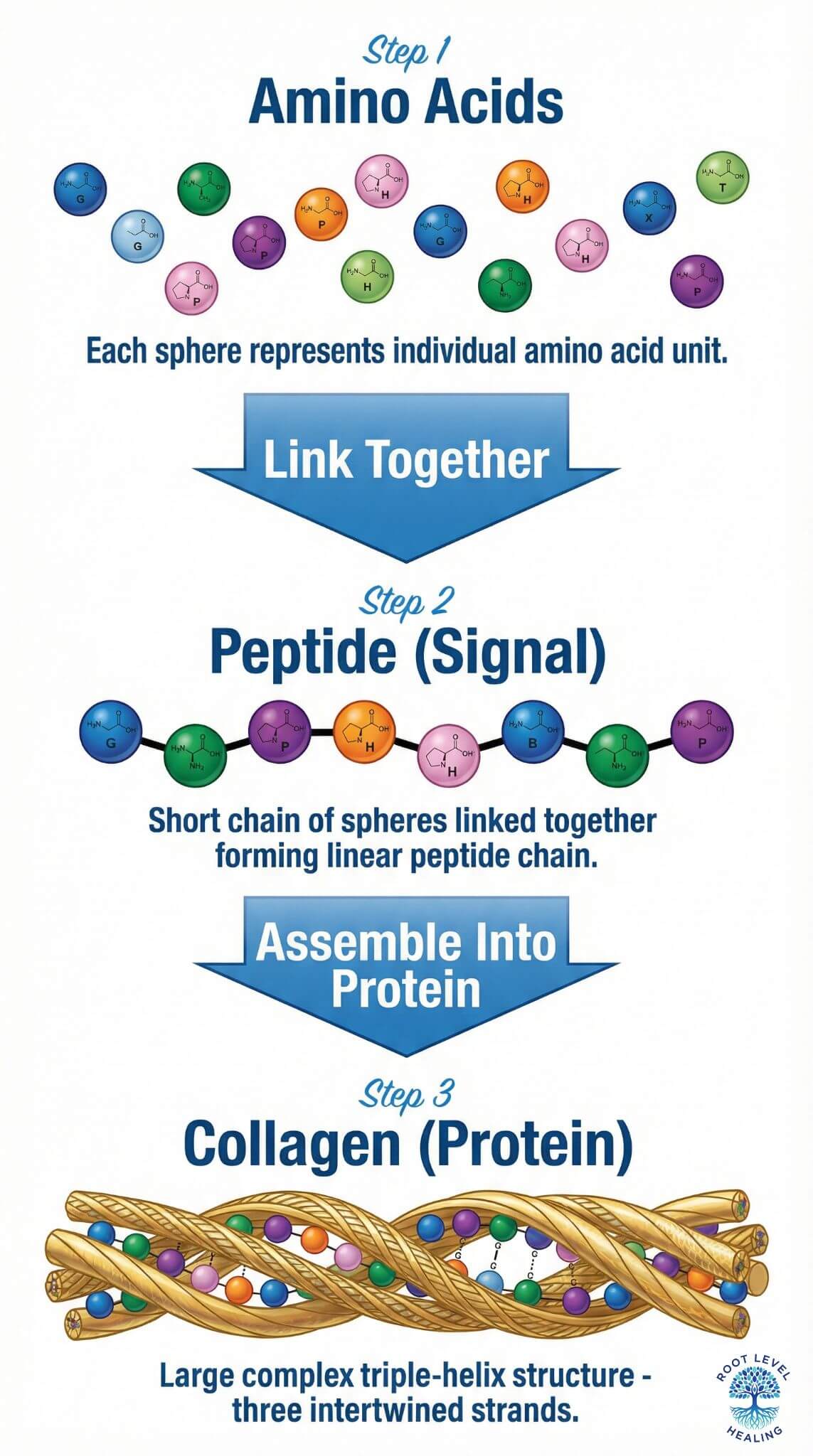
Amino acids are the fundamental units that link together to form signaling peptides. These peptides then instruct cells to assemble long, complex protein structures like collagen, which forms the skin's supportive framework.
Why Your Skin Needs a Complete Amino Acid Complex for True Repair
The modern skincare landscape often pushes a reductionist view, focusing on a single "magic" ingredient. But as the science clearly shows, skin biology is a story of synergy and interdependence. True cellular repair requires a holistic approach that respects the complexity of the skin's natural processes.
As we age, our body's ability to synthesize non-essential amino acids declines, creating deficiencies that directly impact skin health. While younger skin can efficiently produce amino acids like Proline and Serine from other nutrients, this capacity diminishes with time, making topical supplementation increasingly critical. Additionally, environmental stressors like UV radiation, pollution, and oxidative stress actively deplete the skin's amino acid reserves, creating a state of chronic deficiency. This is where the concept of "rate-limiting" amino acids becomes crucial. In protein synthesis, if even one essential amino acid is missing or in short supply, the entire process stalls—like a factory assembly line missing a critical part. By providing a complete complex of all necessary amino acids, a well-formulated serum ensures that no single deficiency can bottleneck the skin's repair processes.
Providing a complete amino acid complex ensures that your skin has everything it needs, exactly when it needs it. It eliminates potential bottlenecks in the protein synthesis pathway, allowing your skin to repair damage, build new collagen, and maintain its structural integrity with maximum efficiency. This is particularly crucial as we age and after exposure to environmental stressors like UV radiation, which deplete the skin's natural resources and suppress its regenerative capacity.
By moving beyond single-ingredient marketing and embracing the science of synergy, we can provide our skin with the foundational support it needs for long-term health and resilience. An amino acid-rich serum isn't just another step in a routine; it's a daily deposit into your skin's structural bank account, ensuring it has the capital to thrive for years to come. In our next post, we'll explore how this amino acid foundation is enhanced by a unique, plant-based form of hyaluronic acid for next-level hydration.
Frequently Asked Questions
Q: Are topical amino acids really absorbed by the skin?
A: Yes. Amino acids are small molecules that can effectively penetrate the skin's outer layers to be utilized by the cells in the epidermis and dermis. Their role as a key component of the skin's Natural Moisturizing Factors (NMFs) demonstrates their natural presence and function within the skin [2].
Q: Can't I just get amino acids from my diet?
A: While a protein-rich diet is essential for overall health, topical application provides a direct, concentrated supply of amino acids to the skin cells that need them most for repair and regeneration. This is especially important for addressing specific concerns like sun damage or signs of aging.
Q: Are amino acid serums suitable for sensitive or acne-prone skin?
A: Absolutely. Amino acids are naturally found in the skin and are generally very well-tolerated. Many, like Histidine, have soothing properties. A well-formulated amino acid serum can help strengthen the skin barrier and improve hydration, which is beneficial for both sensitive and acne-prone skin types.
Q: How do amino acids differ from Vitamin C in boosting collagen?
A: They work together. Vitamin C is an essential cofactor required for the enzymes that cross-link and stabilize collagen fibers. Amino acids are the actual physical building blocks that make up the collagen fibers themselves. You need both for healthy collagen production: Vitamin C as the "worker" and amino acids as the "supplies."
References
- Paula's Choice Skincare. (2023 ). Amino Acids for Skin: Everything You Need to Know.
- Diaz, I., et al. (2021 ). Amino acid complex (AAComplex) benefits in cosmetic formulation. Journal of Cosmetic Dermatology, 21(5), 2249-2256.
- Murakami, H., et al. (2012 ). Importance of amino acid composition to improve skin collagen protein synthesis rates in UV-irradiated mice. Amino Acids, 42(6), 2481-2489.

Ready to Discover Your Score?
This 2-minute quiz is the essential first step to understanding your body's current toxic load and identifying the root cause of how you feel.
Take The Toxicity QuizExplore More Articles
Dive deeper into topics like detoxification, gut health, and mental clarity on our blog. Knowledge is the key to taking control of your health.
Visit The Blog