The Essential Amino Acid Gap: What Most Athletes Are Missing
Key Takeaways
- 🧱BCAAs Are Incomplete: They provide only 3 of the 9 essential amino acids needed for muscle protein synthesis, creating a critical gap in your nutrition.
- ⚡Leucine is the Trigger, Not the Fuel: While leucine activates muscle building, you need all 9 EAAs present to complete the process and build actual muscle tissue.
- 🔬Complete EAA Profile is Essential: Missing even one essential amino acid halts muscle protein synthesis, regardless of how much leucine you consume.
- 🎯Timing and Ratios Matter: The most effective muscle building occurs when all essential amino acids are available in optimal ratios at the right time.
You've been told that BCAAs are the gold standard for muscle building. You've invested in the supplements, timed your intake perfectly, and followed all the protocols. But despite your dedication, your muscle gains have plateaued, and you're starting to wonder if there's something you're missing.
Here's the truth that the supplement industry doesn't want you to know: there's a massive gap in the most popular muscle-building strategy, and it's costing you serious gains.
Welcome to the "Essential Amino Acid Gap"—a critical deficiency that affects millions of athletes and fitness enthusiasts who think they're doing everything right. Today, we're going to expose this gap and show you exactly how to fill it for maximum muscle growth and recovery.
The Amino Acid Gap: Why BCAAs Aren't Enough for Muscle Growth | Essential Amino Acids Explained: A Quick Overview
Before we dive deep into the science, watch this quick overview and discover why BCAAs are only half the story — learn how the Essential Amino Acid Gap is sabotaging your muscle gains and what you need to do to close it for maximum growth and recovery.
In This Article:
EAA vs. BCAA: The Critical Difference Most Athletes Don't Understand
Let's start with the basics that most people get wrong. Essential Amino Acids (EAAs) and Branched-Chain Amino Acids (BCAAs) are not interchangeable terms, despite what many supplement labels would have you believe.
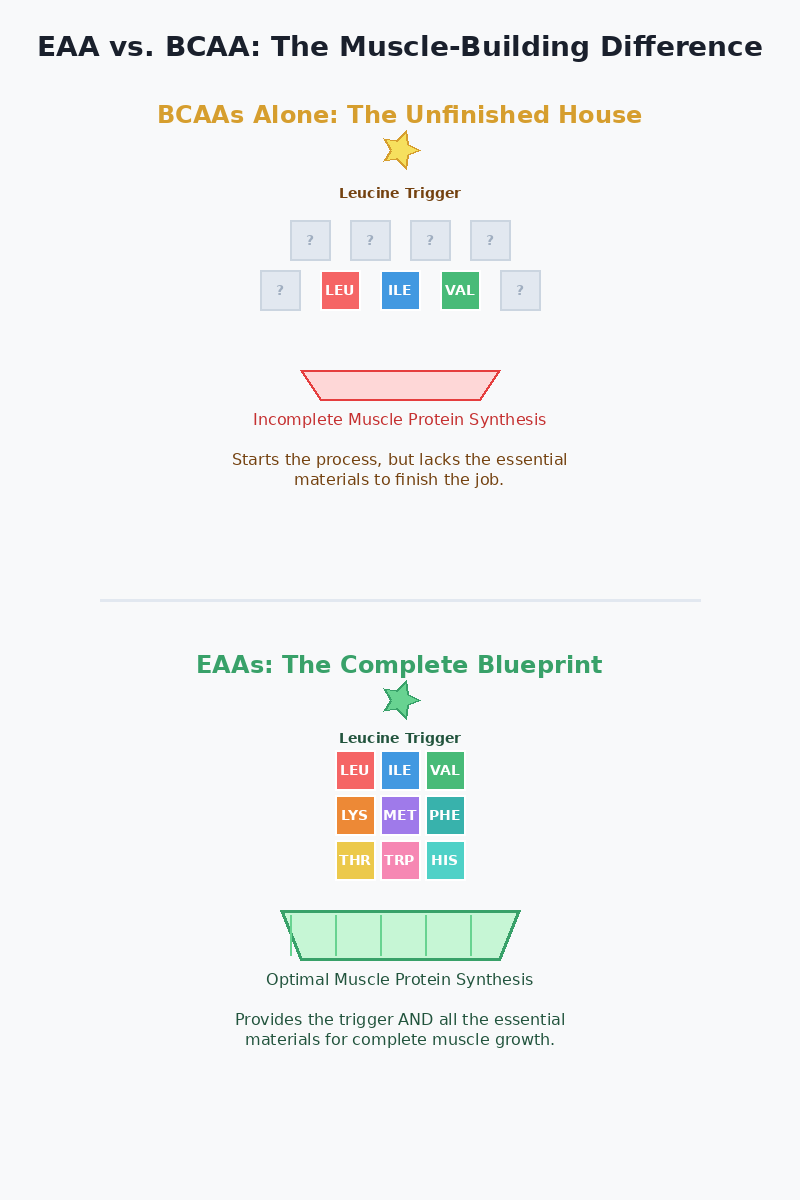
Your body requires 20 different amino acids to function properly. Of these, 9 are considered "essential" because your body cannot produce them on its own—you must get them from food or supplements. These 9 essential amino acids are: leucine, isoleucine, valine, lysine, methionine, phenylalanine, threonine, tryptophan, and histidine.
BCAAs, on the other hand, are just 3 of these essential amino acids: leucine, isoleucine, and valine. They're called "branched-chain" because of their unique molecular structure, not because they're more important than the other essential amino acids.
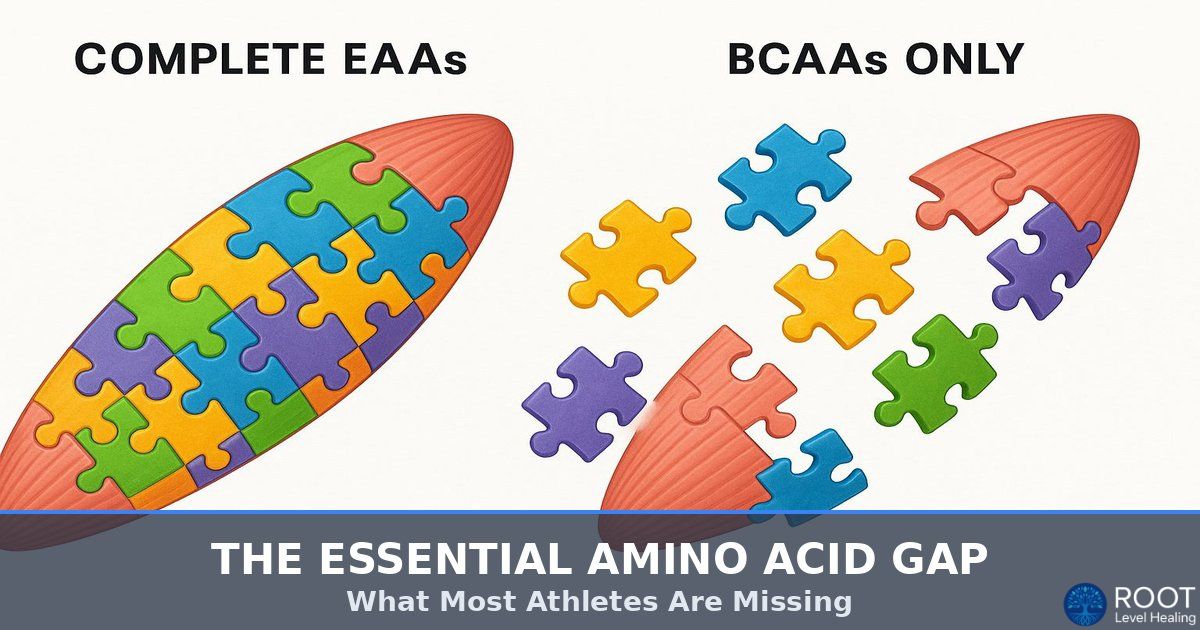
Here's where the problem begins: the supplement industry has marketed BCAAs as the ultimate muscle-building solution, but they're giving you less than half the story. It's like trying to build a house with only the foundation materials—you can start the project, but you'll never complete it without the rest of the building supplies.
The Leucine Trigger: Why Starting the Process Isn't Enough
Leucine deserves special recognition because it plays a unique role in muscle protein synthesis. Think of leucine as the "ignition key" that starts your muscle-building engine. When leucine levels in your blood reach a certain threshold, it activates a cellular pathway called mTORC1, which signals your muscles to begin building new protein. [1]
This discovery led to the BCAA craze. Supplement companies reasoned that if leucine is the trigger, and BCAAs contain leucine plus two other muscle-building amino acids, then BCAAs must be the perfect muscle-building supplement.
But here's the critical flaw in this logic: pulling the trigger is only the first step in a complex process. Once leucine activates the mTORC1 pathway and signals your muscles to start building protein, your body needs all 9 essential amino acids to be present in adequate amounts to actually complete the job.
It's like having the key to start a car but no fuel in the tank. You can turn the engine over, but you're not going anywhere without the complete fuel supply.
"Leucine acts as a nutrient 'trigger' for muscle anabolism, but despite the potent anabolic properties of leucine supplementation, a full complement of essential amino acids is required to facilitate the anabolic actions of leucine leading to muscle protein accretion and hypertrophy." [2]
The Complete Synthesis Requirement: All or Nothing
This is where the essential amino acid gap becomes a major roadblock to your muscle-building goals. Muscle protein synthesis is an all-or-nothing process. If even one essential amino acid is missing or present in insufficient quantities, the entire process grinds to a halt.
Think of it like an assembly line building cars. You can have all the engines, wheels, and seats you want, but if you're missing the steering wheels, production stops completely. The same principle applies to muscle protein synthesis—you need all the essential amino acids present simultaneously to build new muscle tissue.
Recent research has confirmed this principle in real-world scenarios. Studies comparing meals with complete versus incomplete amino acid profiles found that even when total protein content was identical, the incomplete amino acid meals failed to stimulate optimal muscle protein synthesis in both young and older adults. [3]
This explains why many athletes who rely heavily on BCAA supplementation experience initial improvements followed by frustrating plateaus. The leucine trigger works initially, but without the complete amino acid profile, the muscle-building process can't reach its full potential.
Why Timing and Ratios Can Make or Break Your Results
Even if you're getting all 9 essential amino acids from your diet, there's another layer of complexity that most people miss: timing and ratios.
For optimal muscle protein synthesis, all essential amino acids need to be available in your bloodstream at the same time. If you eat a piece of chicken (complete protein) for lunch and then take BCAAs post-workout three hours later, you're not maximizing the synergistic effect of having all amino acids present simultaneously.
Additionally, the ratios matter. Different amino acids are needed in different amounts for optimal muscle building. Leucine might be the trigger, but you need adequate amounts of lysine for muscle repair, methionine for protein initiation, and all the others for their specific roles in the muscle-building process.
This is why the most effective muscle-building protocols focus on providing complete essential amino acid profiles in optimal ratios, timed around workouts when muscle protein synthesis is most active.
Frequently Asked Questions
Q: Can I get enough EAAs from food alone?
A: While whole food sources like meat, eggs, and dairy contain all 9 essential amino acids, the timing, absorption rates, and ratios may not be optimal for maximizing post-workout muscle protein synthesis. Complete EAA supplements can provide precisely what you need when you need it most.
Q: Are BCAA supplements completely useless?
A: Not entirely useless, but significantly limited. BCAAs can help reduce muscle soreness and provide some energy during workouts, but they're not the most effective tool for building new muscle tissue due to the essential amino acid gap.
Q: How much leucine do I need to trigger muscle protein synthesis?
A: Research suggests that approximately 2.5-3 grams of leucine is needed to maximally stimulate muscle protein synthesis in most adults. However, remember that triggering the process is only the first step—you need all 9 EAAs to complete it.
Q: When is the best time to take essential amino acids?
A: The most critical time is within 30-60 minutes post-workout when muscle protein synthesis is most active. However, having adequate amino acid levels throughout the day supports ongoing recovery and adaptation.
References
- Transparent Labs. EAA vs BCAA: Which Amino Acid Supplement is Right for You? https://www.transparentlabs.com/blogs/all/eaas-vs-bcaas-which-is-best-for-athletic-performance-and-building-muscle
- Breen, L., & Churchward-Venne, T. A. (2012 ). Leucine: a nutrient 'trigger' for muscle anabolism, but what more? The Journal of physiology, 590(Pt 9), 2065–2066. https://pmc.ncbi.nlm.nih.gov/articles/PMC3447149/
- Arentson-Lantz, E. J., Von Ruff, Z., Connolly, G., & Paddon-Jones, D. (2024 ). Meals Containing Equivalent Total Protein from Foods Providing Complete, Complementary, or Incomplete Essential Amino Acid Profiles Do Not Differentially Affect 24-h Skeletal Muscle Protein Synthesis in Healthy Older Women. The Journal of nutrition, 154(5), 1362–1371. https://www.sciencedirect.com/science/article/pii/S0022316624010770

Ready to Discover Your Score?
This 2-minute quiz is the essential first step to understanding your body's current toxic load and identifying the root cause of how you feel.
Take The Toxicity QuizExplore More Articles
Dive deeper into topics like detoxification, gut health, and mental clarity on our blog. Knowledge is the key to taking control of your health.
Visit The Blog