
Why Your Muscles Aren't Recovering Properly (And It's Not What You Think)
Key Takeaways
- 🔥Chronic Inflammation Sabotage: Systemic inflammation shifts your body into muscle breakdown mode, preventing proper recovery even with adequate rest and nutrition.
- ⚡Oxidative Stress Damage: Free radicals from intense exercise overwhelm your antioxidant defenses, causing cellular damage that prolongs muscle soreness and fatigue.
- 🧱Essential Amino Acid Gap: Incomplete proteins lack the full spectrum of amino acids needed for muscle protein synthesis, leaving your muscles without proper building blocks.
- 🎯The Complete Solution: Optimal muscle recovery requires addressing inflammation, providing antioxidant support, and ensuring complete essential amino acid availability.
You've crushed another workout. Pushed through the burn. Embraced the challenge. But here you are, days later, still battling the same persistent muscle soreness that just won't quit.
Sound familiar? You're not alone. Millions of dedicated athletes and fitness enthusiasts are trapped in this frustrating cycle of slow muscle recovery, despite doing everything they've been told: eating protein, getting sleep, taking rest days.
But what if I told you that the real culprits behind your sluggish muscle recovery have nothing to do with how hard you train or how much protein you consume? What if the solution lies in understanding three hidden biological processes that most people—including many fitness professionals—completely overlook?
Today, we're diving deep into the cellular battlefield where your muscle recovery is won or lost. By the end of this article, you'll understand exactly why your muscles aren't recovering properly and what you can do about it.
Why Your Muscles Aren't Recovering - 3 Hidden Causes: A Quick Overview
Before we dive deep into the science, watch this quick overview to discover the three hidden biological causes sabotaging your muscle recovery — chronic inflammation, oxidative stress, and the essential amino acid gap.
In This Article:
Hidden Cause #1: The Inflammation Trap That Blocks Muscle Recovery
Here's something most people don't realize: there are actually two completely different types of inflammation affecting your muscle recovery, and only one of them is helping you.
Acute inflammation is your friend. When you exercise, you create microscopic tears in your muscle fibers. Your body responds by sending inflammatory cells to clear out damaged tissue and kickstart the repair process. This is normal, necessary, and temporary.
But then there's chronic inflammation—and this is where your muscle recovery gets hijacked.
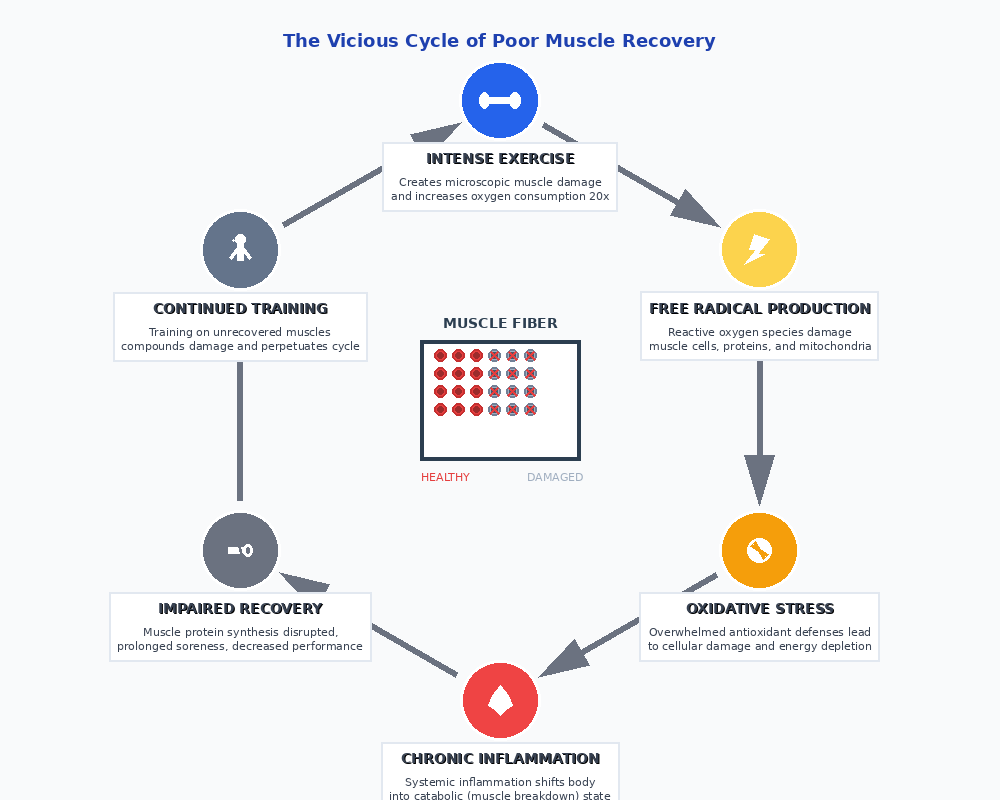
Chronic inflammation is like having a small fire constantly smoldering in your body. It's fueled by processed foods, environmental toxins, chronic stress, poor sleep, and even excessive training without adequate recovery. This systemic inflammation creates a cascade of problems that directly sabotage your muscle recovery process.
When your body is in a state of chronic inflammation, it shifts into what scientists call a "catabolic state"—meaning it favors muscle breakdown over muscle building. Your body becomes so focused on fighting this ongoing inflammatory fire that it can't properly allocate resources to muscle repair and growth.
"The result is that muscle recovery is delayed and your muscles don't get stronger or bigger despite your hard work in the gym."
This explains why some people can train intensely and bounce back quickly, while others struggle with persistent soreness and plateaued progress despite following the same workout and nutrition protocols.
Hidden Cause #2: Oxidative Stress and the Free Radical Attack on Your Muscles
During intense exercise, your oxygen consumption can increase by up to 20 times normal levels. While this oxygen fuels your performance, it also creates a dangerous byproduct: reactive oxygen species, or free radicals.
Think of free radicals as cellular vandals. They're unstable molecules that steal electrons from your healthy cells, causing damage to muscle cell membranes, proteins, and even DNA. In small amounts, they actually serve as important signaling molecules that help your muscles adapt and grow stronger. But when free radical production overwhelms your body's natural antioxidant defenses, you enter a state called oxidative stress [1].
Oxidative stress is like rust spreading through your muscle tissue. It damages the very cellular machinery responsible for energy production, protein synthesis, and repair. This cellular damage manifests as:
Prolonged Muscle Fatigue
Damaged mitochondria can't produce energy efficiently, leaving you feeling drained long after your workout.
Extended Muscle Soreness
Free radical damage to muscle fibers prolongs the inflammatory response, keeping you sore for days.
Impaired Performance
Oxidative damage to muscle proteins reduces contractile function and power output.
The modern lifestyle compounds this problem exponentially. Environmental pollutants, processed foods, chronic stress, and inadequate sleep all increase free radical production while depleting your body's natural antioxidant reserves. This creates a perfect storm where your muscles are under constant oxidative attack, making proper recovery nearly impossible.
Hidden Cause #3: The Essential Amino Acid Gap in Your Protein Sources
Here's where most people get muscle recovery completely wrong. They think it's just about eating "enough" protein. But the truth is, not all protein is created equal when it comes to muscle protein synthesis.
Your body needs all nine essential amino acids in the right ratios to build new muscle tissue. These are called "essential" because your body cannot manufacture them—you must get them from food or supplements. If even one essential amino acid is missing or insufficient, muscle protein synthesis grinds to a halt.
It's like trying to build a house when you're missing a critical type of building material. You can't just substitute something else; you need the complete set to finish the job.
But here's the kicker: most protein sources are incomplete. Plant proteins like rice, beans, and nuts are missing one or more essential amino acids. Even some animal proteins don't provide optimal ratios for muscle building.
Furthermore, one specific amino acid—leucine—acts as the primary trigger for muscle protein synthesis. Research shows you need approximately 2.5-3 grams of leucine per meal to maximally stimulate the muscle-building process [2]. Many common protein sources fall well short of this threshold, which explains why some people struggle to build muscle despite eating adequate total protein.
The Leucine Threshold: Your Muscle-Building Switch
Think of leucine as the ignition key for your muscle-building engine. Without enough leucine, the anabolic signal remains weak, even if your total protein intake is high. This is why the quality and amino acid profile of your protein matters just as much as the quantity.
But the essential amino acid gap goes beyond just leucine. Each of the nine essential amino acids plays a specific role in muscle recovery and growth:
Leucine, Isoleucine, Valine (BCAAs)
These branched-chain amino acids directly stimulate muscle protein synthesis and reduce muscle breakdown during exercise.
Lysine, Methionine, Phenylalanine
These amino acids serve as building blocks for muscle proteins and support various metabolic processes essential for recovery.
Threonine, Tryptophan, Histidine
These amino acids support immune function, neurotransmitter production, and cellular repair processes.
When your protein sources are incomplete, your body simply cannot execute the complex process of muscle protein synthesis effectively. This leaves you in a state of incomplete recovery, where your muscles never fully repair and strengthen from your training efforts.
The Complete Recovery Solution: Addressing All Three Hidden Causes
Now that you understand the three hidden causes sabotaging your muscle recovery, you can see why traditional approaches often fall short. Most recovery protocols only address one piece of the puzzle while ignoring the others.
True muscle recovery optimization requires a comprehensive approach that simultaneously addresses:
The Triple-Threat Recovery Strategy
- Inflammation Management: Reduce systemic inflammation through anti-inflammatory nutrition, stress management, and adequate sleep to shift your body back into an anabolic state.
- Antioxidant Protection: Provide your body with powerful antioxidants to neutralize free radicals and protect your muscle cells from oxidative damage.
- Complete Amino Acid Support: Ensure your body has all nine essential amino acids in optimal ratios to maximize muscle protein synthesis and recovery.
This is why some athletes seem to have "superhuman" recovery abilities while others struggle despite similar training loads. The difference isn't genetics—it's whether their recovery approach addresses all three of these critical factors.
In our next article, we'll dive deep into the science of essential amino acids and explore why the current understanding of protein and BCAAs is incomplete. You'll discover the critical differences between complete proteins, branched-chain amino acids, and essential amino acid supplementation, and why this distinction could be the key to unlocking your true recovery potential.
Frequently Asked Questions
Q: How do I know if chronic inflammation is affecting my muscle recovery?
A: Signs include persistent muscle soreness lasting more than 72 hours, feeling tired despite adequate sleep, frequent minor injuries, slow healing, and plateaued performance despite consistent training. Blood markers like C-reactive protein (CRP) can also indicate systemic inflammation.
Q: Can I get all essential amino acids from a plant-based diet?
A: Yes, but it requires careful planning and combining different protein sources. Most plant proteins are incomplete on their own, so you need to combine foods like rice and beans to create a complete amino acid profile. Many plant-based athletes use essential amino acid supplements to ensure optimal ratios.
Q: Are antioxidant supplements bad for muscle adaptation?
A: This is a common misconception. While extremely high doses of isolated antioxidants taken immediately post-workout can potentially blunt some adaptive signals, moderate antioxidant support from whole food sources or well-formulated supplements is crucial for managing excessive oxidative stress and supporting long-term recovery and health.
Q: How long should muscle recovery take after a workout?
A: For most people, muscle soreness should peak 24-48 hours post-workout and resolve within 72 hours. If you're experiencing soreness lasting longer than this, or if you're not seeing strength improvements over weeks, it may indicate that one or more of these hidden factors is sabotaging your recovery process.
References
- Kozakowska, M., Pietraszek-Gremplewicz, K., Jozkowicz, A., & Dulak, J. (2015 ). The role of oxidative stress in skeletal muscle injury and regeneration: focus on antioxidant enzymes. Journal of muscle research and cell motility, 36(6), 377–393. https://pmc.ncbi.nlm.nih.gov/articles/PMC4762917/
- Arentson-Lantz, E. J., Von Ruff, Z., Connolly, G., & Paddon-Jones, D. (2024 ). Meals Containing Equivalent Total Protein from Foods Providing Complete, Complementary, or Incomplete Essential Amino Acid Profiles Do Not Differentially Affect 24-h Skeletal Muscle Protein Synthesis in Healthy Older Women. The Journal of nutrition, 154(5), 1362–1371. https://www.sciencedirect.com/science/article/pii/S0022316624010770
- Weinert D. J. (2009 ). Nutrition and muscle protein synthesis: a descriptive review. The Journal of the Canadian Chiropractic Association, 53(3), 186–193. https://pmc.ncbi.nlm.nih.gov/articles/PMC2732256/

Ready to Discover Your Score?
This 2-minute quiz is the essential first step to understanding your body's current toxic load and identifying the root cause of how you feel.
Take The Toxicity QuizExplore More Articles
Dive deeper into topics like detoxification, gut health, and mental clarity on our blog. Knowledge is the key to taking control of your health.
Visit The Blog