
The Glucose Trap: How Your Body Stores Every Extra Calorie
Key Takeaways
- 🔒Glucose Transport Dysfunction: When GLUT4 transporters become resistant, glucose can't enter muscle cells and gets diverted to fat storage instead.
- 🏭De Novo Lipogenesis: Your liver converts excess glucose directly into fatty acids through a process that becomes increasingly efficient with repeated exposure.
- ⚡Insulin Signaling Cascade: Chronic high glucose triggers insulin resistance, creating a vicious cycle where more insulin is needed to handle the same glucose load.
- 🔄The Glucose-Fat Cycle: Once established, this system becomes self-perpetuating, making every extra calorie automatically convert to stored fat.
You eat a seemingly innocent meal—maybe some pasta with a side of bread. Within hours, your body has efficiently converted those carbohydrates into glucose, shuttled them through your bloodstream, and... stored them as fat. Not muscle glycogen. Not readily available energy. Fat.
Sound familiar? You're experiencing what researchers call the glucose trap—a metabolic dysfunction where your body becomes increasingly efficient at converting every extra calorie into stored fat, while simultaneously becoming less efficient at using that stored fat for energy.
This isn't about eating "too many carbs" or lacking willpower. This is about a fundamental breakdown in how your body processes glucose—the primary fuel that should be powering your muscles, brain, and daily activities.
Today, we're diving deep into the biochemical mechanisms that turn your body into an automatic fat storage machine. By understanding exactly how the glucose trap works, you'll finally understand why traditional "eat less, move more" approaches fail so spectacularly.
The Glucose Trap: How Your Body Stores Every Extra Calorie | Reverse Insulin Resistance: A Quick Overview
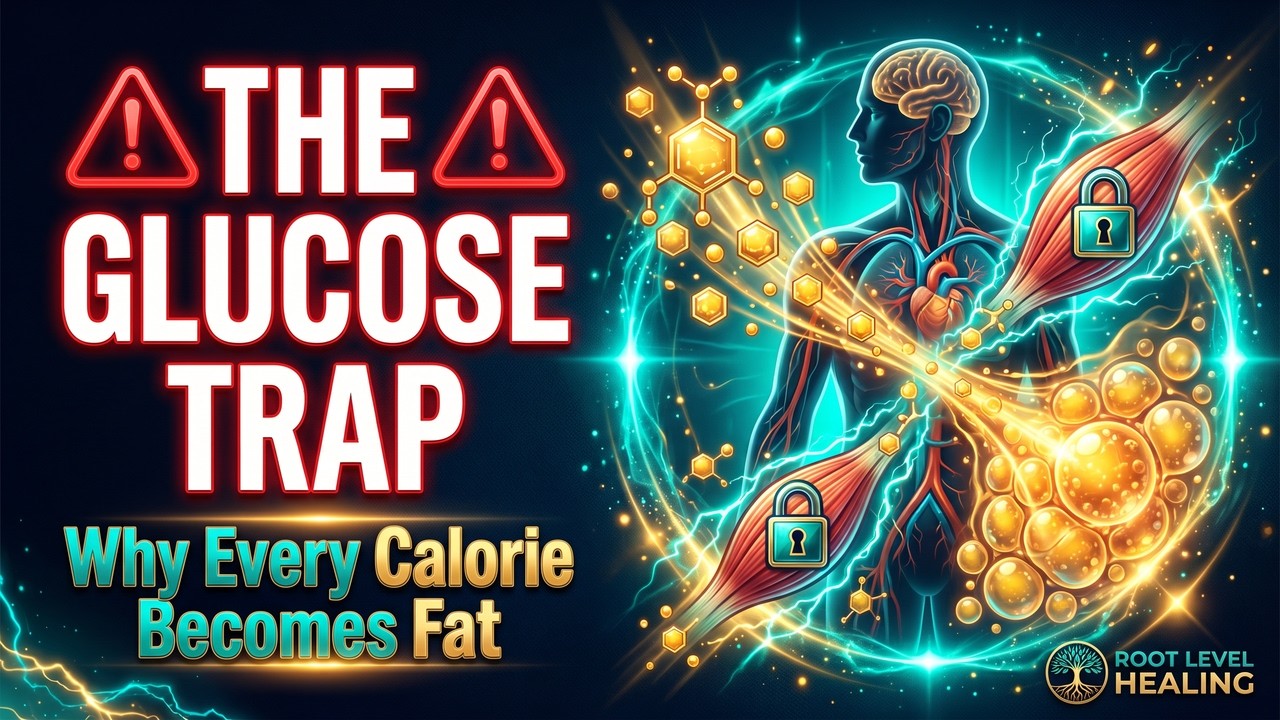
Before we dive deep into the science, watch this quick overview to discover the three biological processes behind the Glucose Trap — GLUT4 resistance, De Novo Lipogenesis, and the vicious cycle of lipotoxicity — and learn how to restore insulin sensitivity, block excess absorption, and enhance fat oxidation to break free.
In This Article:
- The GLUT4 Gateway: When Muscle Cells Lock Their Doors
- Insulin Signaling Breakdown: The Master Switch Goes Haywire
- De Novo Lipogenesis: Your Liver's Fat Factory
- Skeletal Muscle Resistance: The Biggest Player You're Ignoring
- The Vicious Cycle: How It Gets Worse Over Time
- Breaking Free: The Path Forward
- Frequently Asked Questions
The GLUT4 Gateway: When Muscle Cells Lock Their Doors
To understand how the glucose trap works, we need to start with GLUT4 glucose transporters—the molecular doorways that allow glucose to enter your muscle cells. Think of these as the bouncers at an exclusive club, deciding who gets in and who gets turned away.
In a healthy metabolism, when glucose levels rise after a meal, insulin signals these GLUT4 transporters to migrate to the cell surface and open the doors wide. Glucose floods into muscle cells, where it's either used immediately for energy or stored as glycogen for later use.
But here's where things go wrong: chronic exposure to high glucose levels causes these transporters to become less responsive to insulin's signals. The doors start closing, even when glucose is desperately trying to get in.
"When GLUT4 transporters become insulin resistant, glucose uptake in skeletal muscle can decrease by up to 70%, forcing that glucose to find alternative storage sites—primarily fat tissue." [1]

This is where the trap begins. Your muscle cells—which should be the primary destination for glucose—start rejecting it. But your body can't just let glucose accumulate in the bloodstream indefinitely. It needs to go somewhere.
Enter your fat cells, which remain exquisitely sensitive to insulin's fat storage signals even when muscle cells have become resistant. The glucose that should have powered your workouts and daily activities gets diverted straight into adipose tissue.
The Molecular Mechanism
At the cellular level, this process involves complex signaling cascades. When insulin binds to receptors on muscle cells, it normally triggers a series of phosphorylation events that culminate in GLUT4 translocation to the cell membrane.
But chronic hyperinsulinemia—the result of repeatedly high glucose intake—causes several key proteins in this pathway to become phosphorylated in ways that actually inhibit the process. It's like jamming the lock on those cellular doors.
Research shows that this dysfunction can persist for hours or even days after a high-glucose meal, meaning that even your next "healthy" meal gets processed through this broken system [2].
Insulin Signaling Breakdown: The Master Switch Goes Haywire
If GLUT4 transporters are the bouncers, then insulin is the VIP pass that's supposed to get glucose into the club. But what happens when the bouncers stop recognizing the VIP pass? You need more and more passes to get the same result.
This is exactly what happens with insulin resistance—your body starts producing more and more insulin to achieve the same glucose disposal that used to require much less. And here's the cruel irony: while your muscle cells become resistant to insulin's glucose uptake signals, your fat cells remain highly sensitive to insulin's fat storage signals.
The result? Every meal triggers a massive insulin response that's increasingly ineffective at getting glucose into muscle but devastatingly effective at promoting fat storage.
"Insulin resistance creates a metabolic environment where the same meal that used to fuel muscle activity now primarily fuels fat accumulation." [3]
The Cascade Effect
The breakdown in insulin signaling doesn't happen overnight. It's a gradual process that involves multiple molecular pathways:
What makes this particularly insidious is that these changes can occur even in people who appear metabolically healthy on standard tests. You might have normal fasting glucose and even normal HbA1c, but your muscle cells are already starting to resist insulin's signals.
De Novo Lipogenesis: Your Liver's Fat Factory
When glucose can't get into muscle cells efficiently, your body doesn't just give up. It activates an alternative pathway that's designed to handle excess glucose: de novo lipogenesis—literally, "making new fat."
Your liver becomes a fat factory, converting glucose directly into fatty acids through a complex biochemical process. Under normal circumstances, this pathway is relatively inactive in humans. But when the glucose trap is activated, it can ramp up dramatically.
Here's what's particularly troubling: once this pathway becomes active, it becomes increasingly efficient. Your liver literally gets better at converting glucose to fat with practice.
"In individuals with metabolic dysfunction, de novo lipogenesis can contribute up to 25% of total fat synthesis, compared to less than 5% in metabolically healthy individuals." [4]
The Biochemical Process
De novo lipogenesis involves several key enzymes that become upregulated when glucose disposal through normal channels is impaired:
What makes this process particularly problematic is that the newly synthesized fatty acids don't just stay in the liver. They get packaged into VLDL particles and shipped throughout the body, contributing to fat accumulation in muscle, visceral organs, and subcutaneous tissue.
Skeletal Muscle Resistance: The Biggest Player You're Ignoring
Most people think about insulin resistance in terms of diabetes and blood sugar control. But the biggest impact on body composition comes from insulin resistance in skeletal muscle—the tissue that should be your body's primary glucose disposal site.
Your skeletal muscle represents about 40% of your total body mass and, under normal circumstances, is responsible for disposing of 70-80% of glucose after a meal. When this system breaks down, the metabolic consequences are profound.
Skeletal muscle insulin resistance doesn't just mean glucose can't get in—it creates a cascade of metabolic dysfunction that affects how your entire body handles energy.
"Skeletal muscle insulin resistance is the earliest detectable abnormality in the development of type 2 diabetes, often preceding other metabolic dysfunction by years or even decades." [5]
The Muscle-Fat Connection
When skeletal muscle becomes insulin resistant, several things happen simultaneously:
This creates a perfect storm where the tissue that should be your primary calorie-burning engine becomes less effective at both glucose disposal and fat oxidation, while simultaneously becoming more prone to storing both glucose and fat.
The Vicious Cycle: How It Gets Worse Over Time
The glucose trap isn't a static condition—it's a progressive dysfunction that gets worse over time. Each high-glucose meal makes the next one more likely to be stored as fat. Each episode of insulin resistance makes the next one more severe.
This happens because the molecular mechanisms underlying insulin resistance are self-reinforcing. The very act of storing excess glucose as fat creates conditions that promote further insulin resistance.
Here's how the vicious cycle perpetuates itself:
"The progression from normal glucose tolerance to overt diabetes typically takes 10-15 years, but the underlying insulin resistance and fat storage dysfunction can begin decades earlier." [6]
The Point of No Return?
Many people wonder if there's a point where this cycle becomes irreversible. The good news is that while the glucose trap can become deeply entrenched, it's not permanent. The human body retains remarkable plasticity in its metabolic pathways.
However, the longer these dysfunctional patterns persist, the more intervention is required to restore normal glucose metabolism. What might have been correctable with simple dietary changes early on may require more comprehensive approaches later.
Breaking Free: The Path Forward
Understanding the glucose trap is the first step toward breaking free from it. But knowledge alone isn't enough—you need a systematic approach that addresses each component of this dysfunctional system.
The solution isn't simply "eat fewer carbs" or "exercise more." While these strategies can help, they don't address the underlying cellular dysfunction that creates the glucose trap in the first place.
Breaking free requires a multi-pronged approach that:
In our next article, we'll explore exactly how to implement this three-pronged approach using cutting-edge research on natural compounds that can interrupt the glucose trap at multiple points simultaneously.
The glucose trap may feel overwhelming, but it's not insurmountable. With the right understanding and the right tools, you can restore your body's natural ability to handle glucose efficiently and return to effortless fat loss.
Frequently Asked Questions
Q: Can the glucose trap be reversed completely?
A: Yes, the glucose trap can be reversed, though the time and intervention required depends on how long the dysfunction has been present. Research shows that insulin sensitivity can improve significantly within weeks of targeted intervention, though complete restoration may take months.
Q: Is this the same as diabetes?
A: The glucose trap represents the early stages of the same metabolic dysfunction that eventually leads to type 2 diabetes. However, it can be present for years or decades before blood sugar levels become obviously abnormal on standard tests.
Q: Why don't low-carb diets fix this problem?
A: While reducing carbohydrate intake can help manage symptoms, it doesn't address the underlying cellular dysfunction. Many people find that when they reintroduce carbohydrates, the glucose trap returns because the insulin resistance hasn't been resolved at the cellular level.
Q: Can exercise alone break the glucose trap?
A: Exercise, particularly resistance training, can significantly improve insulin sensitivity. However, in cases of established glucose trap dysfunction, exercise alone may not be sufficient to fully restore normal glucose metabolism.
Q: How do I know if I'm in the glucose trap?
A: Common signs include difficulty losing weight despite caloric restriction, energy crashes after meals, increased cravings for carbohydrates, and the tendency to gain weight easily. More definitive testing would include glucose tolerance tests and insulin response measurements.
References
- Insulin signaling and its application. PMC, 2023.
- MicroRNAs-Mediated Regulation of Skeletal Muscle GLUT4 Expression and Translocation in Insulin Resistance. PMC, 2017.
- Role of Skeletal Muscle in Insulin Resistance and Glucose Uptake. PMC, 2021.
- De Novo Lipogenesis in Humans: Metabolic and Regulatory Aspects. European Journal of Clinical Nutrition, 2019.
- Role of Skeletal Muscle in Insulin Resistance and Glucose Uptake. PMC, 2021.
- The natural history of Type 2 diabetes - Wiley Online Library.

Ready to Discover Your Score?
This 2-minute quiz is the essential first step to understanding your body's current toxic load and identifying the root cause of how you feel.
Take The Toxicity QuizExplore More Articles
Dive deeper into topics like detoxification, gut health, and mental clarity on our blog. Knowledge is the key to taking control of your health.
Visit The Blog