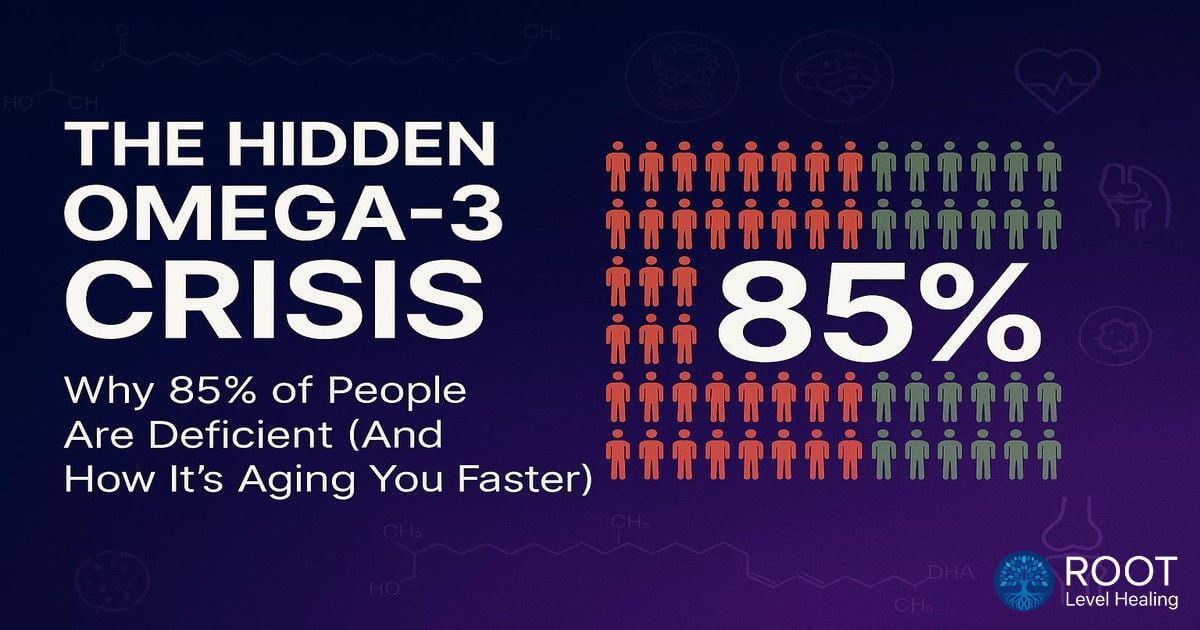
The Hidden Omega-3 Crisis: Why 85% of People Are Deficient (And How It's Aging You Faster)
🔑 Key Takeaways
- 📊Global Crisis Scale: 85% of the world's population is deficient in essential omega-3 fatty acids, creating a widespread health emergency.
- ⚖️Dangerous Imbalance: Modern diets contain 20 times more omega-6s than omega-3s, driving chronic inflammation and accelerated aging.
- 🔥Health Consequences: Omega-3 deficiency increases risk of cardiovascular disease, cognitive decline, depression, and chronic inflammation.
- 🌍Environmental Challenge: Rising ocean temperatures, pollution, and overfishing make it increasingly difficult to obtain clean omega-3s from food sources.
In our modern world, we have access to more food than ever before, yet we are simultaneously facing a silent and widespread nutritional crisis. A groundbreaking 2025 study from Case Western Reserve University delivered a shocking statistic: 85% of the global population is deficient in essential omega-3 fatty acids [1]. This isn't a minor nutritional gap; it's a gaping hole in our collective health that is accelerating the aging process and driving the chronic disease epidemic.
This deficiency is the result of a seismic shift in our food supply. Over the past century, our diets have become saturated with pro-inflammatory omega-6 fatty acids from processed vegetable oils, while our intake of omega-3-rich foods like fatty fish has plummeted. The result is a dangerously imbalanced omega-6 to omega-3 ratio, which has been shown to be as high as 20:1 in many Western diets—a far cry from the balanced 1:1 ratio of our ancestors [2]. This imbalance is a primary driver of chronic inflammation, the very engine of aging and disease.
The Hidden Omega-3 Crisis: Why 85% Are Deficient & Aging Faster: A Quick Overview
Before we dive deep into the science of omega-3s, watch this quick overview explaining why 85% of people are deficient and how it's aging you faster.
In This Article:
The Far-Reaching Consequences of Omega-3 Deficiency
When your body is starved of essential omega-3s like EPA and DHA, every system begins to suffer. These fatty acids are integral components of your cell membranes, ensuring they remain fluid and responsive. Without them, cellular communication breaks down, leading to a cascade of health problems.
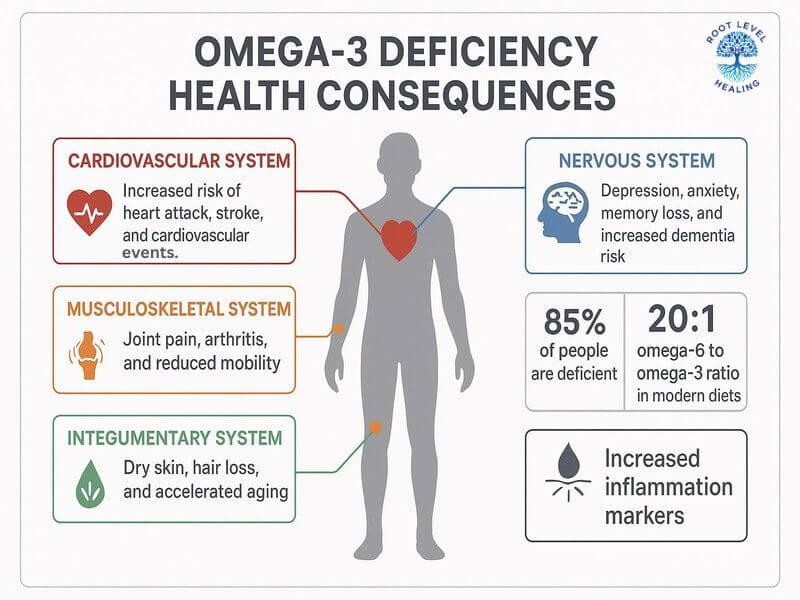
The widespread health consequences of omega-3 deficiency affect every major body system, from cardiovascular to cognitive health.
Cardiovascular Health at Risk
Omega-3s are critical for maintaining cardiovascular health. They help regulate heart rhythm, lower blood pressure, reduce triglycerides, and combat inflammation in the arteries. A deficiency has been directly linked to an increased risk of heart attack, stroke, and other cardiovascular events [3]. The American Heart Association has long recommended omega-3s for heart disease prevention, yet the vast majority of the population is not getting enough.
Cognitive Decline and Mental Health Disorders
Your brain is composed of nearly 60% fat, and a significant portion of that is DHA. This omega-3 fatty acid is essential for building healthy brain cells and facilitating communication between neurons. A deficiency has been linked to a host of neurological and psychiatric issues, including:
Depression and Anxiety: Numerous studies have shown a strong correlation between low omega-3 levels and an increased risk of depression [4].
Cognitive Decline and Dementia: Inadequate DHA intake is a major risk factor for age-related cognitive decline and Alzheimer's disease [5].
ADHD: Research has found that children with ADHD often have significantly lower blood levels of omega-3s compared to their peers [6].
The Fire of Chronic Inflammation
Perhaps the most significant consequence of omega-3 deficiency is the unchecked chronic inflammation it promotes. Omega-3s are the raw materials for producing powerful anti-inflammatory molecules called resolvins and protectins. When you are deficient, your body cannot effectively turn off the inflammatory response. This low-grade, systemic inflammation—often called "inflammaging"—is now understood to be a root cause of nearly every chronic disease, from arthritis and autoimmune conditions to cancer and diabetes [7].
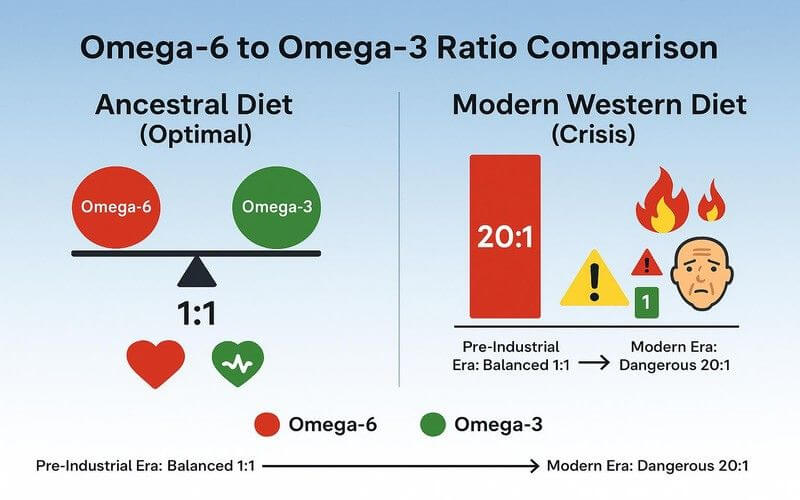
The dramatic shift from balanced omega-6:omega-3 ratios in ancestral diets to the dangerous 20:1 imbalance in modern Western diets.
Are You Part of the 85%? Signs and Symptoms of Omega-3 Deficiency
Because omega-3s are so fundamental to cellular health, a deficiency can manifest in a wide variety of ways. Here are some of the most common signs that you may not be getting enough:
Skin Issues: Dry, irritated, or bumpy skin (keratosis pilaris) is a classic sign.
Mood Imbalances: Increased feelings of depression, anxiety, or mood swings.
Cognitive Difficulties: Brain fog, poor memory, and difficulty concentrating.
Dry Eyes: Omega-3s are crucial for maintaining the oily layer of your tear film.
Joint Pain and Stiffness: Chronic inflammation from omega-3 deficiency often settles in the joints.
Hair Changes: Dry, brittle hair and increased hair loss.
The Environmental Crisis Compounding the Problem
Even for those who actively try to increase their omega-3 intake, our environment presents significant challenges. Rising ocean temperatures, overfishing, and widespread pollution with heavy metals like mercury have made it increasingly difficult to source clean, safe, and sustainable fatty fish [1]. This means that even if you are eating fish regularly, you may be exposing yourself to harmful toxins that can negate the benefits.
This is the reality of our modern world: we are simultaneously deficient in the most critical anti-inflammatory nutrient while being bombarded with pro-inflammatory inputs from our diet and environment. This is the perfect storm for accelerated aging and chronic disease.
Frequently Asked Questions
Q: How can I know for sure if I am deficient in omega-3s?
A: The most accurate way to determine your omega-3 status is through a blood test called the Omega-3 Index, which measures the percentage of EPA and DHA in your red blood cell membranes. An ideal level is 8% or higher; most Americans are below 4%.
Q: Can I get enough omega-3s from plant-based sources like flax or chia seeds?
A: Plant-based sources provide an omega-3 called ALA (alpha-linolenic acid). While beneficial, the conversion of ALA to the more critical EPA and DHA in the body is very inefficient (often less than 5%). Therefore, it is extremely difficult to achieve optimal levels of EPA and DHA from plant sources alone.
Q: Isn't eating fish twice a week enough?
A: While a good start, it is often not enough to overcome a significant deficiency, especially given the declining omega-3 content and increasing contaminant levels in many fish species. High-quality supplementation is often necessary to reach therapeutic levels.
Q: What is the difference between EPA and DHA, and do I need both?
A: EPA (eicosapentaenoic acid) and DHA (docosahexaenoic acid) are the two most critical marine omega-3 fatty acids. EPA is primarily anti-inflammatory and supports heart and mood health. DHA is the structural building block of the brain and retina. You need both — EPA to fight inflammation and DHA to maintain brain structure and function. A supplement providing both is far superior to one providing only one type.
Q: Why are omega-3s considered "essential" fatty acids?
A: "Essential" in nutritional science means your body cannot synthesize the nutrient on its own — you must obtain it from food or supplements. Your body has no metabolic pathway to create EPA or DHA from scratch, which is why a dietary deficiency has such far-reaching consequences across every system in the body.
The Path Forward: Reclaiming Your Omega-3 Advantage
Understanding the scale of this hidden crisis is the first step toward taking control of your health. In our next post, we will explore the different types of omega-3 supplements and reveal why one particular source stands out as a vastly superior and more effective solution for restoring your body's essential fatty acid balance.
Research References
- Ciesielski, T. (2025). Global shortage of essential nutrient poses health concern. Case Western Reserve University Newsroom. https://case.edu/news/global-shortage-essential-nutrient-poses-health-concern
- Simopoulos, A. P. (2002). The importance of the ratio of omega-6/omega-3 essential fatty acids. Biomedicine & Pharmacotherapy, 56(8), 365-379. https://pubmed.ncbi.nlm.nih.gov/12442909/
- Mozaffarian, D., & Wu, J. H. (2011). Omega-3 fatty acids and cardiovascular disease: effects on risk factors, molecular pathways, and clinical events. Journal of the American College of Cardiology, 58(20), 2047-2067. https://www.jacc.org/doi/full/10.1016/j.jacc.2011.06.063
- Lange, K. W. (2020). Omega-3 fatty acids and mental health. Global Health Journal, 4(1), 18-30. https://www.sciencedirect.com/science/article/pii/S241464472030004X
- Canhada, S., Castro, K., Perry, I. S., & Luft, V. C. (2018). Omega-3 fatty acids' supplementation in Alzheimer's disease: A systematic review. Nutritional Neuroscience, 21(8), 529-538. https://www.tandfonline.com/doi/full/10.1080/1028415X.2017.1321813
- Chang, J. P. C., Su, K. P., Mondelli, V., & Pariante, C. M. (2019). High-dose eicosapentaenoic acid (EPA) improves attention and vigilance in children and adolescents with attention deficit hyperactivity disorder (ADHD) and low endogenous EPA levels. Translational Psychiatry, 9(1), 303. https://www.nature.com/articles/s41398-019-0633-0
- Calder, P. C. (2017). Omega-3 fatty acids and inflammatory processes: from molecules to man. Biochemical Society Transactions, 45(5), 1105-1115. https://pubmed.ncbi.nlm.nih.gov/28900017/

Ready to Discover Your Score?
This 2-minute quiz is the essential first step to understanding your body's current toxic load and identifying the root cause of how you feel.
Take The Toxicity QuizExplore More Articles
Dive deeper into topics like detoxification, gut health, and mental clarity on our blog. Knowledge is the key to taking control of your health.
Visit The Blog