Quercetin: The Natural Senolytic for Clearing Zombie Cells
In our journey so far, we've uncovered two of the primary culprits behind aging: the relentless assault of DNA damage and the subsequent decline of the master repair molecule, NAD+. But there's a third, equally sinister piece to the aging puzzle: the accumulation of senescent cells, more commonly known as "zombie cells." These are damaged cells that refuse to die, lingering in our tissues and spewing a toxic cocktail of inflammatory signals that corrupt their healthy neighbors.
What if we could selectively eliminate these zombie cells? This is the revolutionary concept behind a new class of compounds called senolytics. And at the forefront of this research is a powerful, naturally occurring flavonoid that has been shown to possess remarkable senolytic properties: Quercetin. Understanding how quercetin can help us clear out these cellular saboteurs is the final piece of foundational knowledge we need before we can assemble the ultimate defense against cellular aging.
Key Takeaways
- 🧟Zombie Cell Threat: Senescent "zombie" cells accumulate with age, secreting a complex inflammatory cocktail (SASP) that damages healthy tissue, drives chronic inflammation ("inflammaging"), and accelerates aging.
- 🎯Advanced Senolytic Action: Senolytics are compounds that selectively destroy senescent cells. Quercetin is a leading natural senolytic that targets multiple pro-survival pathways (PI3K/Akt/mTOR, p53-p21, NF-κB) that are uniquely upregulated in zombie cells.
- 🌿Multi-Pronged Attack: Quercetin doesn't just kill zombie cells; it also suppresses their toxic SASP by inhibiting the NF-κB pathway, providing a dual-action approach to mitigating the damage caused by cellular senescence.
- 🔬Clinically Validated & Evolving: Human clinical trials using Quercetin in combination with Dasatinib (D+Q) have confirmed its senolytic efficacy. The field is now expanding to include other compounds and senomorphic drugs that suppress the SASP without killing the cells.
Quercetin: The Natural Senolytic That Destroys Zombie Cells: A Quick Overview
Before we dive deep into the science of senolytics, watch this quick overview explaining how Quercetin helps clear out clear zombie cells.
In This Article:
- What Are Senescent "Zombie" Cells? A Deeper Look
- The SASP: The Zombie Cell's Toxic Arsenal
- The Rise of Senolytics: A New Anti-Aging Paradigm
- Quercetin's Multi-Pronged Attack: A Masterclass in Senolysis
- The Clinical Evidence for Senolytics
- The Bioavailability Challenge: Unlocking Quercetin's Full Potential
- Beyond D+Q: The Expanding Landscape of Senolytic Research
What Are Senescent "Zombie" Cells? A Deeper Look
Cellular senescence is a fundamental biological process where a cell permanently stops dividing but does not die. It's a crucial protective mechanism that prevents damaged cells—such as those with potentially cancerous mutations—from replicating. In our youth, the immune system is efficient at identifying and clearing out these senescent cells.
However, as we age, two things happen: the rate of senescent cell formation increases due to accumulated DNA damage, and our immune system becomes less effective at clearing them out. The result is a progressive accumulation of these "zombie" cells in our tissues. They are metabolically active and incredibly harmful, secreting a toxic cocktail of inflammatory proteins known as the Senescence-Associated Secretory Phenotype (SASP) [1].
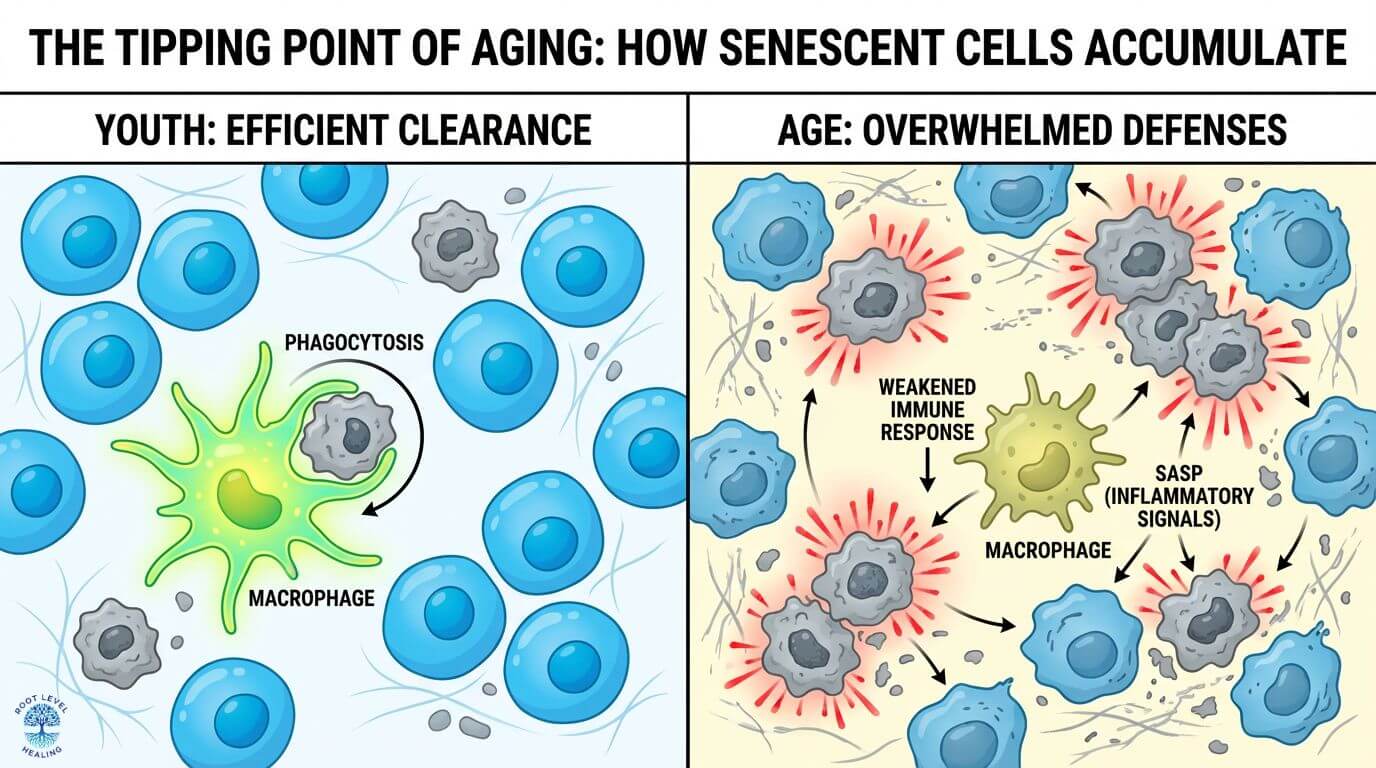
Senescent cells act like "bad apples," spreading inflammation and dysfunction to the healthy cells around them through the toxic SASP.
This SASP is a key driver of "inflammaging"—the chronic, low-grade inflammation that characterizes aging. It disrupts normal tissue function, degrades the extracellular matrix (the scaffolding that holds tissues together), and can even push neighboring healthy cells into a senescent state, creating a vicious, self-perpetuating cycle of damage.
A Deeper Dive into the SASP: The Zombie Cell's Toxic Arsenal
The Senescence-Associated Secretory Phenotype (SASP) is not a monolithic entity; it is a complex and dynamic cocktail of hundreds of different molecules. These can be broadly categorized into several groups:
- Pro-inflammatory Cytokines and Chemokines: Molecules like Interleukin-6 (IL-6), IL-8, and Monocyte Chemoattractant Protein-1 (MCP-1) are potent drivers of inflammation. They recruit immune cells to the site of the senescent cell, creating a chronic inflammatory state that can damage surrounding tissues.
- Growth Factors: The SASP includes growth factors that can, paradoxically, promote the growth of nearby pre-cancerous cells, highlighting the double-edged nature of senescence.
- Matrix Metalloproteinases (MMPs): These enzymes degrade the extracellular matrix, the structural scaffolding that holds tissues together. This can lead to a loss of tissue integrity and function, contributing to conditions like osteoarthritis and skin aging.
The Rise of Senolytics: A New Anti-Aging Paradigm
For decades, scientists believed that senescence was an irreversible endpoint. But a groundbreaking 2015 study from the Mayo Clinic turned this idea on its head. They identified a new class of drugs, which they termed "senolytics," that could selectively induce apoptosis (programmed cell death) in senescent cells while leaving healthy cells unharmed [2].
This was a paradigm shift in aging research. Instead of just slowing down the damage, we could now actively remove one of its primary sources. The first senolytic combination identified was a pairing of the chemotherapy drug Dasatinib and our hero molecule, Quercetin. This combination proved remarkably effective at clearing senescent cells in animal models, leading to improved cardiovascular function, reduced osteoporosis, and increased healthspan.
Quercetin's Multi-Pronged Attack: A Masterclass in Senolysis
Quercetin's genius as a senolytic lies in its ability to simultaneously attack multiple survival pathways that are uniquely upregulated in senescent cells. This multi-targeted approach is crucial, as senescent cells are notoriously resistant to apoptosis.
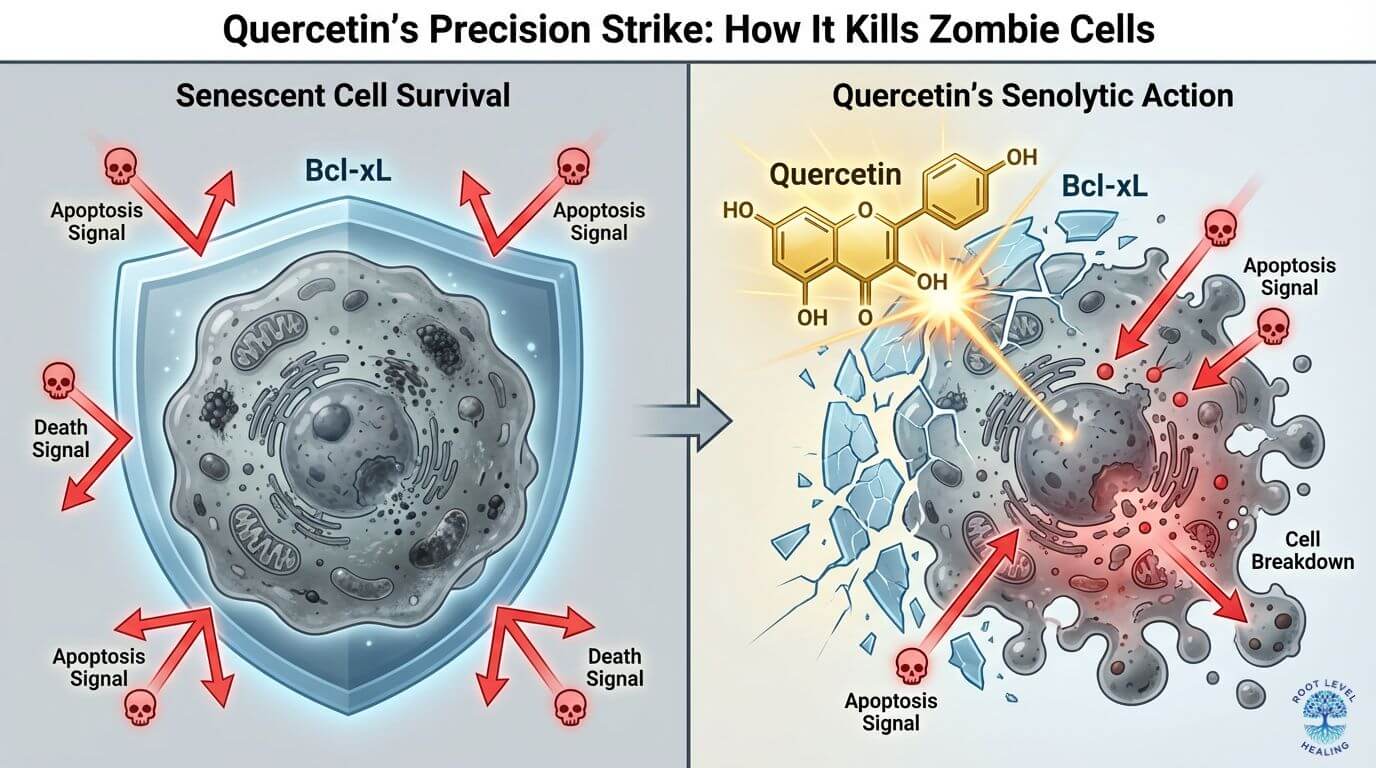
Quercetin acts as a targeted weapon, disabling the specific survival shields that senescent cells use to evade destruction.
Research has identified several key mechanisms:
| Pathway | Quercetin's Action | Outcome |
|---|---|---|
| PI3K/Akt/mTOR Pathway | This central survival pathway is hyperactive in senescent cells. Quercetin is a potent inhibitor, cutting off this primary pro-survival signal. | The cell's pro-survival signaling is cut off, making it vulnerable to apoptosis. |
| Bcl-2 Family Proteins (e.g., Bcl-xL) | Quercetin binds to and inhibits these key anti-apoptotic proteins that senescent cells rely on to survive. | Apoptosis (programmed cell death) is triggered in the senescent cell. |
| p53-p21 Pathway | Quercetin modulates this tumor suppressor pathway, which initiates senescence, to re-engage apoptotic signals. | Sensitizes senescent cells to apoptosis. |
| NF-κB Pathway | As a powerful inhibitor of this key inflammatory transcription factor, Quercetin suppresses the production of the toxic SASP. | Reduces chronic inflammation and the collateral damage caused by zombie cells. |
In essence, quercetin exploits the very defenses that zombie cells build to protect themselves. By disabling these pro-survival pathways, it leaves them with no choice but to undergo apoptosis, clearing the way for healthy tissue regeneration [4].
The Clinical Evidence for Senolytics
The promise of senolytics has rapidly moved from animal models to human clinical trials. The first-in-human study of the Dasatinib and Quercetin (D+Q) combination, published in The Lancet, provided proof-of-concept that senolytics can work in people [3].
In this landmark trial, individuals with diabetic kidney disease were given a short, intermittent course of D+Q. The results were remarkable: the treatment significantly reduced the number of senescent cells in adipose tissue and skin. It also decreased the circulating levels of key SASP inflammatory proteins. This confirmed that the senolytic effect observed in mice was translatable to humans.
Since then, numerous trials have been launched to investigate the effects of D+Q and other senolytics on a wide range of age-related conditions, including osteoporosis, Alzheimer's disease, cardiovascular disease, and frailty. While much research is still ongoing, the initial results are incredibly promising and validate the approach of targeting senescent cells to improve healthspan [5].
Natural Sources and Bioavailability of Quercetin
Quercetin is one of the most abundant flavonoids in the human diet. It is found in a wide variety of plant-based foods, giving many fruits and vegetables their vibrant colors.

Quercetin is abundant in many healthy foods, particularly in the skins of fruits and vegetables like apples and onions.
Some of the richest dietary sources of quercetin include:
- Capers: The highest known concentration.
- Onions: Especially red onions, with the highest levels in the outer rings.
- Apples: Primarily in the skin.
- Berries: Such as cranberries, blueberries, and elderberries.
- Kale and Broccoli.
- Green and Black Tea.
The Bioavailability Challenge: Unlocking Quercetin's Full Potential
The primary hurdle in harnessing the full power of Quercetin is its poor bioavailability. When consumed, it is extensively metabolized by enzymes in the gut wall and liver into less active forms. To overcome this, advanced delivery systems are being developed:
- Phytosome Technology: This involves complexing Quercetin with phospholipids (such as those from lecithin) to create a phytosome. This lipid-soluble complex is better able to pass through the gut wall, dramatically increasing absorption.
- Combination with other Bio-enhancers: Combining Quercetin with compounds like Bromelain (an enzyme from pineapple) or Vitamin C can improve its absorption and bioavailability.
Beyond D+Q: The Expanding Landscape of Senolytic Research
While the Dasatinib and Quercetin (D+Q) combination remains the most studied senolytic cocktail, the field is rapidly evolving. Researchers are now investigating other natural compounds with senolytic properties, such as Fisetin (another flavonoid) and Piperlongumine. Furthermore, a new class of drugs called senomorphics is emerging. Unlike senolytics, which kill senescent cells, senomorphics aim to suppress the harmful SASP without inducing cell death. This may offer a gentler, alternative approach to managing the burden of senescent cells.
We have now explored the three pillars of modern anti-aging science: combating DNA damage, boosting NAD+ levels, and clearing senescent cells. In our final post, we will bring it all together and introduce a comprehensive formula designed to address all three of these core aspects of cellular aging: Immune Defense Shield.
Frequently Asked Questions
Q: What are senescent "zombie" cells?
A: They are damaged cells that have stopped dividing but refuse to die. They accumulate with age and secrete a toxic mix of inflammatory proteins (SASP) that damages surrounding healthy tissues and accelerates aging.
Q: What are senolytics?
A: Senolytics are a new class of compounds that can selectively find and destroy senescent cells while leaving healthy cells unharmed. This is a revolutionary approach to treating age-related diseases.
Q: How does quercetin work as a senolytic?
A: Quercetin works by inhibiting the specific pro-survival pathways (like PI3K/Akt/mTOR and Bcl-xL) that senescent cells use to resist apoptosis (programmed cell death). By disabling these defenses, it forces the zombie cells to self-destruct.
Q: Is quercetin safe?
A: Quercetin is a natural flavonoid found in many fruits and vegetables and is considered very safe. Human clinical trials using quercetin as a senolytic have shown it to be well-tolerated, especially when used in short, intermittent cycles.
Q: Can I get enough quercetin from food?
A: While a diet rich in fruits and vegetables is beneficial, achieving the high, therapeutic doses of quercetin used in senolytic research through diet alone is very difficult due to its poor bioavailability. This is why targeted supplementation with enhanced bioavailability is often necessary.
References
- Gorgoulis, V., et al. (2019 ). Cellular Senescence: Defining a Path forward. *Cell*, 179(4), 813-827.
- Zhu, Y., et al. (2015 ). The Achilles’ heel of senescent cells: from transcriptome to senolytic drugs. *Aging Cell*, 14(4), 644-658.
- Hickson, L. J., et al. (2019 ). Senolytics decrease senescent cells in humans: Preliminary report from a clinical trial of Dasatinib plus Quercetin in individuals with diabetic kidney disease. *EBioMedicine*, 47, 446-456.
- Zoico, E., et al. (2021 ). Senolytic effects of quercetin in an in vitro model of pre-adipocytes and adipocytes induced senescence. *Scientific Reports*, 11, 23237.
- Cui, Z., et al. (2022 ). Therapeutic application of quercetin in aging-related diseases: SIRT1 as a potential mechanism. *Frontiers in Immunology*, 13, 943321.

Ready to Discover Your Score?
This 2-minute quiz is the essential first step to understanding your body's current toxic load and identifying the root cause of how you feel.
Take The Toxicity QuizExplore More Articles
Dive deeper into topics like detoxification, gut health, and mental clarity on our blog. Knowledge is the key to taking control of your health.
Visit The Blog