Shungite: The Ancient Carbon Mineral Shielding Modern Bodies from Electromagnetic Radiation
In the remote Karelia region of northwestern Russia, buried deep within ancient rock formations, lies a mineral unlike any other on Earth. For nearly two billion years, this rare carbon-rich stone has remained hidden, its extraordinary properties waiting to be discovered. Today, as our modern world becomes increasingly saturated with electromagnetic radiation from cell towers, WiFi networks, and 5G technology, this ancient mineral—known as shungite—is emerging as a powerful natural solution for protection.
Shungite is not just another crystal or stone touted for metaphysical benefits. It is a scientifically fascinating material with a unique molecular structure that sets it apart from every other mineral. At its core are fullerenes, hollow spherical molecules of carbon that earned their discoverers a Nobel Prize in Chemistry. These remarkable structures give shungite its distinctive ability to interact with electromagnetic fields in ways that other materials simply cannot match.
As we navigate an environment filled with invisible electromagnetic radiation, understanding shungite's properties and potential protective benefits has never been more relevant. This article explores the science behind this ancient mineral, examining its geological origins, its unique fullerene composition, and the research demonstrating its electromagnetic shielding capabilities. Whether you're concerned about EMF exposure or simply curious about this remarkable substance, the story of shungite bridges ancient Earth history with cutting-edge materials science.
Key Takeaways
- 🪨Ancient Origins: Shungite is a 2-billion-year-old carbon-rich mineral found exclusively in the Karelia region of Russia, making it one of Earth's rarest geological treasures.
- ⚛️Nobel Prize Chemistry: Shungite contains fullerenes—hollow carbon molecules (C60, C70) shaped like soccer balls—that earned their discoverers the 1996 Nobel Prize in Chemistry.
- 🛡️EMF Shielding: Scientific research demonstrates that shungite's unique carbon structure and electrical conductivity enable it to interact with and reduce electromagnetic radiation exposure.
- 🔬Research-Backed: A 2003 Russian study found that shungite shielding decreased the severity of damage from high-frequency electromagnetic radiation in laboratory tests.
- ⚡Unique Properties: Shungite's 98% carbon composition, electrical conductivity similar to graphite, and fullerene structure make it biocompatible and effective for EMF applications.
Shungite Explained: Ancient Carbon Mineral for EMF Protection (A Quick Overview)
Before we dive deep into the science, watch this quick overview to discover the science behind Shungite, Earth's rarest carbon mineral, and how its Nobel Prize-winning fullerene structure acts as a powerful shield against electromagnetic radiation.
In This Article:
What is Shungite? A Geological Marvel
Shungite is a rare, carbon-based mineral that formed approximately two billion years ago during the Paleoproterozoic Era, a time when Earth's atmosphere was still developing and life consisted primarily of simple microorganisms. Found almost exclusively in the Zazhoginsky deposit near Lake Onega in the Karelia region of Russia, shungite's unique formation process remains a subject of scientific fascination and debate.
Unlike coal or other carbon-rich rocks that formed from ancient plant matter, shungite's origins are far more mysterious. The prevailing theory suggests it formed from ancient marine microorganisms, particularly plankton and algae, that accumulated on the sea floor and underwent extreme compression and transformation over billions of years. Some researchers have even proposed that shungite's carbon may have extraterrestrial origins, possibly delivered to Earth via meteorite impact, though this remains speculative.
What makes shungite truly exceptional is its composition. Authentic shungite contains approximately 98% carbon, with the remaining 2% consisting of trace minerals including silicates, iron oxides, and other compounds. This extraordinarily high carbon content is what gives shungite its distinctive black, lustrous appearance and its remarkable physical properties. However, not all shungite is created equal. The mineral is classified into different types based on carbon content, with elite (or noble) shungite containing 90-98% carbon and representing the rarest and most prized variety.
The Karelia region where shungite is found has a long history of utilizing this mineral. Local residents have used shungite-infused water for centuries, and Peter the Great, the Russian Tsar, famously established Russia's first spa in Karelia in the early 18th century, specifically to take advantage of shungite's purported healing properties. Today, shungite continues to be mined in this region, with the vast majority of the world's supply coming from these ancient Russian deposits.
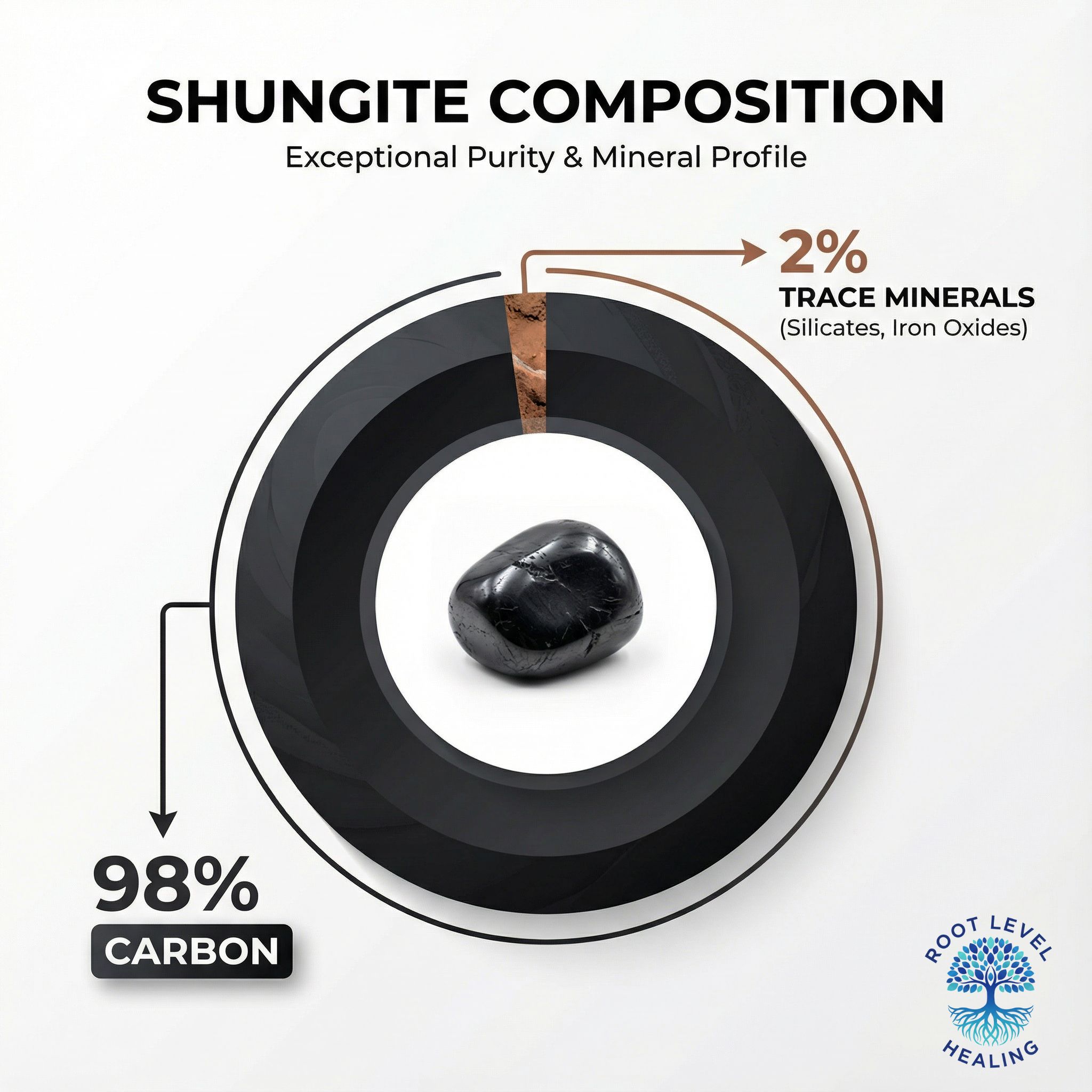
Shungite's exceptional composition consists of 98% carbon with trace minerals, giving it unique electrical and chemical properties unlike any other naturally occurring mineral.
The Fullerene Factor: Nobel Prize-Winning Carbon
At the heart of shungite's remarkable properties lies one of chemistry's most elegant molecular structures: fullerenes. These are hollow, cage-like molecules composed entirely of carbon atoms arranged in hexagonal and pentagonal patterns, resembling a soccer ball or geodesic dome. The most common fullerene, known as C60, contains exactly 60 carbon atoms arranged in this distinctive spherical configuration.
The discovery of fullerenes revolutionized materials science. In 1985, scientists Harold Kroto, Robert Curl, and Richard Smalley first synthesized C60 fullerenes in a laboratory, a breakthrough that earned them the 1996 Nobel Prize in Chemistry [3]. What made this discovery even more extraordinary was the subsequent realization that fullerenes occur naturally in shungite—making this ancient Russian mineral one of the only known natural sources of these remarkable carbon structures on Earth. The only other natural occurrence of fullerenes has been found in certain meteorites and in the residue of lightning strikes [4].
Fullerenes are not just scientifically interesting; they possess unique physical and chemical properties that make them valuable for numerous applications. Their hollow structure allows them to encapsulate other molecules, earning them the nickname "buckyballs" (after architect Buckminster Fuller, whose geodesic domes inspired their name). More importantly for our purposes, fullerenes exhibit exceptional electrical conductivity and can interact with electromagnetic fields in distinctive ways.
The fullerene content in shungite is what distinguishes it from other carbon-rich materials like coal, graphite, or charcoal. While these materials are also composed primarily of carbon, they lack the organized, spherical fullerene structures that give shungite its unique properties. The carbon in shungite exists in a partially graphitized state, with fullerene-like globules interspersed throughout the mineral's structure. This creates a three-dimensional network of carbon that is both electrically conductive and structurally stable [5].
Research has shown that the fullerenes in shungite are remarkably stable and resistant to degradation. Unlike synthetic fullerenes that can be expensive and difficult to produce, shungite provides a naturally occurring, abundant source of these valuable carbon structures. This stability and availability make shungite particularly interesting for practical applications, including electromagnetic field protection.
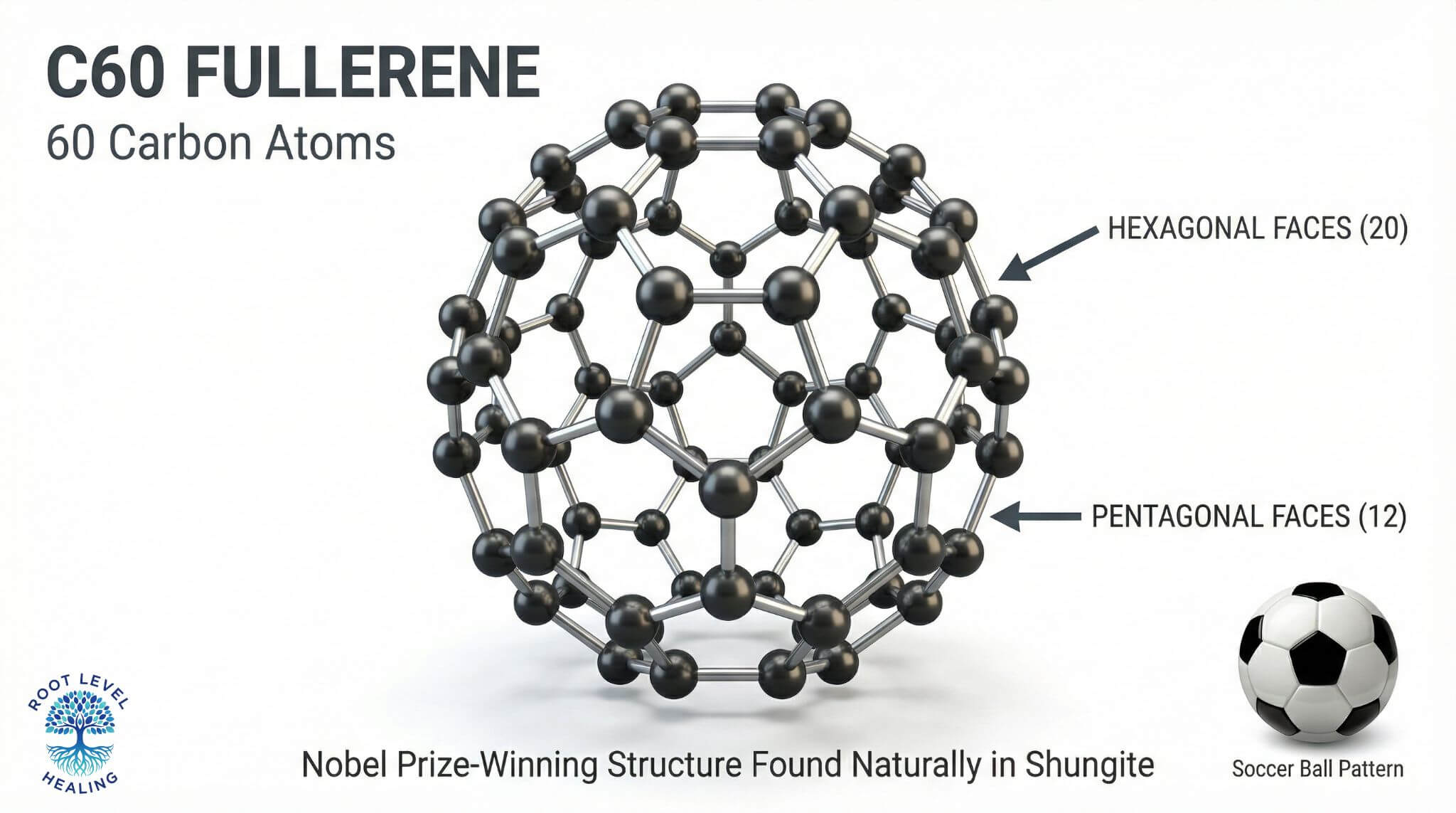
The C60 fullerene molecule contains 60 carbon atoms arranged in a hollow sphere with hexagonal and pentagonal faces, resembling a soccer ball. This Nobel Prize-winning structure is naturally found in shungite.
How Shungite Interacts with Electromagnetic Fields
The question of how shungite interacts with electromagnetic fields (EMF) is rooted in its unique physical properties, particularly its electrical conductivity and fullerene-rich carbon structure. Unlike insulating materials that simply block electromagnetic waves, shungite's conductive nature allows it to absorb and disperse electromagnetic energy in a more nuanced way.
Shungite's electrical conductivity is comparable to that of graphite, another form of carbon. This conductivity arises from the delocalized electrons within its carbon structure, which can move freely and interact with incoming electromagnetic waves. When electromagnetic radiation encounters shungite, the material's conductive carbon network can absorb the energy and convert it to heat, effectively reducing the intensity of the electromagnetic field that passes through or reflects from the material.
Scientific research supports shungite's electromagnetic shielding capabilities. A pivotal 2003 study by Kurotchenko and colleagues, published in the *Bulletin of Experimental Biology and Medicine*, investigated the protective effects of shungite against high-frequency electromagnetic radiation. The researchers exposed laboratory rats to nonthermal 37-GHz radiation—a frequency in the millimeter wave range similar to some 5G applications—while some animals were shielded with shungite. The results were significant: shielding with shungite decreased the severity of damage produced by the electromagnetic radiation, as measured by changes in blood cell counts and hemoglobin levels [1].
A more recent 2021 study by Antonets and colleagues, published in *Current Applied Physics*, examined the electromagnetic shielding effectiveness of lightweight shungite plates. The research demonstrated that shungite exhibits measurable shielding properties across a range of frequencies, with effectiveness varying based on the thickness and carbon content of the material. The study noted that shungite's unique properties, including its high chemical stability, electrical conductivity, and fire resistance, make it particularly suitable for electromagnetic shielding applications [2].
It is important to understand that shungite does not create an impenetrable barrier that completely blocks all electromagnetic radiation. Rather, it reduces the intensity of electromagnetic fields through absorption and dispersion. The degree of protection depends on several factors, including the thickness of the shungite material, its carbon content and purity, the frequency of the electromagnetic radiation, and the distance between the shungite and the radiation source.
The mechanism by which shungite provides EMF protection is multifaceted. First, its conductive carbon structure absorbs electromagnetic energy. Second, the fullerenes within shungite may act as molecular antennae that can capture and neutralize electromagnetic waves. Third, shungite's ability to reduce oxidative stress—a key mechanism of EMF-related biological damage—may provide additional protective benefits at the cellular level.
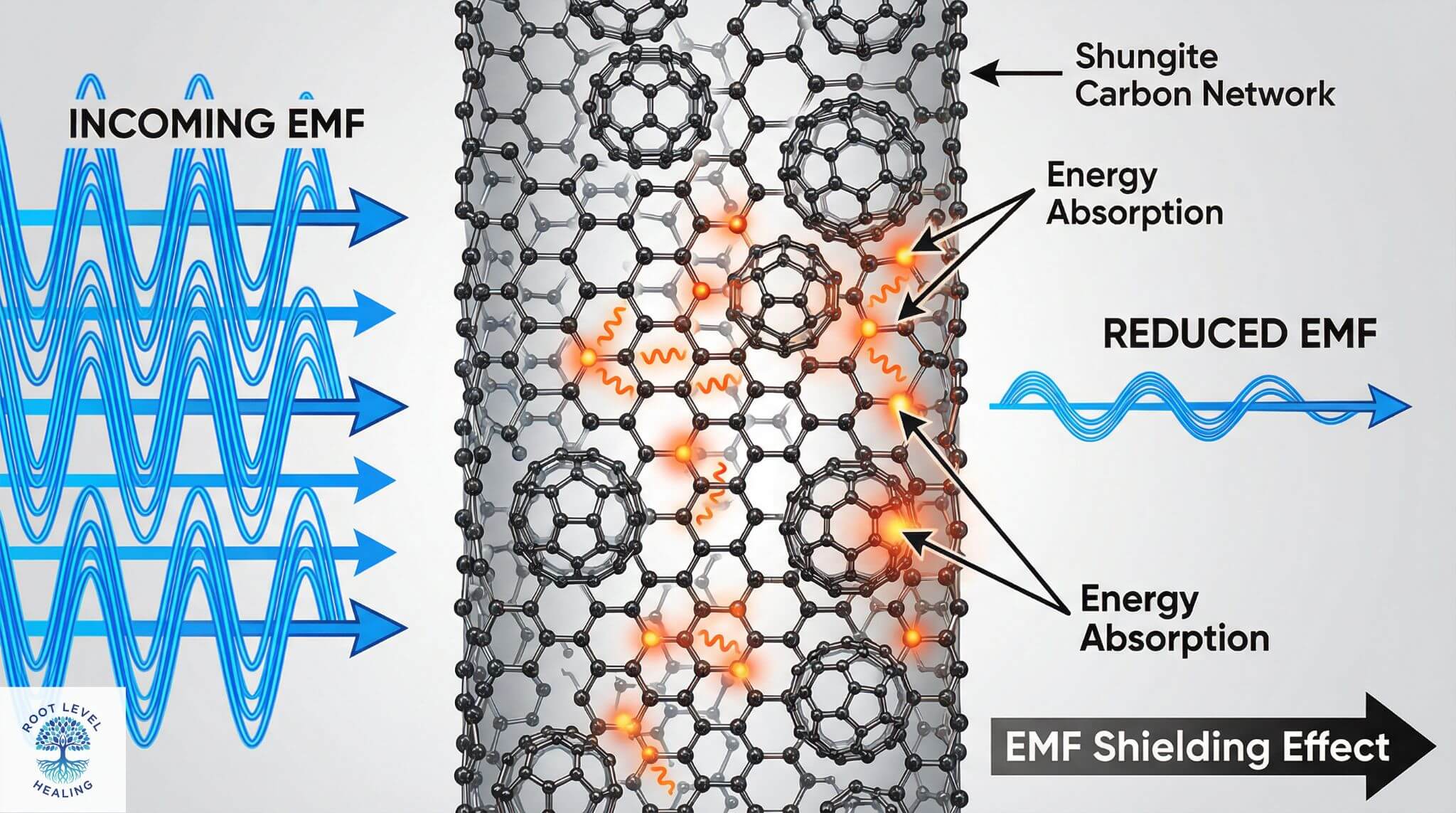
Shungite's conductive carbon network absorbs incoming electromagnetic waves and converts the energy to heat, reducing the intensity of EMF that passes through the material.
Beyond EMF: Other Remarkable Properties
While electromagnetic shielding has become shungite's most well-known modern application, this ancient mineral possesses a range of other remarkable properties that have been recognized and utilized for centuries. Understanding these additional characteristics provides a more complete picture of why shungite is such a unique and valuable material.
One of shungite's most celebrated properties is its ability to purify water. For hundreds of years, residents of the Karelia region have used shungite to treat water, and modern research has confirmed the scientific basis for this traditional practice. When water comes into contact with shungite, the mineral acts as a natural filter, removing bacteria, heavy metals, pesticides, chlorine, and other contaminants. Studies have shown that shungite can reduce concentrations of harmful substances in water while simultaneously enriching it with beneficial minerals.
The water purification mechanism appears to involve both physical filtration through shungite's porous structure and chemical interactions with its fullerene content. Fullerenes are known to possess strong antioxidant properties and can bind to various organic and inorganic compounds, effectively neutralizing them. This makes shungite-treated water not only cleaner but potentially beneficial for health, though more research is needed to fully understand these effects.
Shungite also demonstrates notable antibacterial and antiviral properties. Research has shown that shungite can inhibit the growth of various pathogenic bacteria and may have antiviral effects as well. These antimicrobial properties are thought to be related to the fullerene content and the mineral's ability to generate reactive oxygen species that can destroy harmful microorganisms without damaging human cells. This selective antimicrobial action makes shungite particularly interesting for applications in water treatment and potentially in medical and hygiene products.
Another significant property of shungite is its antioxidant capacity. Fullerenes are powerful antioxidants, capable of neutralizing free radicals that cause oxidative stress and cellular damage. This antioxidant effect may explain some of the protective benefits attributed to shungite, including its potential to mitigate the oxidative stress induced by electromagnetic radiation exposure. The ability to combat oxidative stress at the molecular level positions shungite as more than just a physical shield—it may offer biochemical protection as well.
Historically, shungite has been used in traditional Russian medicine for a variety of purposes, including treating skin conditions, joint pain, and digestive issues. While many of these traditional uses lack rigorous scientific validation, the growing body of research on shungite's antibacterial, antioxidant, and purification properties suggests that some of these historical applications may have legitimate scientific foundations.
The Science of Carbon-Based Protection
To fully appreciate shungite's protective capabilities, it's helpful to understand why carbon-based materials are particularly effective for electromagnetic shielding and how shungite compares to other EMF protection options. Carbon's unique atomic structure and the various forms it can take make it an ideal material for interacting with electromagnetic fields.
Carbon atoms have four valence electrons that can form strong covalent bonds with other atoms, including other carbon atoms. This allows carbon to create a vast array of structures, from the hardness of diamond to the slippery layers of graphite to the hollow spheres of fullerenes. Each of these carbon allotropes has distinct electrical properties. Graphite and fullerenes, like those found in shungite, are electrically conductive, while diamond is an insulator. This conductivity is key to electromagnetic shielding.
When electromagnetic waves encounter a conductive material, the oscillating electric and magnetic fields induce currents in the material. These induced currents create their own electromagnetic fields that oppose the incoming waves, effectively absorbing and dissipating the energy. This is why metals like copper, silver, and aluminum are commonly used in EMF shielding applications—they are excellent electrical conductors. However, metals have drawbacks: they can be heavy, expensive, prone to corrosion, and may cause complete signal blocking, which can interfere with desired wireless communications.
Carbon-based materials like shungite offer several advantages over metals for certain EMF protection applications. First, they are lightweight and can be incorporated into fabrics, coatings, and composite materials more easily than metals. Second, carbon materials are chemically stable and resistant to corrosion. Third, and perhaps most importantly, carbon-based shielding can be tuned to absorb specific frequencies while allowing others to pass through, providing protection without completely blocking all electromagnetic signals.
Shungite's specific advantage lies in its fullerene content and its naturally occurring, stable structure. While synthetic carbon nanomaterials like carbon nanotubes and graphene have been developed for EMF shielding, they can be expensive to produce and may raise concerns about biocompatibility and environmental impact. Shungite, by contrast, is a naturally occurring material that has existed for billions of years, suggesting excellent long-term stability and minimal environmental concerns.
The following table compares shungite to other common EMF shielding materials, highlighting its unique combination of properties:
| Material | Conductivity | Biocompatibility | Weight | Cost | Durability |
|---|---|---|---|---|---|
| Shungite | ⭐⭐⭐⭐ | ⭐⭐⭐⭐⭐ | ⭐⭐⭐⭐⭐ | ⭐⭐⭐⭐ | ⭐⭐⭐⭐⭐ |
| Copper | ⭐⭐⭐⭐⭐ | ⭐⭐⭐ | ⭐⭐ | ⭐⭐ | ⭐⭐⭐ |
| Silver | ⭐⭐⭐⭐⭐ | ⭐⭐⭐⭐ | ⭐⭐ | ⭐ | ⭐⭐⭐⭐ |
| Aluminum | ⭐⭐⭐⭐ | ⭐⭐⭐ | ⭐⭐⭐ | ⭐⭐⭐⭐ | ⭐⭐⭐ |
| Nickel | ⭐⭐⭐⭐ | ⭐⭐ | ⭐⭐ | ⭐⭐⭐ | ⭐⭐⭐⭐ |
| Graphene | ⭐⭐⭐⭐⭐ | ⭐⭐⭐ | ⭐⭐⭐⭐⭐ | ⭐ | ⭐⭐⭐⭐ |
Rating scale: ⭐ = Poor, ⭐⭐⭐ = Average, ⭐⭐⭐⭐⭐ = Excellent. Shungite offers an optimal balance of conductivity, biocompatibility, light weight, affordability, and exceptional durability.
As the table illustrates, shungite offers a compelling combination of properties. While it may not have the absolute highest conductivity of metals like copper or silver, it excels in biocompatibility, weight, cost-effectiveness, and long-term durability. This makes shungite particularly well-suited for applications where the material will be in close contact with the body, such as in clothing treatments or body sprays—applications that would be impractical or unsafe with heavy metals.
The biocompatibility of carbon-based materials is a crucial consideration. Shungite has been used by humans for centuries without reports of toxicity or adverse effects [6]. Its carbon structure is chemically inert and does not leach harmful substances. This stands in contrast to some metals that can cause skin irritation, allergic reactions, or, in the case of nanoparticles, potential unknown health effects.
Conclusion: Ancient Wisdom Meets Modern Science
Shungite represents a remarkable intersection of ancient geological processes and modern scientific understanding. This 2-billion-year-old mineral, formed in an era when Earth's atmosphere and life were fundamentally different from today, contains within its structure some of the most sophisticated carbon molecules known to science. The presence of fullerenes—those elegant, soccer-ball-shaped carbon cages that earned a Nobel Prize—transforms shungite from a mere curiosity into a material with genuine practical applications.
The scientific evidence supporting shungite's electromagnetic shielding properties is compelling, though it is important to maintain realistic expectations. Shungite is not a magical cure-all that will eliminate all electromagnetic radiation from your environment. Rather, it is a tool that can reduce EMF exposure when properly applied, particularly in specialized forms and applications. The research demonstrates measurable protective effects, especially against high-frequency radiation, and suggests mechanisms by which shungite's unique carbon structure interacts with electromagnetic fields.
What makes shungite particularly intriguing for modern applications is its combination of effectiveness, safety, and practicality. Unlike heavy metal shielding materials that can be cumbersome, expensive, or potentially toxic, shungite offers a lightweight, biocompatible, and naturally occurring alternative. Its additional properties—water purification, antibacterial effects, and antioxidant capacity—further enhance its value and suggest that its protective benefits may extend beyond simple electromagnetic shielding to include biochemical protection at the cellular level.
As we move forward into an era of increasing electromagnetic exposure from 5G networks, WiFi proliferation, and ubiquitous wireless devices, the need for effective, safe, and practical EMF protection solutions becomes more pressing. Shungite, with its ancient origins and modern scientific validation, offers a promising approach. However, the full potential of this remarkable mineral has yet to be realized. Innovative applications—such as incorporating shungite into liquid sprays that can be applied to clothing and skin—represent the next frontier in making this ancient protective mineral accessible and practical for everyday use.
In our next article, we will shift our focus from the solution to the problem itself. We will explore the invisible threat of 5G and EMF exposure in depth, examining the scientific evidence for health concerns, the mechanisms by which electromagnetic radiation affects the body, and why the modern electromagnetic environment represents an unprecedented challenge to human health. Understanding the threat is the first step toward effective protection.
Frequently Asked Questions
Q: Is all shungite the same quality?
A: No. Shungite is classified by carbon content. Elite (or noble) shungite contains 90-98% carbon and is the rarest and most effective form, appearing silvery-black and metallic. Regular shungite contains 30-50% carbon and is more common but less potent. For EMF protection applications, higher carbon content generally means better effectiveness. Always source shungite from reputable suppliers who can verify its origin from the Karelia region of Russia, as authentic shungite is found almost exclusively in this location.
Q: How does shungite compare to other EMF protection products?
A: Shungite offers unique advantages over many EMF protection products. Unlike metal-based shielding (copper, silver, aluminum), shungite is lightweight, biocompatible, and won't corrode. Unlike EMF-blocking phone cases that only protect from one device, shungite can provide more comprehensive protection when applied to clothing or used in room shielding. Its fullerene content also provides antioxidant benefits that address the oxidative stress mechanism of EMF damage, offering protection beyond simple physical shielding.
Q: Can shungite completely block all electromagnetic radiation?
A: No. Shungite reduces and attenuates electromagnetic radiation but does not create a complete barrier. The degree of protection depends on the thickness of the shungite material, its carbon content, the frequency of the EMF, and the distance from the source. Research shows it can significantly decrease EMF intensity, but it should be viewed as a tool for reducing exposure rather than eliminating it entirely. Complete EMF blocking would also prevent desired wireless communications.
Q: Is shungite safe to use on skin or clothing?
A: Yes. Shungite has been used by humans for centuries without reports of toxicity or adverse effects. Its carbon structure is chemically inert and biocompatible. Shungite may leave black residue when handled in its raw stone form, but this is simply carbon dust that washes off easily. When properly processed into liquid formulations or textile treatments, shungite is safe for direct skin contact and clothing application. However, as with any product, those with specific sensitivities should test a small area first.
Q: How long does shungite's protective effect last?
A: Shungite's electromagnetic shielding properties are inherent to its carbon structure and fullerene content, so they do not "wear out" or degrade over time under normal conditions. A piece of shungite will maintain its EMF-interacting properties indefinitely. However, in applications where shungite is applied to clothing or surfaces (such as in sprays or coatings), the duration of protection depends on the formulation and how well the shungite particles adhere to and remain on the treated surface. Reapplication after washing or extended wear is typically recommended.
Q: What's the difference between shungite and activated charcoal?
A: While both are carbon-based materials, they are fundamentally different. Activated charcoal is processed carbon (usually from wood or coconut shells) with a highly porous structure designed for absorption and filtration. Shungite is a naturally occurring mineral with a unique fullerene-rich structure that provides electrical conductivity and EMF interaction properties. Activated charcoal is excellent for filtering toxins and chemicals but does not have the electromagnetic shielding capabilities of shungite. They serve different purposes and are not interchangeable.
References
- Kurotchenko SP, Subbotina TI, Tuktamyshev II, Tuktamyshev ISh, Khadartsev AA, Yashin AA. Shielding effect of mineral schungite during electromagnetic irradiation of rats. Bull Exp Biol Med. 2003;136(5 ):458-459. https://pubmed.ncbi.nlm.nih.gov/14968159/
- Antonets IV, Golubev EA, Shcheglov VI, et al. Electromagnetic shielding effectiveness of lightweight and flexible ultrathin shungite plates. Curr Appl Phys. 2021;32:24-32. https://www.sciencedirect.com/science/article/abs/pii/S1567173921001577
- Kroto HW, Heath JR, O'Brien SC, Curl RF, Smalley RE. C60: Buckminsterfullerene. Nature. 1985;318(6042 ):162-163. https://www.nature.com/articles/318162a0
- Buseck PR, Tsipursky SJ, Hettich R. Fullerenes from the geological environment. Science. 1992;257(5067 ):215-217. https://www.science.org/doi/10.1126/science.257.5067.215
- Mosin OV, Ignatov I. The structure and composition of natural carbonaceous fullerene containing mineral shungite and microporous crystalline aluminosilicate mineral zeolite. Adv Phys Theor Appl. 2013;24:12-21. Available online
- Andrievsky GV, Klochkov VK, Derevyanchenko LI. Is the C60 fullerene molecule toxic?! Fuller Nanotub Carbon Nanostructures. 2005;13(4 ):363-376. https://www.tandfonline.com/doi/full/10.1080/15363830500237267

Ready to Discover Your Score?
This 2-minute quiz is the essential first step to understanding your body’s current toxic load and identifying the root cause of how you feel.
Take The Toxicity QuizExplore More Articles
Dive deeper into topics like detoxification, gut health, and mental clarity on our blog. Knowledge is the key to taking control of your health.
Visit The Blog