The Silent Epidemic: Why Your Liver is Under Attack (And What You Can Do About It)
🔑 Key Takeaways
- 📊100+ Million Americans Affected: Over 100 million Americans have some form of liver disease, with 42% having fatty liver disease—most without knowing it.
- ⚠️Silent Progression: Liver disease progresses from reversible fatty liver to irreversible cirrhosis, often without symptoms until advanced stages.
- 🎯Modern Lifestyle Threats: Processed foods, environmental toxins, and alcohol create a "perfect storm" overwhelming our liver's capacity.
- 🛡️Proactive Protection: Early intervention and targeted liver support can prevent progression and restore optimal function.
Beneath the surface of our daily lives, a silent epidemic is unfolding. It doesn't make headlines or cause widespread panic, but it affects over 100 million Americans—many of whom have no idea they are at risk [1]. This is the modern liver health crisis, a slow-burning fire fueled by our diet, environment, and lifestyle choices. Your liver, the body's tireless gatekeeper and master detoxifier, is under an unprecedented assault, and the consequences can be devastating.
From the processed foods we eat to the alcohol we consume socially, our livers are tasked with filtering a constant barrage of toxins. Over time, this relentless workload can lead to a cascade of health issues, starting with fatty liver disease and potentially progressing to inflammation (hepatitis), scarring (cirrhosis), and even liver failure. The most alarming part? The early stages are often completely silent, with no obvious symptoms until significant damage has already been done.
In this article, we will pull back the curtain on this silent epidemic. We will explore the shocking statistics, uncover the hidden stressors that are damaging our livers, and reveal the early warning signs you need to watch for. Most importantly, we will introduce the concept of proactive liver support—a new paradigm for taking control of your health and protecting your body's most vital organ before it's too late.
The Silent Epidemic: Why Your Liver is Under Attack And What You Can Do About It - Holistic Support: A Quick Overview
Before we dive deep into the science, watch this quick overview and discover the silent epidemic affecting over 100 million Americans — learn how the "perfect storm" of processed foods, environmental toxins, and alcohol is attacking your liver, and how to proactively protect your body's master detoxifier before irreversible damage occurs.
In This Article:
The Perfect Storm: How Modern Life is Waging War on Your Liver
The staggering rise in liver disease isn't a random occurrence; it's the direct result of a "perfect storm" of modern lifestyle factors. Our bodies, which evolved over millennia, are struggling to cope with the challenges of the 21st century. The primary culprits behind this crisis are a trio of relentless attackers: our diet, environmental toxins, and alcohol consumption.
Processed foods, laden with high-fructose corn syrup, unhealthy fats, and chemical additives, place an enormous metabolic burden on the liver. When the liver is overwhelmed with more fat and sugar than it can process, it begins to store the excess in its own cells, leading to a condition known as nonalcoholic fatty liver disease (NAFLD). Shockingly, recent studies estimate that over 40% of U.S. adults now have NAFLD, making it the most common form of chronic liver disease [2].
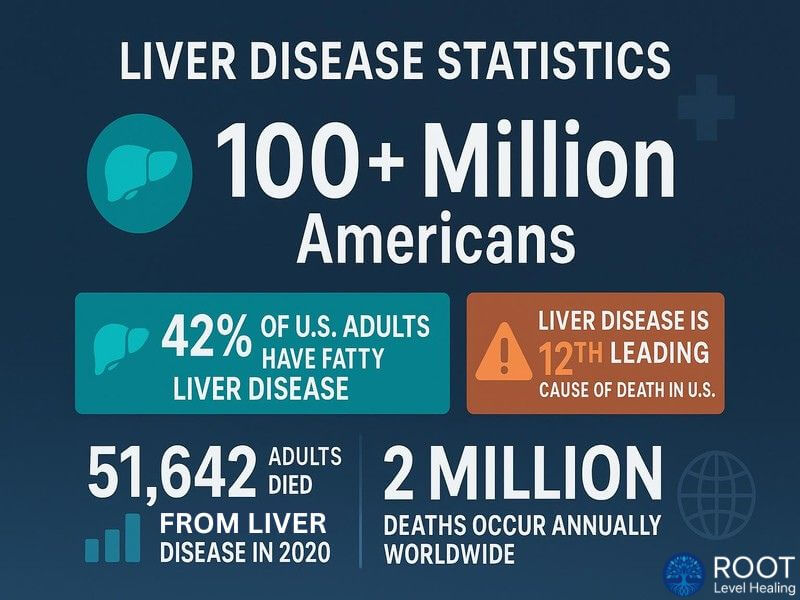
The shocking statistics of the modern liver disease epidemic affecting over 100 million Americans.
Compounding this issue is our constant exposure to environmental toxins. Pesticides in our food, chemicals in our water, and pollutants in the air we breathe all end up being processed by the liver. This adds another layer of stress, forcing the organ to work overtime to neutralize and eliminate these foreign substances. Finally, even moderate social drinking contributes significantly to the problem. As the primary site of alcohol metabolism, the liver takes a direct hit with every drink, leading to inflammation and the depletion of its precious antioxidant reserves.
The Silent Progression: From Fatty Liver to Cirrhosis
Liver disease rarely develops overnight. It's a slow, insidious progression that often begins with a simple and reversible condition: steatosis, or fatty liver. At this stage, excess fat has accumulated in the liver cells, but there is typically no inflammation or damage. The vast majority of the 100 million Americans with fatty liver disease are in this stage, completely unaware of the ticking time bomb inside them.
If the underlying causes are not addressed, the condition can advance to nonalcoholic steatohepatitis (NASH), a more serious form where the fat accumulation is accompanied by inflammation. This inflammation is the body's response to cellular injury, and it signals that the liver is actively being damaged. Over time, this chronic inflammation can lead to the formation of scar tissue, a process known as fibrosis.
As fibrosis progresses, the healthy, functional tissue of the liver is gradually replaced by hard, fibrous scar tissue. This is the hallmark of cirrhosis, the late stage of liver disease. A cirrhotic liver is stiff and nodular, and its ability to perform its more than 500 vital functions is severely compromised. At this point, the damage is largely irreversible, and the risk of life-threatening complications, including liver failure and liver cancer, increases dramatically.
| Stage of Liver Disease | Characteristics | Reversibility |
|---|---|---|
| Healthy Liver | No excess fat, no inflammation. | N/A |
| Steatosis (Fatty Liver) | Excess fat accumulation (>5% of liver weight). | Highly Reversible |
| NASH (Steatohepatitis) | Fat accumulation with inflammation and cell damage. | Potentially Reversible |
| Fibrosis | Formation of scar tissue due to chronic inflammation. | Manageable, but scarring is difficult to reverse. |
| Cirrhosis | Extensive, advanced scarring; impaired liver function. | Generally Irreversible |
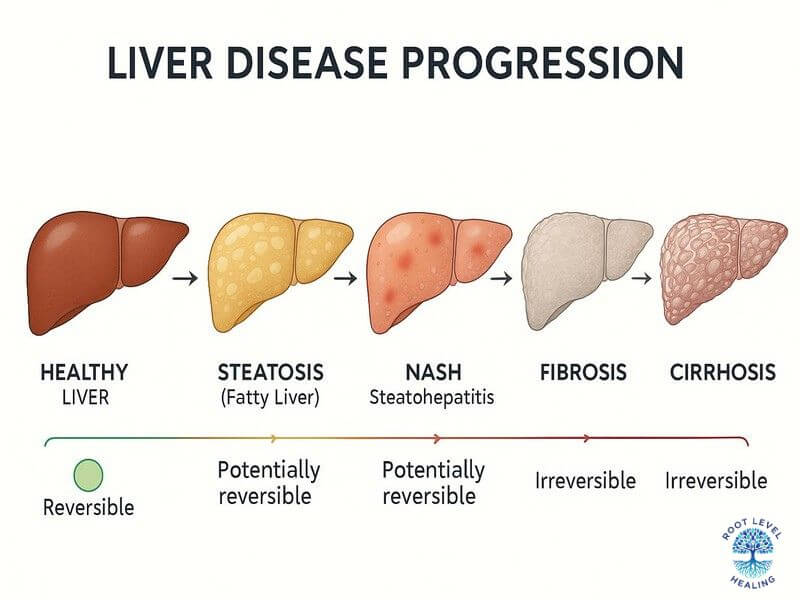
The progressive stages of liver disease from healthy liver to irreversible cirrhosis.
Are You at Risk? Early Warning Signs of a Struggling Liver
Because the liver has a remarkable capacity to regenerate and function even when partially damaged, the early stages of liver disease are notoriously asymptomatic. However, as the damage progresses, your body may start sending subtle signals that its primary detoxification organ is struggling. Recognizing these early warning signs is crucial for taking action before irreversible damage occurs.
Common, yet often overlooked, symptoms include persistent fatigue—a feeling of deep, unshakable tiredness that isn't relieved by rest. Brain fog manifests as difficulty concentrating, memory lapses, and a general feeling of mental cloudiness. Digestive issues may present as unexplained nausea, loss of appetite, bloating, or discomfort in the upper right abdomen. Skin problems can include yellowing of the skin or eyes (jaundice), persistent itching, or the appearance of spider-like blood vessels. Additionally, hormonal imbalances may occur, as the liver plays a key role in regulating hormones, and dysfunction can manifest in various ways.
If you experience any of these symptoms, especially in combination with risk factors like a diet high in processed foods, regular alcohol consumption, or a family history of liver issues, it's a clear signal to prioritize your liver health.
A New Paradigm: Proactive Liver Support
The traditional medical approach often waits for liver enzymes to become elevated or for symptoms to become severe before intervening. However, a new paradigm focused on proactive liver support is emerging. This approach recognizes that in our modern, toxin-laden world, the liver requires daily, dedicated support to perform its functions optimally and protect itself from damage.
Proactive support involves two key strategies: reducing the liver's toxic load and providing it with the specific nutrients it needs to enhance its natural detoxification and antioxidant defense systems. This means adopting a diet rich in whole foods, minimizing exposure to environmental toxins, and being mindful of alcohol intake. Crucially, it also involves targeted nutritional supplementation with compounds that have been scientifically shown to support liver function, protect liver cells from oxidative stress, and boost the production of the body's master antioxidant, glutathione.
By taking a proactive stance, you can move from a position of defense to one of offense, empowering your liver to not only cope with the demands of modern life but to thrive. In the following articles in this series, we will delve deeper into the science of alcohol metabolism, the critical role of glutathione, and the specific strategies you can use to build a more resilient and powerful liver.
Frequently Asked Questions
Q: Can my liver really heal itself?
A: The liver has an incredible capacity for regeneration, especially in the early stages of disease. If you have fatty liver (steatosis), making significant lifestyle changes can often allow your liver to heal completely. However, once significant scarring (cirrhosis) has occurred, the damage is generally considered irreversible.
Q: How much alcohol is too much for my liver?
A: There is no single answer, as individual tolerance varies based on genetics, body size, and overall health. However, guidelines generally define heavy drinking as more than 4 drinks on any day or 14 drinks per week for men, and more than 3 drinks on any day or 7 drinks per week for women. Any amount of alcohol places a burden on the liver.
Q: Are liver detoxes or cleanses effective?
A: Most commercial "detox" teas or juice cleanses are not supported by scientific evidence and can sometimes be harmful. True liver detoxification is a complex biochemical process that requires specific nutrients to function properly. The most effective way to support this process is through a healthy diet and targeted nutritional support, not through extreme, short-term cleanses.
Q: What are the most important nutrients for liver health?
A: Key nutrients for liver health include glutathione (the body's master antioxidant), N-acetylcysteine (NAC) which helps produce glutathione, vitamin C for antioxidant support, and minerals like zinc and selenium that support enzyme function. A diet rich in cruciferous vegetables, berries, and lean proteins also provides essential liver-supporting compounds.
References
- American Liver Foundation. (n.d. ). Liver Disease Statistics https://liverfoundation.org/resource-center/blog/liver-disease-statistics/
- VCU Health. (2024, November 12 ). More than 40% of U.S. adults have liver disease, with higher risk among Hispanics, new study finds. Retrieved from https://www.vcuhealth.org/news/more-than-40-percent-of-us-adults-have-liver-disease-with-higher-risk-among-hispanics-new-study/

Ready to Discover Your Score?
This 2-minute quiz is the essential first step to understanding your body's current toxic load and identifying the root cause of how you feel.
Take The Toxicity QuizExplore More Articles
Dive deeper into topics like detoxification, gut health, and mental clarity on our blog. Knowledge is the key to taking control of your health.
Visit The Blog