Superfoods vs. Super Powders: The Science Behind Concentrated Nutrition
Key Takeaways
- 🔬The Bioavailability Factor: Concentrated powders often have higher bioavailability, meaning your body can absorb and utilize more nutrients compared to whole foods with tough cellular walls.
- 🌿Nutrient Synergy: Well-formulated powders combine multiple superfoods in precise ratios to create synergistic effects that are difficult to achieve through diet alone.
- 🎯Therapeutic Dosing: Powders deliver therapeutic doses of specific compounds (like antioxidants from berries or chlorophyll from greens) that would require eating impractical amounts of whole foods.
- ⚡Convenience & Consistency: Superfood powders provide a consistent, convenient way to ensure you get a wide spectrum of nutrients daily, overcoming the challenges of modern lifestyles.
Yesterday, we uncovered the hidden nutrient gap and the uncomfortable truth that even the healthiest diets can fall short in our modern world. The combination of soil depletion, busy lifestyles, and absorption challenges means that relying on whole foods alone might not be enough to reach optimal health.
This naturally leads to a critical question: if whole foods aren't sufficient, what's the solution? Many turn to superfoods—nutrient-dense foods like kale, blueberries, and spirulina—to bridge the gap. But is a handful of goji berries in your smoothie truly enough? Or is there a more powerful, scientifically-backed approach?
This is where the debate between superfoods and super powders begins. While eating whole superfoods is always beneficial, the science of nutrition reveals why a high-quality, concentrated superfood powder can often deliver superior results. It comes down to three key concepts: bioavailability, synergy, and therapeutic dosing.
Superfoods vs. Super Powders: Which One ACTUALLY Works? (Bioavailability Science Explained): A Quick Overview
Before we dive deep into the science, watch our short video to learn the science behind superfood powders and why they might be more powerful than the whole foods.
In This Article:
The Bioavailability Advantage: Unlocking Trapped Nutrients
Bioavailability refers to the proportion of a nutrient that is absorbed from the diet and used for normal body functions. Just because a food contains a nutrient doesn't mean your body can actually use it. Plant cells have rigid walls made of cellulose, which human bodies cannot digest. This means many of the valuable nutrients within those cells can pass through your system unabsorbed.
"The bioavailability of nutrients from plant foods can be influenced by a variety of factors, including the food matrix, the presence of antinutrients, and the processing methods used." - *Critical Reviews in Food Science and Nutrition* [1]
High-quality superfood powders have a distinct advantage here. The processes used to create them—such as cold-pressing, juicing, and careful dehydration—effectively break down these tough cell walls *before* you consume them. This pre-digestion process unlocks the nutrients, making them far more accessible to your body.
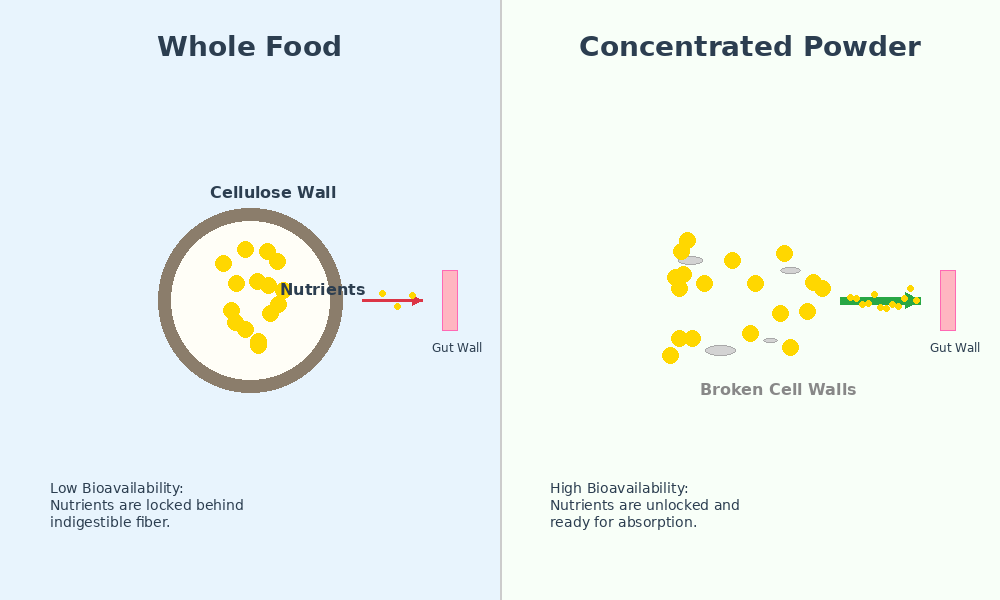
Think of it like this: eating a raw carrot is healthy, but your body has to do a lot of work to break it down. A gently processed carrot powder delivers those same nutrients in a form your body can absorb almost instantly, with minimal digestive effort. This is especially critical for individuals with compromised gut health, who may already struggle with nutrient absorption [2].
The Power of Synergy: 1 + 1 = 3
Nutrients rarely work in isolation. Their effects are often amplified when they are consumed together in a phenomenon known as **nutrient synergy**. For example, the iron in spinach is absorbed more effectively when consumed with vitamin C. The curcumin in turmeric is made thousands of times more bioavailable when combined with piperine from black pepper [3].
While a varied whole-food diet can provide some synergy, creating optimal combinations consistently is incredibly difficult. It requires extensive nutritional knowledge, precise meal planning, and access to a wide variety of fresh ingredients year-round.
Synergy in Action: A Real-World Example
A well-formulated greens powder might combine iron-rich spirulina with vitamin C-rich acerola cherry and camu camu. It could pair the anti-inflammatory power of turmeric with a pinch of black pepper extract. These are not random combinations; they are scientifically designed to maximize the potency and absorption of each ingredient, creating a final product that is far more powerful than the sum of its parts.
Achieving this level of nutritional engineering with your daily meals is nearly impossible. A high-quality powder does the work for you, delivering a precisely formulated, synergistic blend in every scoop.
Therapeutic Dosing: Getting Enough to Make a Difference
Many of the incredible health benefits associated with superfoods—such as reducing inflammation, boosting antioxidant levels, or supporting detoxification—are only achieved at **therapeutic doses**. This is the amount of a specific compound needed to produce a measurable biological effect.
For example, studies showing the powerful antioxidant effects of blueberries often use extracts equivalent to several cups of berries per day [4]. To get the amount of sulforaphane used in studies on broccoli sprouts for detoxification, you'd need to eat an impractically large amount of the whole vegetable daily.
Spirulina for Energy
You might need 3-5 grams of spirulina daily to see a significant impact on energy and endurance. That's about a full teaspoon of pure powder.
Açai for Antioxidants
Getting a therapeutic dose of antioxidants from açai would require eating a large bowl of the fresh pulp, which is high in sugar and calories and not widely available.
Wheatgrass for Detox
A single shot of wheatgrass juice is equivalent to the nutrients found in several pounds of leafy greens.
Superfood powders excel at delivering these therapeutic doses in a convenient, low-calorie form. They concentrate the active compounds, allowing you to consume the amount needed to see real, tangible benefits without having to eat pounds of vegetables.
The Convenience Factor: Consistency is Key
Finally, we have to be realistic about our modern lives. The single biggest factor in the success of any health protocol is **consistency**. Even the perfect diet is useless if you can't stick to it.
As we discussed yesterday, shopping for, preparing, and consuming 7-13 servings of diverse vegetables daily is a significant challenge. A high-quality greens powder removes that barrier. It offers a simple, consistent, and convenient way to ensure your body gets a foundational blast of diverse, bioavailable nutrients every single day, regardless of how busy you are.
The Verdict: Powders as a Powerful Complement
The goal is not to replace whole foods, but to complement them. A diet rich in whole, organic superfoods should always be the foundation. However, by adding a high-quality, concentrated superfood powder, you are leveraging the power of science to bridge the modern nutrient gap, ensuring bioavailability, maximizing synergy, and achieving therapeutic doses that food alone often cannot provide.
Frequently Asked Questions
Q: Are all superfood powders the same?
A: Absolutely not. Quality varies dramatically. Look for powders that are organic, use whole-food ingredients (not synthetic isolates), are third-party tested, and use cold-processing or other gentle methods to preserve nutrients. Avoid products with fillers, artificial sweeteners, or unnecessary additives.
Q: Can my body become dependent on powders?
A: No. Think of it like a multivitamin, but derived from whole foods. It's simply providing your body with the raw materials it needs to function optimally. It complements your diet, it doesn't replace your body's natural processes.
Q: Isn't fresh always better than processed?
A: Not necessarily. While "processed" often has a negative connotation, gentle processing methods like freeze-drying or cold-pressing can actually make nutrients *more* bioavailable than in their raw form by breaking down tough plant cell walls. The key is the *quality* of the processing.
Q: How do I choose the right superfood powder?
A: Look for a formula that aligns with your health goals. Do you need more energy? Detox support? Immune function? A good all-around powder should contain a diverse blend of greens (like spirulina, chlorella), fruits (like açai, goji), and adaptogens or other functional ingredients.
References
- Palafox-Carlos, H., et al. (2011 ). The role of dietary fiber in the bioaccessibility and bioavailability of fruit and vegetable antioxidants. *Journal of Food Science*, 76(1), R6-R15.
- Yao Shen, Nairui Fan, Shu‐xia Ma, Xin Cheng, Xuesong Yang, Guang Wang. (2020 ). Gut Microbiota Dysbiosis: Pathogenesis, Diseases, Prevention, and Therapy.
- Hewlings, S. J., & Kalman, D. S. (2017 ). Curcumin: A Review of Its Effects on Human Health. *Foods*, 6(10), 92.
- Kalt, W., et al. (2019 ). Recent Research on the Health Benefits of Blueberries and Their Anthocyanins. *Advances in Nutrition*, 10(2), 305-320.

Ready to Discover Your Score?
This 2-minute quiz is the essential first step to understanding your body's current toxic load and identifying the root cause of how you feel.
Take The Toxicity QuizExplore More Articles
Dive deeper into topics like detoxification, gut health, and mental clarity on our blog. Knowledge is the key to taking control of your health.
Visit The Blog