
The Building Blocks of Longevity: Essential Nutrients That Protect Your Pet's DNA
In our first two articles, we uncovered the primary drivers of aging in our pets. We started with the relentless assault of DNA damage, and then revealed how the age-related decline of NAD+ creates a cellular energy crisis that prevents effective repair. We've established the problem: the blueprint of life is crumbling, and the energy to fix it is fading.
But what if we could equip the repair crew with better tools? What if we could build a stronger defense system to protect the DNA from damage in the first place? Energy from NAD+ is critical, but it's only half the equation. The cellular machinery that performs these vital repairs and defensive functions is built from and powered by a specific set of essential nutrients. Without these building blocks, the repair process grinds to a halt, no matter how much energy is available.
This article will explore the essential nutrients that form the foundation of your pet's cellular defense system. We'll uncover the roles of trace minerals as the literal nuts and bolts of repair enzymes, vitamins as the frontline antioxidant defenders, and powerful plant-based compounds that can even remove aging 'zombie' cells. This is the final piece of the puzzle before we unveil the comprehensive solution that brings it all together.
Key Takeaways
- 🔩Mineral Cofactors: Trace minerals like Zinc, Selenium, and Copper are essential 'helper molecules' that activate the very enzymes responsible for DNA repair and antioxidant defense.
- 🛡️Antioxidant Defense: Vitamins C and E form a powerful, synergistic network that neutralizes DNA-damaging free radicals, acting as the cell's primary shield against oxidative stress.
- 🧹Cellular Cleanup: Senolytic compounds like quercetin can selectively target and remove senescent (or 'zombie') cells, reducing inflammation and restoring tissue function.
- 🤝The Power of Synergy: These nutrients don't work in isolation. Their combined effect is far greater than the sum of their parts, creating a multi-layered defense and repair system that promotes true cellular health.
Building Blocks of Longevity: Essential Nutrients That Protect Pet DNA (A Quick Overview)
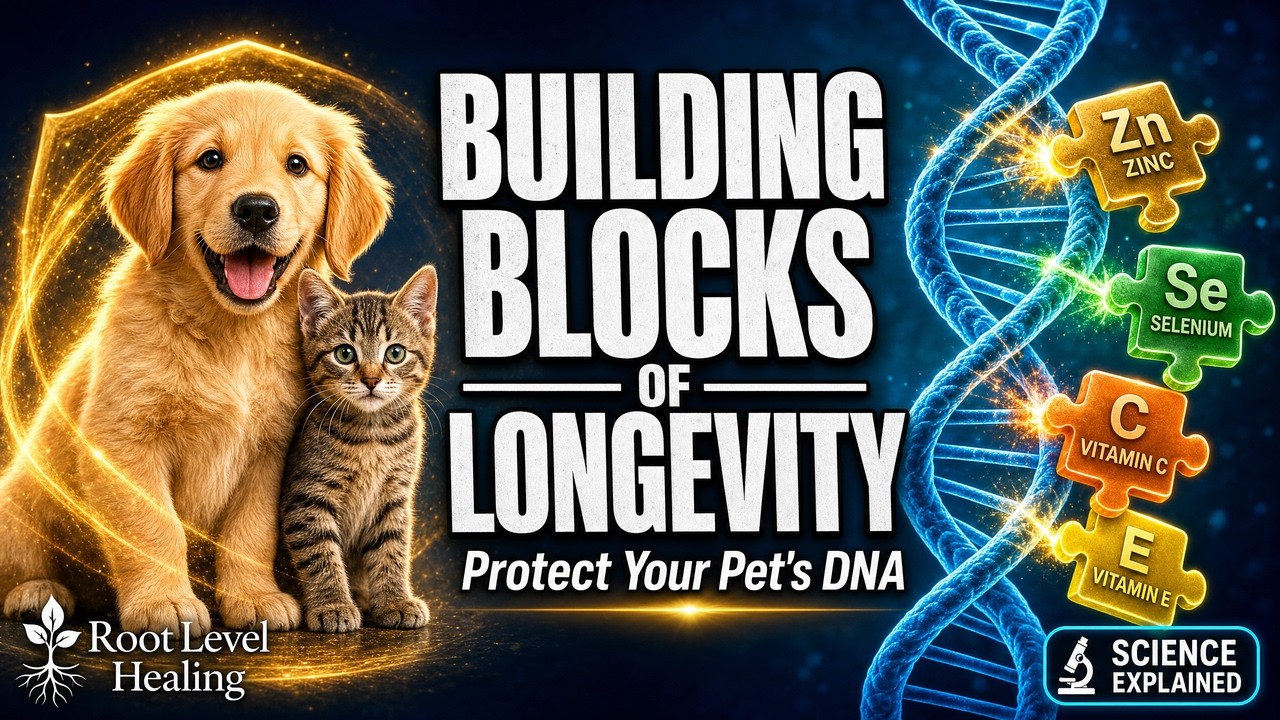
Before we dive deep into the science, watch this quick overview to understand exactly how these essential nutrients work together to defend your pet's cells.
In This Article:
- Trace Minerals: The Nuts and Bolts of DNA Repair
- The Antioxidant Network: Your Pet's Frontline Defense
- The Cellular Cleanup Crew: Removing Zombie Cells with Senolytics
- Dietary Sources vs. Supplementation: Why Food Alone Isn't Enough
- Nutrient Synergy: Why the Whole is Greater Than the Sum of its Parts
- Conclusion: Building a Foundation for Longevity
Trace Minerals: The Nuts and Bolts of DNA Repair
If DNA repair enzymes are the 'carpenters' of the cell, trace minerals are the hammers, nails, and saws they need to do their job. These minerals are essential cofactors, meaning they are 'helper molecules' that bind to enzymes and activate them. Without the correct mineral cofactor, a repair enzyme is like a carpenter with no tools—present, but useless. Several trace minerals are absolutely critical for maintaining genomic stability.
Zinc (Zn) is arguably the most important mineral for DNA integrity. It is required to activate over 300 different enzymes in the body, a huge number of which are involved in DNA synthesis, replication, and repair [1]. Beyond its role as an enzymatic cofactor, zinc plays a critical structural role in what are called 'zinc finger' proteins—specialized DNA-binding proteins that act like molecular clamps, holding DNA in the correct position so that repair enzymes can do their work. These zinc fingers are essential for reading genetic instructions accurately and for regulating which genes are turned on or off. A deficiency in zinc directly impairs the cell's ability to fix DNA damage, leading to an accumulation of errors that accelerates aging. In pets, zinc deficiency can manifest as poor coat quality, impaired wound healing, and a weakened immune response—all signs that cellular repair processes are struggling.
Selenium (Se) is a core component of some of the body's most powerful antioxidant enzymes, most notably glutathione peroxidase. This enzyme is a master scavenger of free radicals, neutralizing them before they can attack and damage DNA. Selenium acts as the catalytic center of this enzyme, making it a frontline defender of the genome. But selenium's role extends beyond antioxidant defense. It is also essential for proper thyroid hormone metabolism, which regulates your pet's metabolic rate and energy production. Additionally, selenium is required for the production of selenoproteins, a family of at least 25 different proteins that play diverse roles in immune function, inflammation control, and even cancer prevention. The challenge with selenium is that it has a narrow therapeutic window—too little leads to deficiency, but too much can be toxic. This is why a carefully formulated supplement is far superior to haphazard supplementation.
Copper (Cu) and Manganese (Mn) are crucial for protecting the mitochondria, the cell's powerhouses. They are required cofactors for the superoxide dismutase (SOD) family of enzymes—Cu for SOD1 in the cell's cytoplasm and Mn for SOD2 within the mitochondria. These enzymes disarm one of the most dangerous types of free radicals produced during energy generation, protecting both mitochondrial DNA and nuclear DNA from constant oxidative assault [2]. Copper also plays a vital role in the formation of collagen and elastin, the structural proteins that give tissues their strength and flexibility, and it is essential for proper iron metabolism. Manganese, on the other hand, is critical for bone formation, wound healing, and the metabolism of carbohydrates and amino acids. Importantly, copper and zinc must be kept in proper balance—too much of one can interfere with the absorption of the other. This delicate balance is another reason why a scientifically formulated supplement, rather than random individual minerals, is the best approach for comprehensive cellular support.
Key Insight: Trace minerals like Zinc, Selenium, Copper, and Manganese are not optional extras; they are essential cofactors that activate the very enzymes responsible for repairing damaged DNA and neutralizing the free radicals that cause the damage.

Trace minerals are the essential 'tools' that enable the cell's repair crew to fix DNA damage and defend against oxidative stress.
The Antioxidant Network: Your Pet's Frontline Defense
Every minute of every day, your pet's cells are bombarded by free radicals—unstable molecules that ricochet around the cell, damaging everything they touch, especially DNA. This process is called oxidative stress. To combat this, the body employs a sophisticated, multi-layered defense system of antioxidants. Vitamins C and E are two of the most important players in this network.
Vitamin E is a fat-soluble antioxidant, which means it integrates directly into the fatty layers of cell membranes. This positions it perfectly to be the first line of defense, stopping chain reactions of lipid peroxidation that can destabilize the entire cell and expose the DNA within the nucleus to harm.
Vitamin C is a water-soluble antioxidant, allowing it to work in the fluid parts of the cell, like the cytoplasm. One of its most critical roles is to 'recharge' or regenerate Vitamin E after it has neutralized a free radical. This creates a powerful synergistic cycle where Vitamin E protects the membranes and Vitamin C restores Vitamin E so it can fight again. This recycling process, which also involves the master antioxidant glutathione, is essential for sustained protection [3]. Without adequate Vitamin C, Vitamin E is quickly depleted, leaving cell membranes vulnerable.
Glutathione is often called the 'master antioxidant' because it is the most abundant antioxidant molecule in the cell and plays a central role in the entire antioxidant network. It not only neutralizes free radicals directly but also regenerates other antioxidants like Vitamin C, completing the recycling loop. Glutathione is synthesized within the cell from three amino acids: cysteine, glutamine, and glycine. However, its production declines with age, and it is heavily consumed during periods of high oxidative stress. Supporting glutathione levels through the provision of its building blocks, or through compounds that boost its synthesis, is a key strategy for maintaining cellular health. Additionally, other antioxidants like Coenzyme Q10 (CoQ10) play a specialized role in protecting the mitochondria, where the majority of free radicals are generated. CoQ10 is embedded in the mitochondrial membrane and acts as both an electron carrier in energy production and a powerful antioxidant, preventing oxidative damage at the source.
Key Insight: Vitamins C and E form a synergistic antioxidant network. Vitamin E provides frontline protection in cell membranes, while Vitamin C regenerates Vitamin E, creating a continuous defense system that shields DNA from oxidative damage.

The antioxidant network is a recycling system where Vitamin C recharges Vitamin E, providing constant protection against free radicals.
The Cellular Cleanup Crew: Removing Zombie Cells with Senolytics
Sometimes, a cell's DNA becomes so damaged that it enters a state of irreversible growth arrest called senescence. These 'zombie cells' stop dividing but refuse to die. Instead, they linger, secreting a cocktail of inflammatory proteins (known as the Senescence-Associated Secretory Phenotype, or SASP) that damages surrounding healthy tissue and creates a pro-aging environment [4]. The SASP includes a wide array of harmful molecules, including pro-inflammatory cytokines like IL-6 and IL-8, matrix metalloproteinases that break down the structural scaffolding of tissues, and growth factors that can promote abnormal cell proliferation. This toxic secretion doesn't just stay local—it can spread inflammation throughout the body, accelerating aging in distant tissues and organs. The accumulation of these zombie cells is a major driver of age-related decline, contributing to everything from arthritis and cognitive dysfunction to weakened immunity and reduced tissue regeneration capacity.
So, how do we get rid of them? The answer lies in a class of compounds called senolytics. Senolytics are remarkable molecules that can selectively induce apoptosis (programmed cell death) in senescent cells while leaving healthy cells unharmed. One of the most well-researched natural senolytics is Quercetin.
Quercetin is a flavonoid found in many plants, such as apples and onions. It has been shown to act as a potent senolytic by inhibiting the pro-survival pathways that allow zombie cells to resist death. Specifically, quercetin targets proteins like BCL-2 and BCL-xL, which are overexpressed in senescent cells and act as 'survival switches' that prevent apoptosis. By blocking these pathways, quercetin tips the balance in favor of programmed cell death, but only in cells that are already senescent—healthy cells are left unharmed. By helping to clear out these dysfunctional, inflammatory cells, quercetin effectively reduces the overall burden of aging on tissues, allowing healthy cells to function properly and promoting a more youthful cellular environment. It's the biological equivalent of taking out the trash, preventing it from piling up and causing problems. Research has shown that senolytic interventions can improve physical function, extend healthspan, and even reverse some age-related pathologies in animal models.
Key Insight: The natural compound Quercetin acts as a senolytic, or 'cellular cleanup crew,' by selectively targeting and removing inflammatory 'zombie' cells that accumulate with age, thereby reducing a major source of age-related tissue damage.

Quercetin helps clear out dysfunctional 'zombie' cells, reducing inflammation and allowing healthy tissue to thrive.
Dietary Sources vs. Supplementation: Why Food Alone Isn't Enough
A common question pet owners ask is: "Can't I just provide these nutrients through a high-quality diet?" The answer is nuanced. While a nutritious, whole-food diet is absolutely foundational and should never be neglected, achieving therapeutic levels of all these protective nutrients through food alone is extremely challenging, especially for senior pets or those facing health challenges.
Let's consider some examples. Zinc is found in meat, shellfish, and legumes, but its bioavailability—the amount that is actually absorbed and used by the body—varies widely depending on the food source and the presence of other dietary factors. Phytates, which are common in plant-based foods, can bind to zinc and prevent its absorption. Selenium content in food depends heavily on the selenium content of the soil where the food was grown, which varies dramatically by region. Some areas have selenium-rich soil, while others are deficient. Quercetin is present in apples, onions, and berries, but onions are toxic to pets, and the amount of quercetin in a few apple slices is far below the therapeutic dose shown to have senolytic effects in research studies.
Moreover, the aging process itself impairs nutrient absorption. Senior pets often have reduced digestive enzyme production, lower stomach acid, and compromised gut barrier function, all of which decrease the efficiency of nutrient uptake from food. Additionally, the modern pet food supply chain—processing, storage, and cooking—can degrade heat-sensitive vitamins like Vitamin C and reduce the bioavailability of minerals. Even the highest-quality commercial pet foods are formulated to meet minimum nutritional requirements for general health, not to provide the elevated, therapeutic doses of specific nutrients needed to actively combat cellular aging and DNA damage.
This is where targeted supplementation becomes essential. A well-formulated supplement can provide precise, therapeutic doses of bioavailable nutrients in the optimal ratios and forms. For example, using chelated minerals (minerals bound to amino acids) dramatically improves absorption compared to inorganic mineral salts. Providing NAD+ precursors like NMN in a supplement ensures a direct, potent boost that no food source can match. Supplementation is not about replacing a good diet—it's about augmenting it, filling the gaps, and providing the extra support that aging cells desperately need to maintain their repair and defense systems. Think of food as the foundation and supplements as the reinforcement that makes the structure truly resilient.
Key Insight: While a high-quality diet is foundational, achieving therapeutic levels of DNA-protective nutrients through food alone is nearly impossible, especially for senior pets. Targeted supplementation provides precise, bioavailable doses that work synergistically to support cellular health in ways that diet cannot.
Nutrient Synergy: Why the Whole is Greater Than the Sum of its Parts
It's tempting to think of these nutrients as individual solutions, but their true power lies in their synergy. The cellular ecosystem is complex and interconnected. Providing just one nutrient is like trying to build a house with only a hammer—you need the full toolkit. A comprehensive approach that leverages nutrient synergy is far more effective.
| Nutrient Category | Primary Role | How it Synergizes with Others |
|---|---|---|
| NAD+ Precursors (e.g., NMN) | Provides Cellular Energy (ATP) | Fuels the DNA repair enzymes that are activated by trace minerals. |
| Trace Minerals (Zn, Se, Cu) | Activates Repair Enzymes | Act as the 'spark plugs' for the repair machinery that runs on NAD+ energy. |
| Antioxidants (Vitamins C & E) | Neutralizes Free Radicals | Reduces the amount of DNA damage that needs to be repaired, preserving NAD+ stores. |
| Senolytics (Quercetin) | Removes Damaged Cells | Reduces the inflammatory burden caused by zombie cells, creating a healthier environment for other nutrients to work in. |
This is the essence of a multi-faceted longevity strategy. NAD+ provides the energy, trace minerals activate the machinery, antioxidants run defense to lessen the workload, and senolytics clean up the mess. When all these components are present and working together, the cell has everything it needs to defend its DNA and maintain youthful function for as long as possible.
Key Insight: True cellular protection comes from nutrient synergy. NAD+ (energy), trace minerals (tools), antioxidants (defense), and senolytics (cleanup) work together as a team. A comprehensive formula is exponentially more powerful than isolated ingredients.

Nutrient synergy creates a powerful, multi-layered defense system for your pet's cells.
Conclusion: Building a Foundation for Longevity
Across this three-part series, we've journeyed deep into the cell to understand the root causes of aging at the most fundamental level. In Part 1, we uncovered how DNA damage—caused by oxidative stress, environmental toxins, and normal metabolic processes—is the primary driver of cellular aging, not just a consequence of it. In Part 2, we revealed the devastating impact of NAD+ decline, showing how the loss of this critical coenzyme creates a cellular energy crisis that cripples DNA repair, silences longevity genes, and accelerates mitochondrial dysfunction. And now, in Part 3, we've explored the essential nutrients—trace minerals, antioxidants, and senolytics—that provide the tools, defenses, and cleanup mechanisms necessary to support the entire system.
The picture is now complete. Aging is not a mysterious, inevitable decline. It is a biological process driven by identifiable, interconnected mechanisms: DNA damage accumulates, NAD+ levels plummet, repair machinery falters, oxidative stress overwhelms defenses, and senescent cells spread inflammation. But here's the empowering truth: each of these mechanisms can be addressed. We've learned that you can't just address one piece of the puzzle in isolation—a truly effective longevity strategy requires a holistic, multi-faceted approach.
Protecting your pet's DNA and cellular health isn't about a single magic bullet or a trendy superfood. It's about providing the body with a complete, synergistic toolkit. It's about ensuring the cellular repair crew has the energy (NAD+ precursors), the tools (trace minerals as enzymatic cofactors), a robust defense system (a network of antioxidants), and a clean, inflammation-free work environment (thanks to senolytics that remove zombie cells). When all these building blocks are in place and working together, you are giving your pet's body the best possible chance to combat aging at its most fundamental level, promoting not just a longer life, but a healthier, more vibrant one.
The science is clear. The mechanisms are understood. The nutrients are identified. But the challenge for most pet owners is this: how do you translate this complex science into a practical, daily solution? How do you ensure your pet is getting the right nutrients, in the right forms, at the right doses, in the right ratios, all working together synergistically? That's the question we'll answer in our final article, where we introduce the groundbreaking formula that was meticulously designed from the ground up to address every single aspect we've discussed in this series—a comprehensive, all-in-one solution to defend your pet's vitality and longevity from the inside out. Stay tuned.
Final Takeaway: A truly effective longevity strategy requires a synergistic approach. By providing the essential building blocks—minerals for repair, vitamins for defense, and senolytics for cleanup—you create a foundation that empowers the body to maintain its own youthful function and protect its genetic blueprint.
Frequently Asked Questions
Q: What are the most important nutrients for DNA protection in pets?
A: Key nutrients for DNA protection include trace minerals like Zinc, Selenium, Copper, and Manganese, which act as cofactors for repair enzymes; antioxidants like Vitamins C and E, which neutralize DNA-damaging free radicals; and senolytic compounds like quercetin, which help clear out damaged cells.
Q: How do trace minerals help with DNA repair?
A: Trace minerals are essential 'helper molecules' or cofactors for the enzymes that carry out DNA repair. For example, Zinc is required by over 300 enzymes, many of which are involved in DNA replication and repair. Without adequate minerals, the cellular repair machinery cannot function effectively.
Q: What is a senolytic and how does quercetin work?
A: A senolytic is a compound that can selectively induce apoptosis (programmed cell death) in senescent, or 'zombie,' cells. Quercetin, a natural flavonoid, acts as a senolytic by targeting these damaged cells that accumulate with age and release inflammatory signals, helping to 'clean up' the cellular environment without harming healthy cells.
Q: Can I just give my pet a regular multivitamin?
A: While a general multivitamin can be beneficial, they often lack the specific therapeutic doses of key nutrients needed for advanced DNA protection. For example, they may not contain senolytics like quercetin or the optimal forms and ratios of trace minerals required to support the complex enzymatic processes of DNA repair.
Q: Is it better to get these nutrients from food or supplements?
A: A high-quality diet is foundational, but it's very difficult to achieve therapeutic levels of all these nutrients through food alone, especially for senior pets or those with health challenges. Supplementation ensures a consistent, potent, and synergistic dose of these compounds, directly supporting cellular health in a way that diet often cannot.
Q: What are senescent cells?
A: Senescent cells, often called 'zombie cells,' are cells that have stopped dividing due to damage or stress but refuse to die. They accumulate with age and secrete a cocktail of inflammatory proteins (known as SASP) that can damage surrounding healthy tissues and accelerate the aging process.
Q: How does nutrient synergy work?
A: Nutrient synergy means that the combined effect of multiple nutrients working together is greater than the sum of their individual effects. For example, Vitamin C helps regenerate Vitamin E, while trace minerals activate the enzymes that NAD+ precursors provide energy for. A comprehensive formula leverages this synergy for maximum benefit.
Q: Are these nutrients safe for both dogs and cats?
A: Yes, the nutrients discussed—trace minerals, essential vitamins, and compounds like quercetin—are fundamental to the cellular health of both dogs and cats. However, it is crucial to use products specifically formulated for pets to ensure proper dosing, purity, and safety, as some human supplements can be harmful.
Q: How do these nutrients relate to NAD+?
A: These nutrients are the 'tools' and NAD+ is the 'energy' to power them. Trace minerals are required by the DNA repair enzymes (PARPs) that are fueled by NAD+. Antioxidants reduce the oxidative stress that contributes to DNA damage, lessening the burden on NAD+-consuming repair processes. They work as a team.
Q: How soon can I expect to see results from supplementation?
A: Cellular benefits begin immediately, but visible improvements in a pet's energy, coat quality, and overall vitality often become noticeable within 4 to 8 weeks of consistent supplementation. The goal is long-term foundational support, leading to a healthier lifespan over time.
References
- Prasad, A. S. (2008 ). Zinc in human health: effect of zinc on immune cells. Molecular medicine, 14(5-6), 353–357. https://link.springer.com/article/10.2119/2008-00033.Prasad
- Fransson, A., Ruus, P., & Öckerman, P. A. (1980 ). Superoxide dismutases in human leukocytes. Acta medica Scandinavica, 208(1‐2), 79-81. https://pmc.ncbi.nlm.nih.gov/articles/PMC333107/
- Traber, M. G., & Stevens, J. F. (2011 ). Vitamins C and E: beneficial effects from a mechanistic perspective. Free Radical Biology and Medicine, 51(5), 1000-1013. https://www.sciencedirect.com/science/article/abs/pii/S0891584911003194
- Kirkland, J. L., & Tchkonia, T. (2020 ). Senolytic drugs: from discovery to translation. Journal of internal medicine, 288(5), 518-536. https://pubmed.ncbi.nlm.nih.gov/32686219/

Ready to Discover Your Score?
This 2-minute quiz is the essential first step to understanding your body's current toxic load and identifying the root cause of how you feel.
Take The Toxicity QuizExplore More Articles
Dive deeper into topics like detoxification, gut health, and mental clarity on our blog. Knowledge is the key to taking control of your health.
Visit The Blog