
Leaky Gut Causes and Signs: What the Research Says About Gut Support
If you've ever looked up "leaky gut," you've probably noticed it's one of the most searched gut-health phrases online, and also one of the most confusing. Some sources treat it as the root of almost every symptom; others dismiss it entirely. The truth sits in between. When people search for leaky gut causes, what researchers are actually studying is called increased intestinal permeability: a change in how much the lining of the gut lets through.
In this article, we'll explain what the term means, what the research links to increased permeability, why the signs people associate with it are so varied, how scientists measure it, and the everyday habits that support a healthy gut lining. If you've read our earlier article on the 3 surprising signs of leaky gut, think of this as the next chapter.
Key Takeaways
- What it is: "leaky gut" is a popular name for increased intestinal permeability, which researchers can measure. It is not a medical condition with agreed criteria of its own.
- What research links to it: regular use of some pain relievers, heavy alcohol use, intense physical stress, psychological stress and a diet low in fiber have all been connected with changes in the gut barrier.
- Why the signs vary: the symptoms people associate with it are common to many conditions, so persistent symptoms deserve a proper medical look.
- What helps day to day: fiber-rich, varied food, moderate alcohol, stress care and sleep support the gut lining, alongside advice from your doctor.
In This Article:
What "Leaky Gut" Means
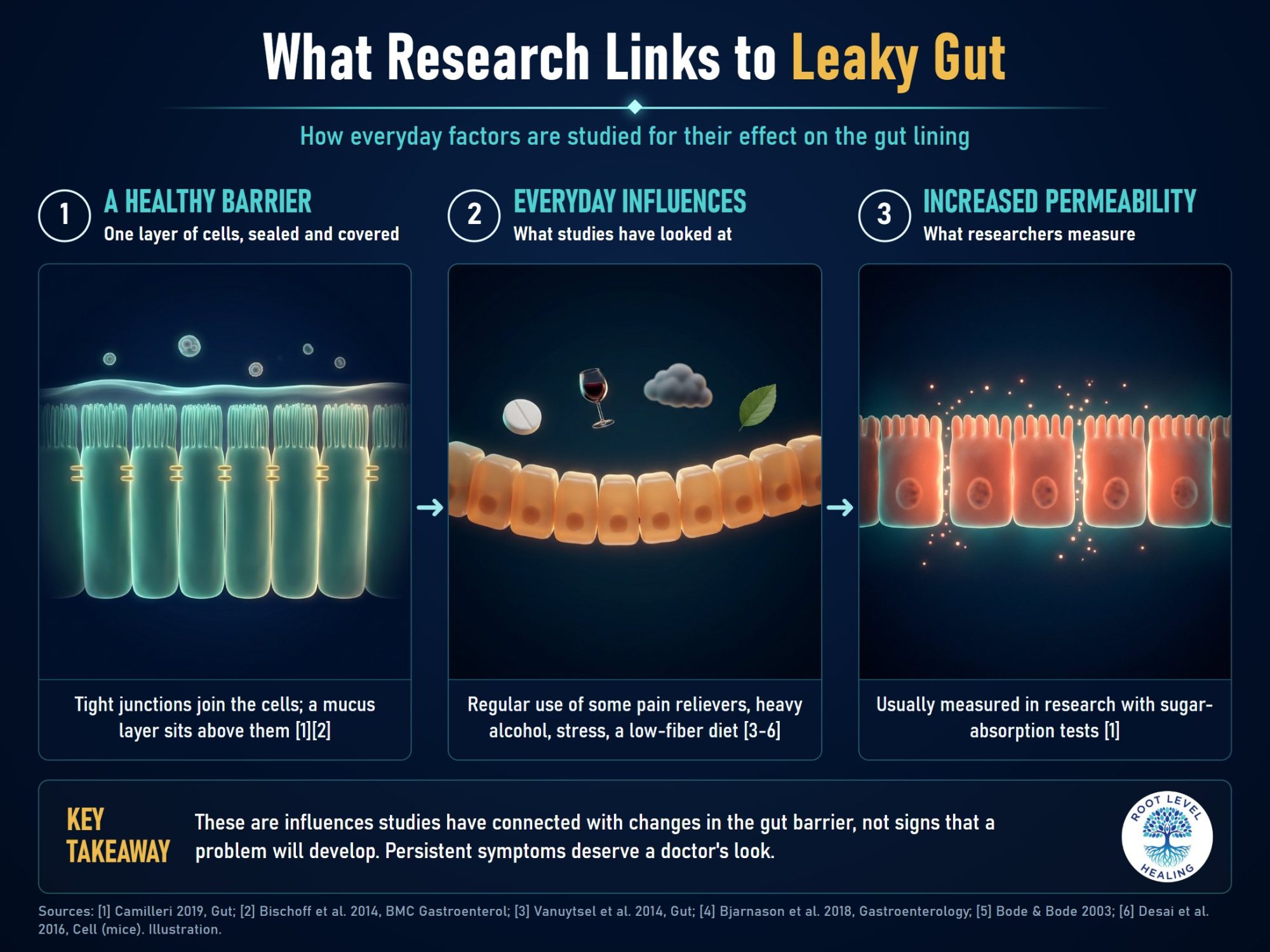
Your intestines are lined with a single layer of cells, held together by protein complexes called tight junctions. Above that layer sits a coat of mucus, and below it a large part of the immune system. Together these form the intestinal barrier: a gatekeeper that lets water and nutrients through while keeping most bacteria and larger molecules out [1] [2].
It helps to separate two ideas that researchers keep apart: the barrier (the physical and immune structures) and permeability (how easily substances pass through it, which can be measured). "Increased intestinal permeability" describes a barrier that lets more through than usual. Some permeability is normal and changes from day to day; the questions research is exploring are when it becomes meaningful, and what drives it [2].
Increased permeability has been observed in people with several digestive and immune-related conditions. What remains unclear in most cases is whether it is a cause, a consequence, or simply something that travels alongside them [1]. That's why "leaky gut" isn't recognized as a stand-alone medical condition, even though the underlying biology is real and actively studied.
Leaky Gut Causes: What the Research Links to Increased Permeability
When people ask about leaky gut causes, the research points to several everyday factors. None of them means a problem will develop; they are influences that studies have connected with changes in the gut barrier.
Regular use of some pain relievers
Non-steroidal anti-inflammatory drugs (NSAIDs) such as ibuprofen and naproxen are well known to affect the stomach, but they can also affect the small intestine. Reviews describe how they can increase intestinal permeability, particularly with regular use [4]. If you take them often, talk to your doctor about it; never change a medicine your doctor has prescribed without their advice.
Heavy alcohol use
Alcohol and its breakdown products can disturb the cells and tight junctions of the gut lining. Studies have found increased intestinal permeability in people who drink heavily [5].
Psychological stress
The gut and the brain are in constant communication. In a study of healthy volunteers, the stress of preparing for a public speech increased small-intestinal permeability, through a stress hormone (corticotropin-releasing hormone) acting on immune cells in the gut wall [3].
Intense physical stress
Very strenuous exercise, especially in the heat, has been linked with temporary changes in gut permeability. For most people who exercise moderately this isn't a concern, and regular activity is part of a healthy routine [2].
A diet low in fiber
Fiber feeds gut bacteria. In a study in mice, gut bacteria deprived of dietary fiber began to feed on the protective mucus layer of the colon instead, thinning the barrier [6]. This was an animal study, so it can't tell us exactly what happens in people, but it's one reason researchers emphasize fiber for gut-barrier health.
| Everyday factor | What research has found | Study type |
|---|---|---|
| Regular use of some pain relievers (NSAIDs) | Can increase small-intestinal permeability [4] | Review of human studies |
| Heavy alcohol use | Increased permeability in people who drink heavily [5] | Review of human studies |
| Psychological stress | Public-speech stress raised permeability in healthy volunteers [3] | Human study |
| Intense physical stress | Temporary changes with very strenuous exercise, especially in the heat [2] | Review |
| A diet low in fiber | Fiber-deprived gut bacteria thinned the colon's mucus layer [6] | Animal study (mice) |
 (opens a larger view)
These are influences studies have connected with changes in the gut barrier, not signs that a problem will develop.
Why the Signs Are So Varied
Bloating, fatigue, food sensitivities, skin changes and brain fog are often listed as signs of leaky gut. Our article on the surprising signs of leaky gut explores why gut health can show up far from the gut. I want to be clear about one thing, though: these symptoms are common, and many different conditions can cause them.
That's exactly why a list of symptoms can't tell you whether your gut barrier is the issue. If symptoms are persistent, getting worse, or affecting your daily life, the most useful next step is a conversation with a doctor who can look at the whole picture.
How Researchers Measure Intestinal Permeability
In research settings, permeability is usually measured with sugar-absorption tests. A person drinks a solution of sugars that are normally poorly absorbed, such as lactulose and mannitol, and the amounts that later appear in the urine show how much passed through the gut wall [1].
Other approaches measure substances in the blood that reflect the barrier. A review in the journal Gut describes these methods and notes that results can vary with the method, the timing and the person, which is one reason permeability testing is mainly used in research rather than in routine care [1]. If you're considering a commercial gut test, it's worth discussing with your doctor what it can and can't tell you.
 (opens a larger view)
Permeability testing is mainly a research tool; results vary with the method, the timing and the person.
Everyday Habits That Support the Gut Lining
The habits that support the gut barrier are the same ones that support gut health in general. None of them is a quick fix, and they work best together:
- Eat a variety of plant foods. Vegetables, fruit, beans, whole grains, nuts and seeds provide the fiber your gut bacteria feed on. Our article on three foods for gut health is a good starting point.
- Keep alcohol moderate. Less is better for the gut lining [5].
- Review regular pain-reliever use with your doctor. They can help you find the right approach for your situation [4].
- Make room for stress care. Walking, breathing exercises, time outdoors or anything that genuinely calms you down supports the gut-brain connection [3].
- Prioritize sleep. Regular, sufficient sleep is part of every healthy routine and supports how you handle stress.

A varied spread of plant foods provides the fiber your gut bacteria feed on.
Our Gut Health & Microbiome guide brings these habits together into a step-by-step plan, and the Toxicity Score Quiz is a free educational self-assessment that can help you see where to start. It's an educational tool only, and it doesn't replace a visit to your doctor.
When to Talk to a Doctor
See a doctor promptly if you notice blood in your stool, unexplained weight loss, ongoing diarrhea, severe or worsening abdominal pain, difficulty swallowing, or symptoms that wake you at night. These are signs that need a proper medical assessment, whatever the underlying reason turns out to be.
For milder, ongoing symptoms, a doctor or a registered dietitian can help you work out what's going on, from food intolerances to medication effects, and build a plan that fits you.
References
- Camilleri, M. (2019). Leaky gut: mechanisms, measurement and clinical implications in humans. Gut, 68(8), 1516–1526. https://doi.org/10.1136/gutjnl-2019-318427
- Bischoff, S. C., Barbara, G., Buurman, W., et al. (2014). Intestinal permeability – a new target for disease prevention and therapy. BMC Gastroenterology, 14, 189. https://doi.org/10.1186/s12876-014-0189-7
- Vanuytsel, T., van Wanrooy, S., Vanheel, H., et al. (2014). Psychological stress and corticotropin-releasing hormone increase intestinal permeability in humans by a mast cell-dependent mechanism. Gut, 63(8), 1293–1299. https://doi.org/10.1136/gutjnl-2013-305690
- Bjarnason, I., Scarpignato, C., Holmgren, E., et al. (2018). Mechanisms of damage to the gastrointestinal tract from nonsteroidal anti-inflammatory drugs. Gastroenterology, 154(3), 500–514. https://doi.org/10.1053/j.gastro.2017.10.049
- Bode, C., & Bode, J. C. (2003). Effect of alcohol consumption on the gut. Best Practice & Research Clinical Gastroenterology, 17(4), 575–592. https://doi.org/10.1016/S1521-6918(03)00034-9
- Desai, M. S., Seekatz, A. M., Koropatkin, N. M., et al. (2016). A dietary fiber-deprived gut microbiota degrades the colonic mucus barrier and enhances pathogen susceptibility. Cell, 167(5), 1339–1353. https://doi.org/10.1016/j.cell.2016.10.043
Frequently Asked Questions
Q: What is leaky gut?
A: "Leaky gut" is a popular name for increased intestinal permeability, a change in how much the lining of the gut lets through. The gut lining is a single layer of cells held together by tight junctions and covered by mucus. Researchers can measure permeability, but leaky gut is not recognized as a medical condition with agreed criteria of its own.
Q: What are the most common leaky gut causes?
A: Research has linked increased intestinal permeability with regular use of some pain relievers (NSAIDs), heavy alcohol use, psychological stress, very intense exercise, and a diet low in fiber. These are influences that studies have connected with changes in the gut barrier, not signs that a problem will develop.
Q: What are the signs of leaky gut?
A: Bloating, fatigue, food sensitivities, skin changes and brain fog are often mentioned. These symptoms are common to many different conditions, so a list of symptoms cannot tell you whether your gut barrier is involved. If symptoms are persistent, worsening or affecting daily life, talk to a doctor who can look at the whole picture.
Q: Can leaky gut be tested?
A: In research settings, yes: permeability is usually measured with sugar-absorption tests such as lactulose and mannitol, along with some blood markers. Results vary with the method and the person, so these tests are mainly used in research rather than routine care. If you're considering a commercial gut test, ask your doctor what it can and can't tell you.
Q: What everyday habits support the gut lining?
A: A varied, fiber-rich diet with plenty of plant foods, moderate alcohol, regular stress care, enough sleep, and reviewing regular pain-reliever use with your doctor all support gut health in general. These habits work best together and over time. Our Gut Health and Microbiome guide brings them together into a step-by-step plan.
Q: When should I see a doctor about gut symptoms?
A: See a doctor promptly for blood in your stool, unexplained weight loss, ongoing diarrhea, severe or worsening abdominal pain, difficulty swallowing, or symptoms that wake you at night. For milder ongoing symptoms, a doctor or registered dietitian can help you work out the cause and build a plan that fits you.
This article is part of our gut health and microbiome guide.

Ready to Discover Your Score?
This 2-minute quiz is the essential first step to understanding your body's current toxic load and identifying the root cause of how you feel.
Take The Toxicity QuizExplore More Articles
Dive deeper into topics like detoxification, gut health, and mental clarity on our blog. Knowledge is the key to taking control of your health.
Visit The Blog