Lion's Mane Mushroom and Lucid Dreaming: The REM Sleep Connection
If you spend enough time in biohacking forums or functional mushroom communities, you will inevitably stumble across a peculiar side effect of taking Lion's Mane (Hericium erinaceus). People who start taking it for memory or focus often report an unexpected secondary benefit: their dreams suddenly become incredibly vivid, highly memorable, and in many cases, completely lucid.
I experienced this firsthand. When I began using a high-quality Lion's Mane tincture to support my cognitive function and clear up brain fog, I noticed a dramatic shift in my sleep architecture. Not only was I remembering three or four distinct dreams every morning, but I was frequently achieving lucidity—the state of being consciously aware that you are dreaming while the dream is happening.
This is not a placebo effect, nor is it a mystical property of the mushroom. It is the result of a highly specific, well-documented neurochemical cascade. Lion's Mane alters the cholinergic system in the brain, directly impacting the neurotransmitters that govern our Rapid Eye Movement (REM) sleep.
In this fourth installment of our Lion's Mane series, we are diving into the fascinating science of sleep neurobiology to understand exactly how this brain-rebuilding mushroom unlocks the door to lucid dreaming.
Key Takeaways
- The Acetylcholine Link: Lion's Mane stimulates Nerve Growth Factor (NGF), which maintains the cholinergic neurons responsible for producing acetylcholine—the primary neurotransmitter that drives REM sleep.
- REM Sleep Density: Higher acetylcholine levels during sleep lead to longer REM cycles, increased dream vividness, and significantly better dream recall upon waking.
- Lucid Dreaming Potential: By enhancing cholinergic activity, Lion's Mane biases the brain toward "top-down" goal-directed responses, making it easier to recognize you are dreaming while asleep.
- Timing Matters: For dream enhancement, taking a high-quality dual-extracted Lion's Mane tincture in the evening or during a "Wake Back to Bed" (WBTB) protocol yields the best results.
Lion's Mane Mushroom and Lucid Dreaming: The REM Sleep & Acetylcholine Connection (A Quick Overview)
Before we dive deep into the science, watch this quick overview explaining how Lion's Mane stimulates NGF and the cholinergic system to enhance REM sleep, vivid dreams, and lucid dreaming.

In This Article:
The Strange Phenomenon of Lion's Mane Dreams
To understand why a mushroom can change the nature of your dreams, we first have to understand what drives the dream state itself. Dreaming occurs primarily during REM sleep, a phase characterized by rapid eye movements, muscle atonia (temporary paralysis to prevent you from acting out your dreams), and a brain wave pattern that looks surprisingly similar to being awake.
The switch that flips your brain into REM sleep is located in the brainstem, specifically in a cluster of cells called the pedunculopontine tegmentum (PPT) and the laterodorsal tegmentum (LDT). These cells are cholinergic neurons, meaning they produce and release the neurotransmitter acetylcholine (ACh).
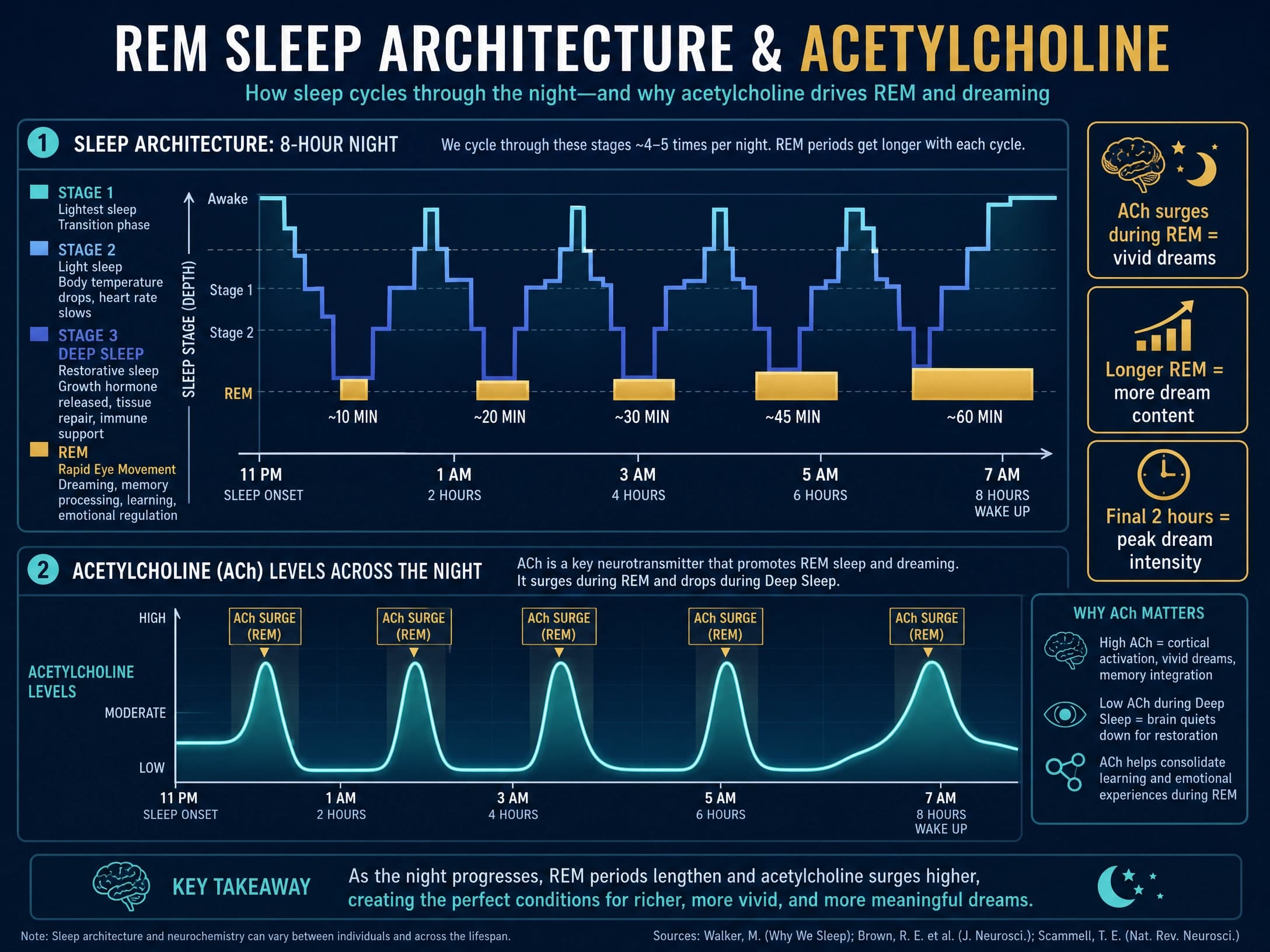
Acetylcholine levels drop during deep slow-wave sleep but surge dramatically during REM sleep, driving the vivid imagery and narrative structure of our dreams.
The Architecture of REM Sleep and Acetylcholine
Acetylcholine is the master conductor of the dream state. When you enter REM sleep, acetylcholine levels in the brain surge. This surge activates the visual cortex and the emotional centers of the brain (like the amygdala), generating the vivid imagery and intense feelings we experience in dreams [1].
At the same time, acetylcholine suppresses the release of other neurotransmitters, particularly serotonin and norepinephrine. This unique neurochemical environment—high acetylcholine, low serotonin/norepinephrine—is what allows the bizarre, unconstrained logic of dreams to unfold without waking you up.
The rule of thumb in sleep science is simple: Higher acetylcholine tone during sleep equals longer REM periods, greater REM density (more rapid eye movements per minute), and significantly more vivid, memorable dreams.
The NGF Connection: How Lion's Mane Alters Sleep
So, how does Lion's Mane fit into this picture? As we explored in Part 1 of this series, the unique compounds in Lion's Mane—hericenones from the fruiting body and erinacines from the mycelium—are the only known natural substances capable of crossing the blood-brain barrier to stimulate the synthesis of Nerve Growth Factor (NGF).
While we often talk about NGF in the context of memory and peripheral nerve repair, NGF plays a highly specific and critical role in the cholinergic system. NGF is absolutely essential for the survival, maintenance, and function of cholinergic neurons in the basal forebrain and brainstem [2].
When Lion's Mane stimulates NGF production, it directly supports the health and activity of the neurons responsible for producing acetylcholine. Furthermore, research indicates that NGF regulates the key enzymes involved in both the synthesis and degradation of acetylcholine within these neurons [3].
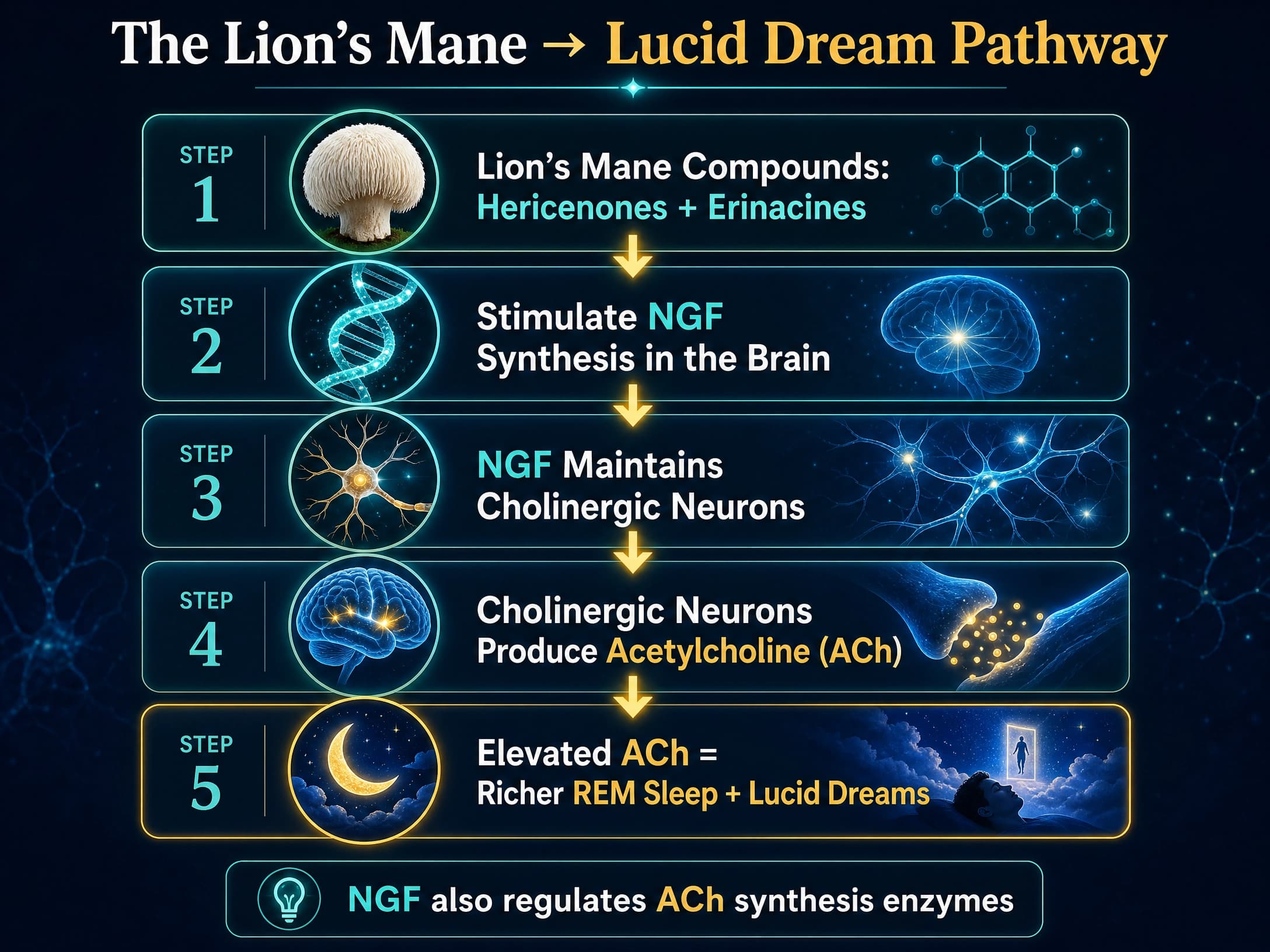
The biological pathway from Lion's Mane ingestion to enhanced dream recall relies entirely on the upregulation of the cholinergic system via Nerve Growth Factor.
By taking a potent, dual-extracted Lion's Mane supplement, you are effectively providing the neurotrophic support necessary to optimize your brain's acetylcholine production. When night falls and your brain transitions into REM sleep, this optimized cholinergic system is capable of producing a more robust acetylcholine surge, leading to the vivid, highly structured dreams so many users report.
The Science of Cholinergic Lucid Dreaming
Vivid dreams are one thing, but lucid dreaming—the metacognitive state of knowing you are dreaming while the dream is happening—requires something more. It requires a specific region of the prefrontal cortex (the dorsolateral prefrontal cortex, or DLPFC) to remain partially active during REM sleep. This is the region responsible for self-awareness, working memory, and metacognition.
To achieve lucidity, that prefrontal area must "wake up" while the rest of the brain remains in REM sleep. Science has proven that elevating acetylcholine is the most reliable pharmacological method for triggering this awakening.
In a landmark 2018 double-blind, placebo-controlled study published in PLOS One, Dr. Stephen LaBerge (the pioneer of lucid dream research) tested the effects of Galantamine on lucid dreaming [4]. Galantamine is an acetylcholinesterase inhibitor (AChEI)—a drug that stops the breakdown of acetylcholine, causing it to accumulate in the brain.
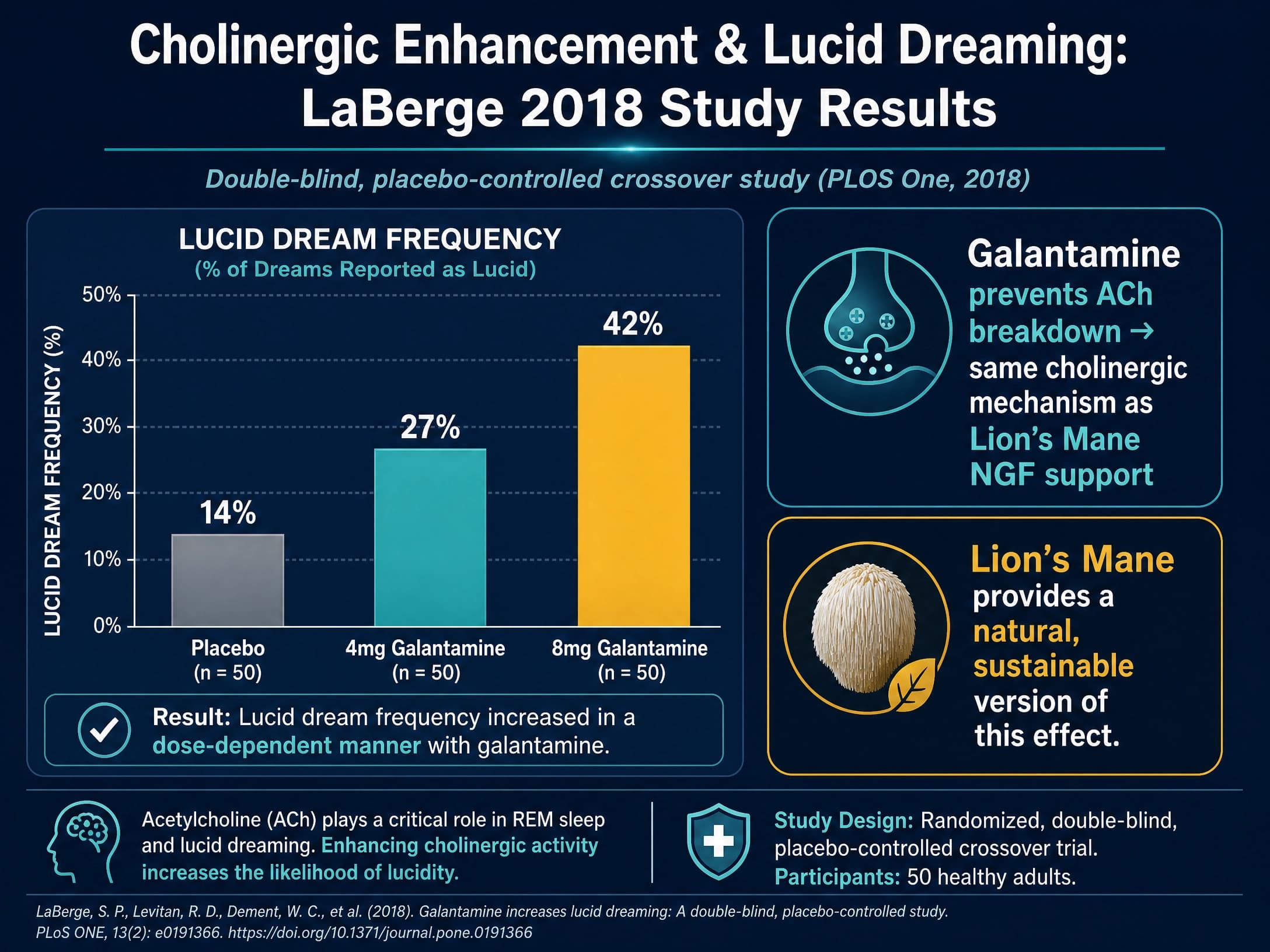
The LaBerge study proved that artificially elevating acetylcholine levels dramatically increases the probability of achieving metacognitive awareness (lucidity) during REM sleep.
The results were staggering. Participants taking a placebo had a 14% chance of having a lucid dream. Those taking 4mg of Galantamine saw their chances jump to 27%. Those taking 8mg achieved a 42% lucid dream rate. The researchers concluded that the accumulation of acetylcholine not only increased REM density but also biased the brain's attention toward "top-down goal-directed responses"—meaning the dreamers were able to remember their intention to recognize they were dreaming.
While Lion's Mane is not a direct AChEI drug like Galantamine, its ability to upregulate the cholinergic system via NGF provides a gentler, natural, and sustainable way to achieve a similar neurochemical environment. It primes the brain with the acetylcholine capacity needed to bridge the gap between normal dreaming and conscious lucidity.
How to Use Lion's Mane for Dream Enhancement
If you are interested in exploring the dream-enhancing properties of Lion's Mane, timing and extraction quality are everything. Because you are trying to influence the cholinergic system during sleep, how and when you take the mushroom matters.
1. Choose a Dual-Extracted Tincture
To get the dream-enhancing benefits, you must consume both the hericenones (from the fruiting body) and the erinacines (from the mycelium). Erinacines are particularly potent stimulators of NGF, but they are alcohol-soluble. A simple hot-water extract powder will leave these crucial compounds behind. You need a dual-extracted (water and alcohol) tincture that utilizes both the mycelium and the fruiting body.
2. The Evening Dose
While many people take Lion's Mane in the morning for focus, taking a dose 1 to 2 hours before bed allows the active compounds to cross the blood-brain barrier just as your brain is preparing for its nightly sleep cycles. A 2021 in vivo study demonstrated that Hericium erinaceus mycelium actually ameliorates anxiety and improves sleep disruptions by modulating dopamine and BDNF alongside NGF [5], making it an excellent pre-sleep supplement.
3. The "Wake Back to Bed" (WBTB) Protocol
If your primary goal is lucid dreaming, you can combine Lion's Mane with the WBTB method used in the Galantamine studies. REM sleep periods get progressively longer as the night goes on, with the longest and most intense REM cycles occurring in the final two hours of sleep.
- Set an alarm for 4.5 to 5 hours after you go to sleep.
- Wake up, stay out of bed for 10 to 15 minutes, and take your dose of Lion's Mane tincture.
- Go back to sleep with the strong mental intention to recognize you are dreaming.
This protocol delivers the neurotrophic compounds exactly when your brain is entering its peak REM phase, maximizing the cholinergic surge and the potential for lucidity.
In the final post of this series, we will review the specific dual-extracted Lion's Mane tincture that I personally use for cognitive enhancement, nerve support, and dream recall, and explain why the extraction method makes all the difference.
Frequently Asked Questions
Q: Will Lion's Mane keep me awake if I take it at night?
A: For most people, no. Unlike caffeine or traditional stimulants, Lion's Mane does not stimulate the central nervous system in a way that prevents sleep. In fact, clinical studies show it can reduce anxiety and improve sleep quality. However, a small percentage of people find the increase in brain activity too engaging for sleep. If you fall into this category, take it in the morning instead.
Q: Can Lion's Mane cause nightmares?
A: Because Lion's Mane increases dream vividness and recall, any dream you have will feel more intense. If you are prone to nightmares or are processing significant trauma, those dreams may become more vivid. However, the mushroom itself does not inherently cause "bad" dreams; it simply turns up the volume on whatever your subconscious is already processing.
Q: How long does it take to notice changes in dreaming?
A: Unlike the long-term nerve repair benefits which can take weeks or months, the effects on dreaming are often acute. Many users report a significant increase in dream recall and vividness within the first 3 to 5 days of taking a high-quality extract, particularly if taken before bed.
Q: Is Lion's Mane as strong as Galantamine for lucid dreaming?
A: No. Galantamine is a pharmaceutical-grade acetylcholinesterase inhibitor that forces a massive, unnatural accumulation of acetylcholine. It is highly effective but can cause sleep disruption and tolerance buildup. Lion's Mane works upstream by supporting the health of the cholinergic neurons via NGF. It is a gentler, natural, and sustainable approach that enhances your baseline dream recall without the harsh side effects of a drug.
Q: What is the best time to take Lion's Mane for dream enhancement?
A: For dream enhancement specifically, taking a dual-extracted Lion's Mane tincture 1 to 2 hours before bed allows the active compounds to cross the blood-brain barrier as your brain prepares for sleep. For advanced lucid dreaming, the Wake Back to Bed (WBTB) protocol — waking after 4.5 to 5 hours of sleep, taking your dose, then returning to sleep with a lucid dreaming intention — is the most effective approach, as it delivers the compounds during your peak REM phase.
References
- Fraigne, J. J., et al. (2015). REM Sleep at its Core — Circuits, Neurotransmitters, and Neuromodulation. Frontiers in Neurology. https://pmc.ncbi.nlm.nih.gov/articles/PMC4448509/
- Li, I. C., et al. (2018). Neurotrophic and Neuroprotective Effects of Hericium erinaceus. International Journal of Molecular Sciences. https://pmc.ncbi.nlm.nih.gov/articles/PMC10650066/
- Sabaratnam, V., et al. (2013). Neuronal Health — Can Culinary and Medicinal Mushrooms Help? Journal of Traditional and Complementary Medicine. https://pmc.ncbi.nlm.nih.gov/articles/PMC3924982/
- LaBerge, S., LaMarca, K., & Baird, B. (2018). Pre-sleep treatment with galantamine stimulates lucid dreaming: A double-blind, placebo-controlled, crossover study. PLOS One. https://pmc.ncbi.nlm.nih.gov/articles/PMC6082533/
- Li, T. J., et al. (2021). Hericium erinaceus mycelium ameliorate anxiety induced by continuous sleep disturbance in vivo. BMC Complementary Medicine and Therapies. https://pmc.ncbi.nlm.nih.gov/articles/PMC8643634/

Ready to Discover Your Score?
This 2-minute quiz is the essential first step to understanding your body's current toxic load and identifying the root cause of how you feel.
Take The Toxicity QuizExplore More Articles
Dive deeper into topics like detoxification, gut health, and mental clarity on our blog. Knowledge is the key to taking control of your health.
Visit The Blog