A Beginner's Guide to Natural Heavy Metal Detox
You’ve connected the dots. The persistent brain fog, the chronic fatigue, the unexplained aches—you realize they might not be random. You suspect that an accumulation of heavy metals could be the root cause, and now you’re asking the most important question: "What can I do about it?"
This guide provides a clear, step-by-step approach to help you start your natural heavy metal detox journey safely and effectively.
Key Takeaways
- 🚫Start by Reducing Exposure: The most crucial first step is to minimize incoming toxins from your water, food, and environment.
- 🥦Support Natural Pathways: Focus on a diet rich in detox-supporting foods (like broccoli and garlic) and lifestyle habits like hydration and sweating.
- 🧲Binders are Essential: To safely remove deeply stored toxins, a systemic binder is necessary to prevent recirculation and a "healing crisis."
- 🏃Detox is a Marathon: True detoxification is a long-term journey, not a quick fix. Start gently and be consistent.
How to Detox Your Body Naturally: A Beginner's Guide
Before we dive deep into this beginner's natural detox guide, watch this quick overview.
In This Guide, You'll Learn:
Phase 1: Reduce Your Exposure (Stop Filling the Tub)
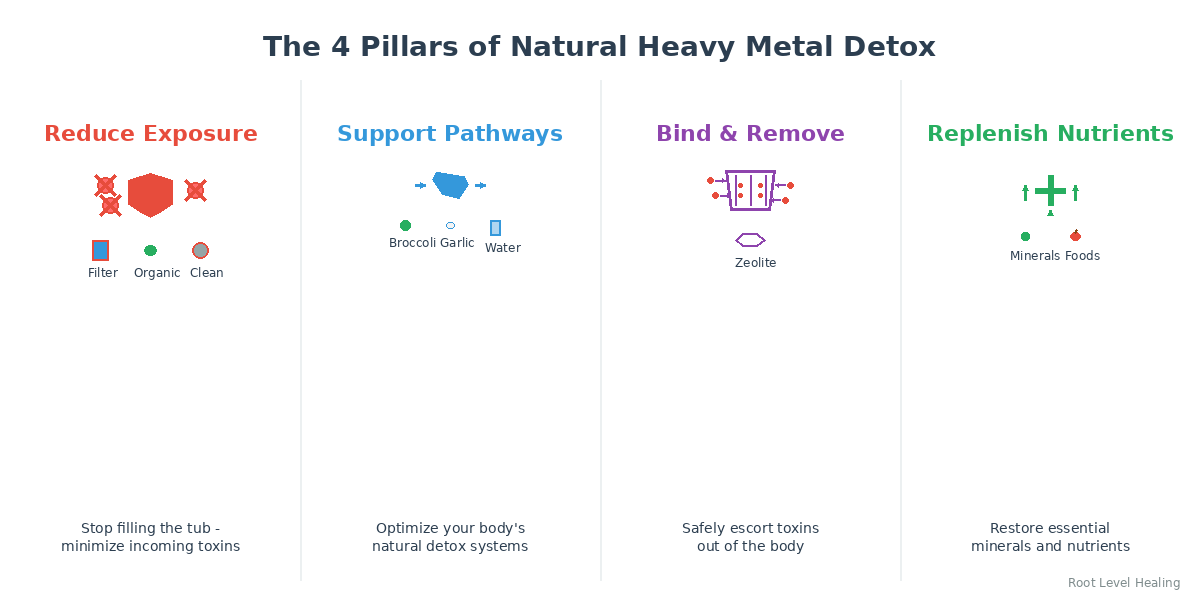
You can't empty a bathtub while the faucet is still running full blast. The first and most critical step in any detox is to minimize the toxins coming in. This reduces the burden on your body and allows its healing mechanisms to catch up.
- Filter Your Water:Municipal water can be a significant source of lead, arsenic, chlorine, and fluoride. Research shows that while standard activated carbon (AC) filters have limited effectiveness against most metals, reverse osmosis (RO) systems can remove over 95% of common heavy metals like lead and arsenic from drinking water [1].
- Choose Your Food Wisely: Opt for organic produce whenever possible to avoid pesticides like glyphosate, which can hinder detox. Be mindful of large, predatory fish (like tuna, swordfish, and shark) as they are often high in mercury.
- Check Your Cookware: Avoid non-stick cookware (Teflon), which can release perfluorinated chemicals (PFCs) when heated. Also, minimize the use of aluminum foil for cooking. Opt for safer materials like cast iron, stainless steel, glass, or ceramic.
- Evaluate Your Personal Care Products: Many conventional deodorants contain aluminum. Cosmetics, lotions, and sunscreens can contain parabens, phthalates, and other chemicals. Switch to natural, non-toxic brands by checking resources like the EWG Skin Deep database.
- Improve Your Indoor Air Quality: Use HEPA air purifiers to filter out mold spores, dust, and volatile organic compounds (VOCs) from furniture and cleaning products. Open windows daily to circulate fresh air.
Phase 2: Support Your Body's Natural Detox Pathways
Once you've reduced your toxic input, you can focus on helping your body's primary detox organs—the liver, kidneys, gut, and skin—do their job more effectively.
Dietary Support: The Foundation of Detox
Your diet is your primary tool for detoxification. Focus on incorporating these foods:
- Cruciferous Vegetables: Broccoli, cauliflower, kale, and Brussels sprouts contain a powerful compound called sulforaphane. Sulforaphane is a potent activator of the Nrf2 pathway, which is like a master switch that turns on hundreds of protective genes, including those responsible for detoxification enzymes in the liver [2].
- Alliums (Garlic and Onions): These are rich in organosulfur compounds, which are essential for the production of glutathione, your body's master antioxidant. Glutathione binds to heavy metals and other toxins, neutralizing them and preparing them for elimination. Studies show that compounds in garlic and onions can significantly boost glutathione levels and support liver function [3].
- Cilantro and Parsley: While more research is needed for definitive proof in humans, some studies suggest that cilantro (Coriandrum sativum) may help mobilize heavy metals from tissues. One study noted that cilantro prevented the localized placement of lead in bone, suggesting a chelating effect [4]. It is best used in conjunction with a binder to ensure the mobilized metals are safely removed.
- Berries and Leafy Greens: Packed with antioxidants, these foods help protect your cells from the oxidative stress that toxins can cause.
- Plenty of Fiber: Soluble and insoluble fiber from sources like psyllium husk, flax seeds, and vegetables is crucial for binding to toxins in the digestive tract and ensuring they are eliminated through regular bowel movements.
Lifestyle Support: Daily Habits for a Cleaner Body
- Hydration is Non-Negotiable: Drink plenty of purified, mineral-rich water throughout the day. Water is essential for flushing toxins out through your kidneys and bowels. Aim for at least half your body weight in ounces of water daily.
- Sweat It Out: Your skin is a major detox organ. Regular exercise that induces sweat, sessions in an infrared sauna, or hot Epsom salt baths can help you eliminate toxins through your skin.
- Prioritize Deep Sleep: Your brain has its own unique cleansing process (the glymphatic system) that is most active while you sleep. Aim for 7-9 hours of quality sleep per night in a dark, cool room to allow your body to repair and detoxify.
- Practice Mindful Movement: Gentle movement like yoga or rebounding (jumping on a mini-trampoline) can stimulate your lymphatic system, which acts like your body's garbage disposal service, helping to move toxic waste out of your tissues.
Phase 3: Introduce Advanced Support with Binders
While diet and lifestyle changes are the foundation, they often aren't enough to deal with a lifetime of accumulated toxins, especially those lodged deep in your tissues and across the blood-brain barrier. This is where a dedicated binding agent becomes essential.
The Root Level Healing Perspective: Why Binders are a Game-Changer
A "binder" is a substance that can travel through the body, attract, and trap toxins like heavy metals through a natural ionic charge, holding onto them until they are safely escorted out of the body. While foods like cilantro can help mobilize metals, you need a powerful binder to safely catch and remove them. Without an effective binder, mobilized metals can simply recirculate and settle in other parts of your body, making you feel even worse—a common issue known as a "healing crisis" or Herxheimer reaction.
This is why we recommend a breakthrough formula like Clean Slate. It uses a proprietary form of Zeolite Clinoptilolite—a natural volcanic mineral renowned for its cage-like structure and negative charge. This structure is perfectly designed to trap positively-charged toxins like lead, mercury, and glyphosate, working systemically and safely without placing extra strain on your detox organs.
Learn More About Clean Slate 🔎Common Detox Mistakes to Avoid
- Aggressive Detoxing Too Soon: Jumping into intense chelation or juice fasts without first supporting your detox pathways can lead to severe side effects. Always start with gentle support.
- Forgetting to Replenish Minerals: The detoxification process can sometimes deplete essential minerals along with the toxins. It's crucial to replenish with a good quality, full-spectrum mineral supplement.
- Ignoring the Gut: If you are constipated, you are not detoxing; you are re-absorbing toxins. Ensuring daily bowel movements is a prerequisite for any successful detox protocol.
Frequently Asked Questions
Q: What are the symptoms of a "healing crisis" or detox reaction?
A: A detox reaction (Herxheimer reaction ) can occur when toxins are mobilized faster than the body can eliminate them. Symptoms can include headache, fatigue, body aches, skin breakouts, and moodiness. This is a sign to slow down, increase your hydration and binder dosage, and ensure your drainage pathways (gut, kidneys, skin) are open.
Q: How long should I detox for?
A: True detoxification from a lifetime of exposure is a marathon, not a sprint. The initial, intensive phase might last for several months, but the principles of reducing exposure and supporting your body's pathways should become a permanent part of your lifestyle for long-term health.
Q: Can children detox?
A: Yes, and it is often crucial as children are more vulnerable to the effects of toxins. However, any detox protocol for children should be done with extreme care and under the guidance of a knowledgeable healthcare practitioner, using gentle, safe, and age-appropriate methods.
Ready to Start Your Healing Journey?
Understanding your body's current state is the first step. Our free 2-minute quiz can help you assess your potential toxic load and provide clarity on your personal path to healing.
Take the Free Toxicity QuizReferences
- Yu, H. Y., Gupta, S., & Zhou, Z. (2024 ). Removal of metals and assimilable organic carbon by activated carbon and reverse osmosis point-of-use water filtration systems. Chemosphere, 365, 143251. https://www.sciencedirect.com/science/article/abs/pii/S0045653524021490
- Houghton, C. A., Fassett, R. G., & Coombes, J. S. (2016 ). Sulforaphane and Other Nutrigenomic Nrf2 Activators: Can the Clinician's Expectation Be Matched by the Reality?. Oxidative medicine and cellular longevity, 2016, 7857186. https://pubmed.ncbi.nlm.nih.gov/26881038/
- Bianchini, F., & Vainio, H. (2001 ). Allium vegetables and organosulfur compounds: do they help prevent cancer?. Environmental health perspectives, 109(9), 893–902. https://pubmed.ncbi.nlm.nih.gov/11673117/
- Mehrandish, R., Rahimian, A., & Shahriary, A. (2019 ). Heavy metals detoxification: A review of herbal compounds for chelation therapy in heavy metals toxicity. Journal of Herbmed Pharmacology, 8(2), 69-77. https://herbmedpharmacol.com/Article/jhp-9359

Ready to Discover Your Score?
This 2-minute quiz is the essential first step to understanding your body’s current toxic load and identifying the root cause of how you feel.
Take The Toxicity QuizExplore More Articles
Dive deeper into topics like detoxification, gut health, and mental clarity on our blog. Knowledge is the key to taking control of your health.
Visit The Blog