Orthosilicic Acid: The Silicon Secret to Stronger, More Resilient Skin
In the quest for youthful, vibrant skin, we often focus on surface-level solutions—hydrating creams, protective sunscreens, and potent antioxidants. These are all vital components of a healthy skincare regimen. But what if the secret to truly resilient, age-defying skin lies deeper? What if the most profound strength comes not from what we put on our skin, but from what we use to build it from within?
This is where silicon, a crucial but often overlooked trace mineral, enters the conversation. It is a foundational building block for all connective tissues, providing the essential framework that gives our skin its structure and youthful bounce. However, not all silicon is created equal. For the body to harness its power, it must be in a specific, bioavailable form: Orthosilicic Acid (OSA).
This article will explore the pivotal role of OSA in building stronger, more resilient skin from the inside out. We will examine its direct impact on collagen production, the scientific evidence supporting its benefits, and why bioavailability is the key to unlocking silicon’s true potential for profound, structural skin health.
Key Takeaways
- 💎Essential Mineral: Silicon is a vital trace mineral essential for the health and structural integrity of skin, hair, nails, and bones.
- 🧬Collagen Synthesis: Orthosilicic Acid (OSA) directly stimulates fibroblasts, the skin's collagen factories, to increase the production of Type I collagen.
- 🚀Superior Absorption: OSA is the most bioavailable form of silicon, meaning it is easily absorbed and utilized by the body, unlike many other silicon sources.
- 🔬Clinical Research: In a small 90-day trial (22 people), ortho-silicic acid stabilized with marine collagen improved clinician-rated skin texture, firmness and hydration compared with placebo [3].
- 🏗️Structural Support: By reinforcing the skin's collagen framework, OSA helps create a stronger, firmer, and more resilient dermal structure.
Orthosilicic Acid (OSA): The Silicon Secret to Stronger Skin & Collagen (A Quick Overview)
Before we dive deep into the science, watch this quick overview to discover how Orthosilicic Acid (OSA)—the highly bioavailable form of silicon—acts as the essential "steel rebar" for your skin, directly stimulating collagen production and building resilience from within.
In This Article:
Silicon: The Unsung Hero of Structural Health
When we think of essential minerals for our health, names like calcium, magnesium, and iron often come to mind. Yet, silicon, the third most abundant trace element in the human body, plays an equally critical role, acting as the unsung hero of our structural integrity. It is found in high concentrations in all connective tissues, including bones, cartilage, and, most importantly for our appearance, the skin.
Unfortunately, silicon levels in the body, particularly within the dermis, naturally and significantly decline with age. This depletion is directly correlated with many of the visible signs of aging we strive to combat: reduced skin thickness, loss of elasticity, and the formation of fine lines and wrinkles. As our internal silicon reserves diminish, the structural framework of our skin begins to weaken.
To understand its importance, it’s helpful to use an analogy. Think of building a concrete structure. While cement, sand, and water are the main components, it is the hidden network of steel rebar that provides the essential tensile strength and prevents the structure from crumbling under stress. In the human body, silicon acts like that rebar. It provides the foundational framework and strength that other critical components, like collagen, elastin, and glycosaminoglycans, build upon to create a firm, resilient, and hydrated dermal matrix [1].
The Collagen Connection: How OSA Builds Stronger Skin
Collagen is the most abundant protein in our skin, making up roughly 80% of its dry weight. It is the primary component of the dermis, providing the structural scaffolding that keeps skin firm, plump, and smooth. As we age, collagen production slows down, and existing collagen fibers begin to break down, leading to sagging and wrinkles. This is where Orthosilicic Acid makes its most profound impact.
OSA works by directly stimulating the skin’s collagen factories: the fibroblast cells located in the dermis. Scientific research has shown that physiological concentrations of OSA directly signal these cells to ramp up the synthesis of new Type I collagen, the most prevalent and structurally important type in our skin [2]. It essentially acts as a key, turning on the machinery that builds the very foundation of youthful skin.
Going a level deeper, the mechanism involves a critical enzymatic process. Silicon is an essential cofactor for the enzyme prolyl hydroxylase. This enzyme is indispensable for the formation and stabilization of the collagen triple helix structure—the strong, rope-like configuration that gives collagen its incredible tensile strength. Without sufficient silicon, this process becomes inefficient, resulting in weaker, less stable collagen. By ensuring an adequate supply of bioavailable silicon, OSA empowers the body to produce not just *more* collagen, but *stronger* and more resilient collagen, directly counteracting the age-related degradation of the dermal matrix.
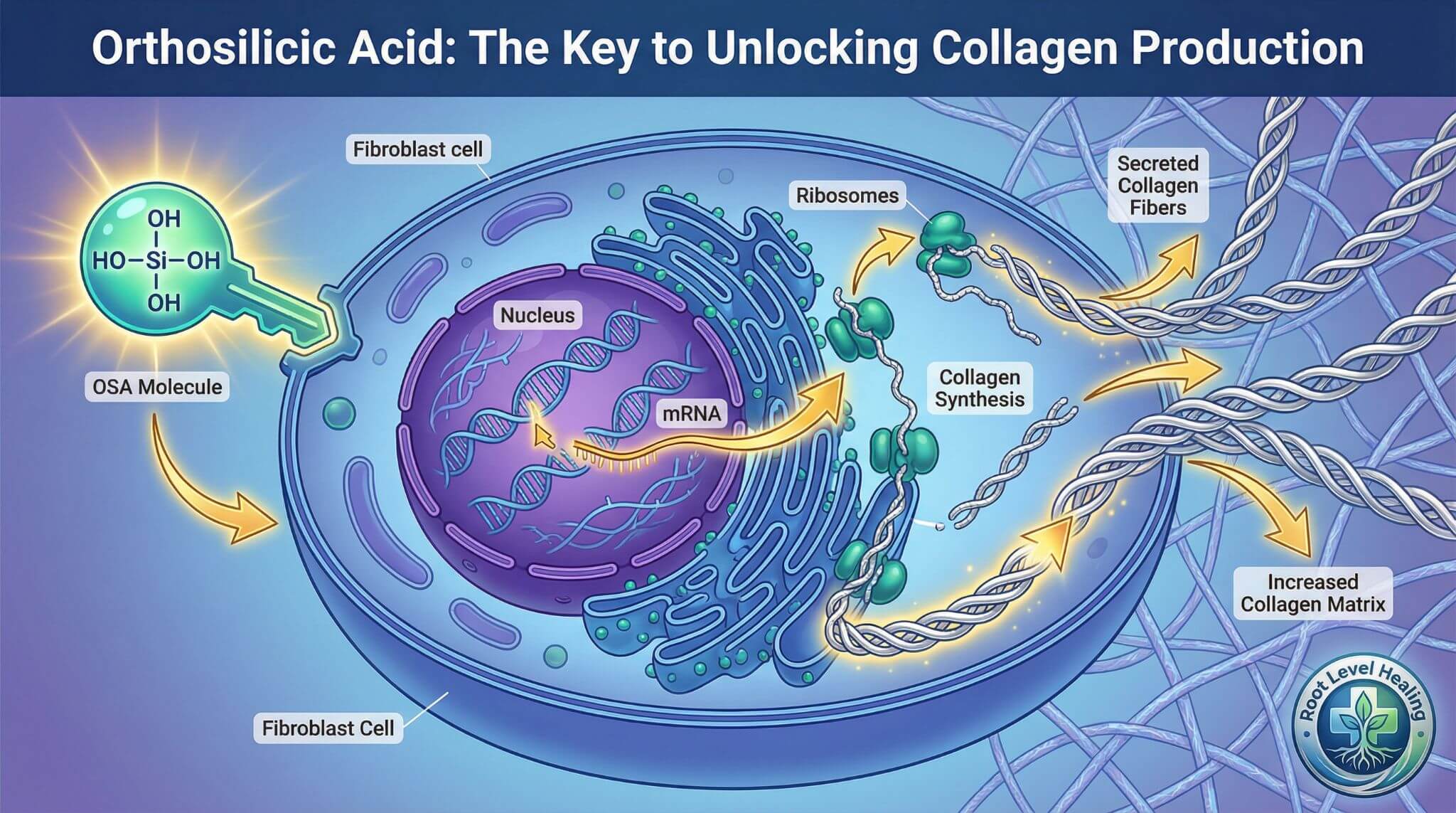
Orthosilicic Acid acts as a biological key, signaling fibroblast cells to increase the synthesis of Type I collagen, which strengthens the skin’s dermal matrix.
Not All Silicon is Created Equal: The Bioavailability Breakthrough
While silicon is abundant in nature, found in everything from sand to certain plants, its form dictates whether our bodies can actually use it. The vast majority of silicon in nature and in common supplements exists as silica (silicon dioxide) or silicates. These are long, polymerized chains of silicon molecules that are very large and poorly soluble, making them extremely difficult for the body to absorb.
This is the bioavailability challenge. You can consume plenty of silicon, but if it’s not in the right form, it will simply pass through your system without providing any benefit. This is where Orthosilicic Acid (Si(OH)4) represents a monumental breakthrough. OSA is the simple, monomeric (single-molecule) form of silicon that is water-soluble and readily absorbed by the gastrointestinal tract and, ultimately, by our cells.
Comparing sources makes the difference clear. The bioavailability of silicon from mineral sources like silica can be less than 1-5%. Plant sources, such as the popular herb horsetail, are slightly better, but still only offer moderate absorption, typically in the range of 5-15%. In stark contrast, stabilized Orthosilicic Acid boasts a bioavailability of nearly 50%, making it exponentially more effective at delivering usable silicon to the body’s tissues [1]. To ensure this high bioavailability, OSA must be stabilized (e.g., with a compound like choline) to prevent it from polymerizing back into non-absorbable chains before it can be utilized.
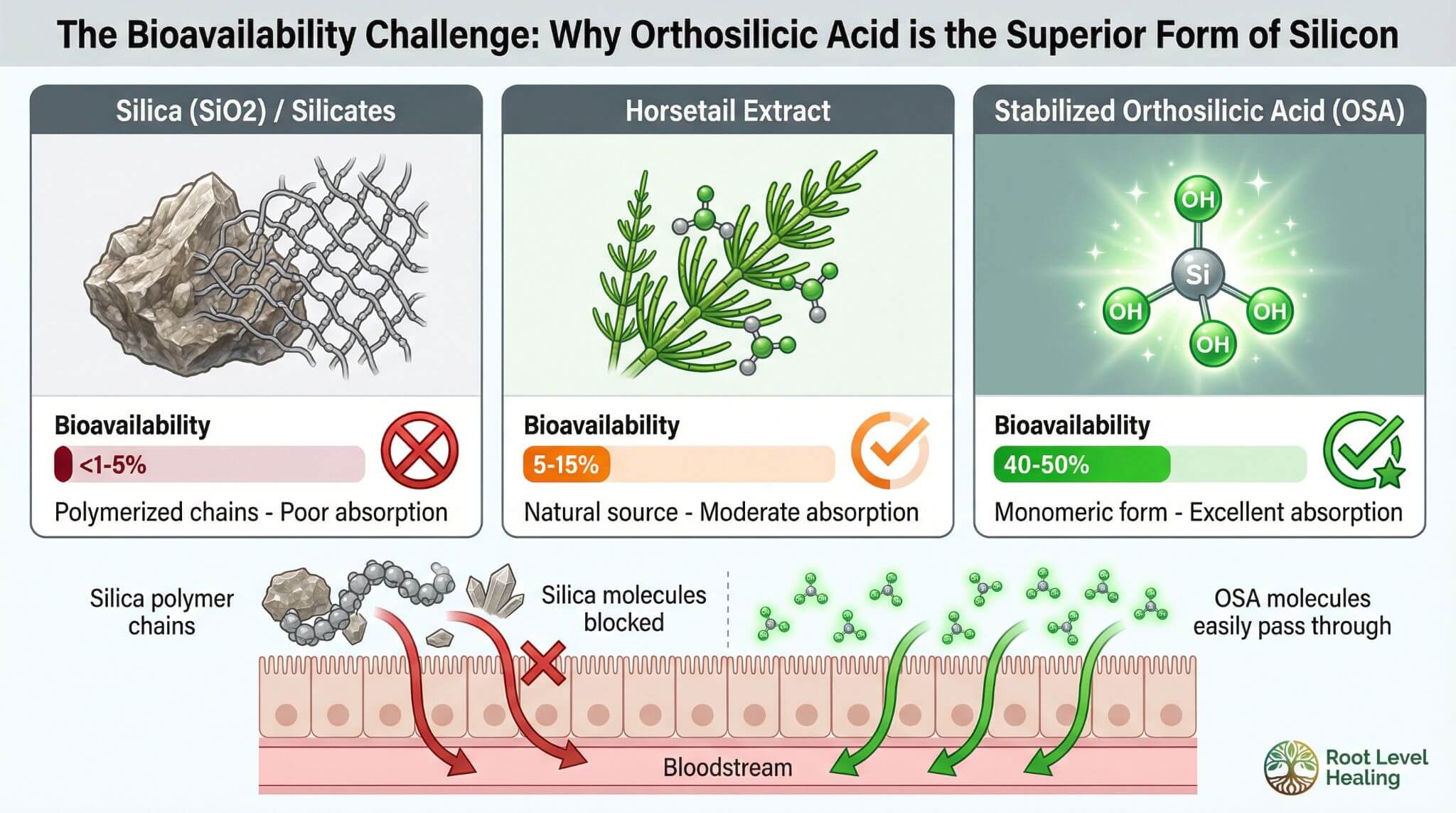
The bioavailability of silicon varies dramatically by its chemical form. Stabilized Orthosilicic Acid (OSA) is the most effective form for absorption, far surpassing common sources like silica and horsetail.
The Clinical Evidence for Skin Health
The theoretical benefits of Orthosilicic Acid are strongly supported by human clinical trials demonstrating its real-world efficacy for skin rejuvenation. Multiple studies have documented measurable improvements in skin health following supplementation with stabilized OSA.
Key findings from this body of research consistently point to statistically significant improvements across several key metrics of skin aging. Participants in these studies have shown a marked reduction in skin roughness and wrinkle depth, enhanced skin elasticity and firmness, and improved skin hydration. One pivotal study highlighted significant positive results in overall cutaneous rejuvenation, confirming OSA’s role in promoting a more youthful skin appearance [3].
Furthermore, these studies often reveal secondary benefits that underscore silicon’s foundational role in all keratinous structures. Participants frequently report a noticeable reduction in hair brittleness and a significant improvement in nail strength, with less fragility and splitting. This holistic effect confirms that bioavailable silicon works systemically to reinforce the structural integrity of not just the skin, but hair and nails as well.
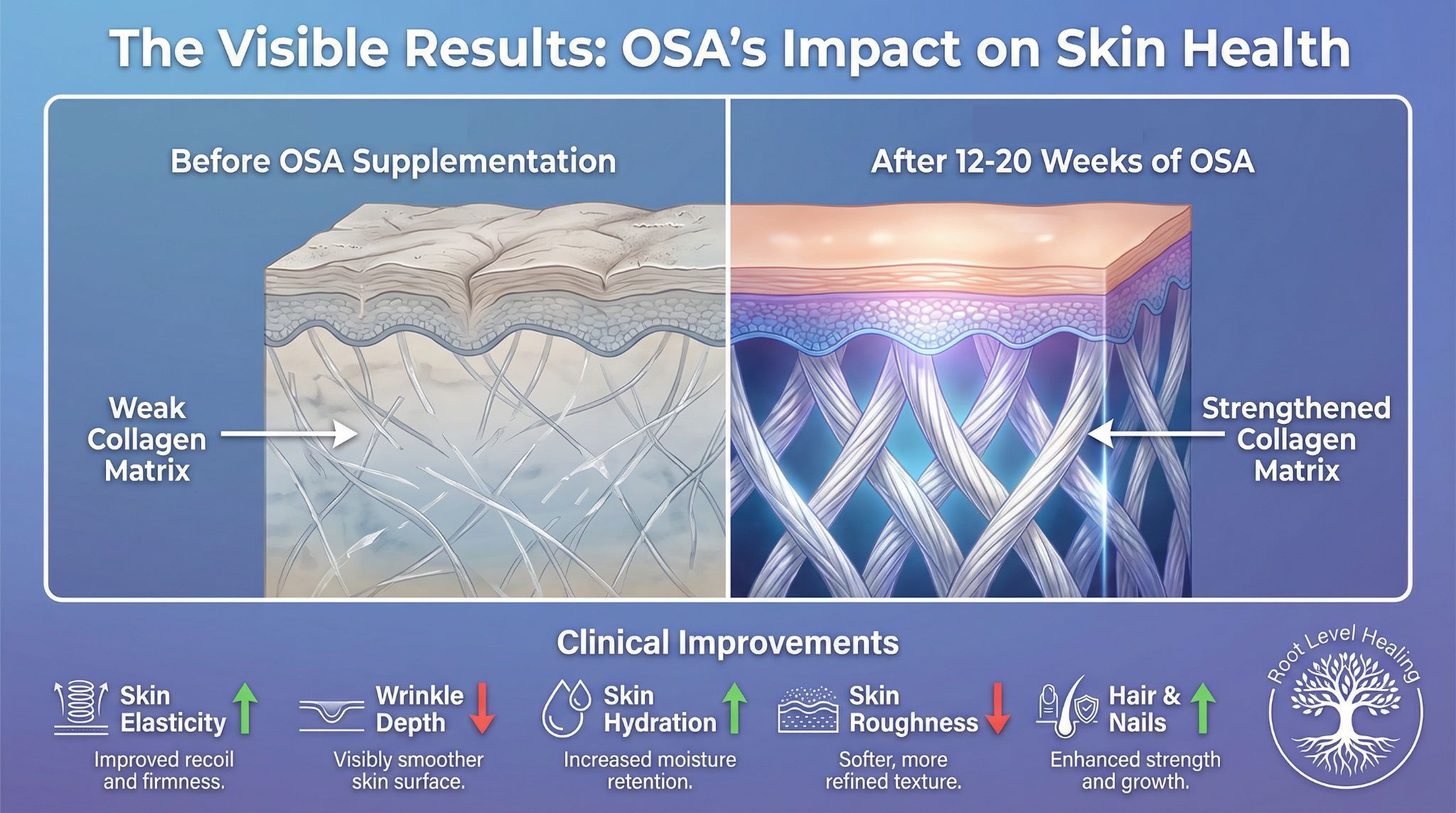
Clinical studies demonstrate measurable improvements in skin elasticity, hydration, and collagen density after 12-20 weeks of Orthosilicic Acid supplementation, with additional benefits to hair and nail strength.
Conclusion: Building Resilience from Within
Orthosilicic Acid is not just another trendy ingredient; it is a fundamental building block that empowers the skin to rebuild and reinforce its own structural framework. By directly stimulating collagen synthesis and providing the essential silicon needed for strong, stable connective tissue, OSA addresses the root cause of age-related structural decline.
This internal approach to skin health works in perfect synergy with the protective measures discussed in our previous article. While Hypochlorous Acid provides an active, antimicrobial shield on the surface, Orthosilicic Acid works from within to ensure the very structure being protected is strong, dense, and resilient. It’s a comprehensive, two-pronged strategy for truly healthy skin.
With a powerful antimicrobial shield (HOCl) and a reinforced structural foundation (OSA), our skin is well-equipped to defend itself. But what exactly is it defending against? In our next article, we will confront the invisible aggressors of modern life—the environmental pollutants that make up the ‘exposome’ and accelerate skin aging.
Frequently Asked Questions
Q: What is the difference between silicon and silica?
A: Silicon is a chemical element, a trace mineral essential for the body. Silica, or silicon dioxide (SiO2), is a compound made of silicon and oxygen and is the most common form of silicon found in nature (like sand or quartz). While silica contains silicon, its polymerized structure makes it very poorly absorbed by the body. Orthosilicic Acid is the bioavailable, monomeric form of silicon that the body can actually use.
Q: Can I get enough silicon from my diet?
A: While some foods like bananas, green beans, and whole grains contain silicon, modern food processing can reduce its content. More importantly, the silicon in food is often in less bioavailable forms. Therefore, while a healthy diet provides a baseline, it can be difficult to get a therapeutic amount of highly bioavailable silicon for noticeable skin benefits without targeted supplementation with a source like stabilized OSA.
Q: How long does it take to see results from taking Orthosilicic Acid?
A: Because OSA works by stimulating the body’s own collagen production processes, results are not instantaneous. Most clinical studies show noticeable improvements in skin elasticity, hydration, and wrinkle depth after 12 to 20 weeks of consistent daily supplementation. Benefits to hair and nails may also become apparent within this timeframe.
Q: Is Orthosilicic Acid safe?
A: Yes. Stabilized Orthosilicic Acid has been extensively studied and is considered safe and well-tolerated. It is a naturally occurring compound that the body recognizes and utilizes. As with any supplement, it is always recommended to follow the product’s dosage instructions and consult with your healthcare provider before starting a new regimen.
References
- de Araújo, L. A., Addor, F., & Campos, P. M. (2016). Use of silicon for skin and hair care: an approach of chemical forms available and efficacy. Anais Brasileiros de Dermatologia, 91(3), 331–335. https://pmc.ncbi.nlm.nih.gov/articles/PMC4938278/
- Reffitt, D. M., Ogston, N., Jugdaohsingh, R., et al. (2003 ). Orthosilicic acid stimulates collagen type 1 synthesis and osteoblastic differentiation in human osteoblast-like cells in vitro. Bone, 32(2), 127–135. https://www.sciencedirect.com/science/article/abs/pii/S875632820200950X
- Kalil, C. L. P. V., Campos, V., Cignachi, S., et al. (2018 ). Evaluation of cutaneous rejuvenation associated with the use of ortho-silicic acid stabilized by hydrolyzed marine collagen. Journal of Cosmetic Dermatology, 17(5), 813–820. https://pubmed.ncbi.nlm.nih.gov/28941141/

Ready to Discover Your Score?
This 2-minute quiz is the essential first step to understanding your body’s current toxic load and identifying the root cause of how you feel.
Take The Toxicity QuizExplore More Articles
Dive deeper into topics like detoxification, gut health, and mental clarity on our blog. Knowledge is the key to taking control of your health.
Visit The Blog