
Gut Health Testing: What Each Test Can and Can't Tell You
Have you seen the ads for an at-home gut health test that promises to reveal what's really going on inside you? Mail in a small sample, and a few weeks later you get a report full of bacteria names, scores and suggestions. It's an appealing idea, especially if you've been living with symptoms that never quite add up. But a gut health test can mean very different things, and the tests behind that phrase range from well studied to largely unproven.
In this article, we'll look at what people usually mean by gut health testing, what at-home microbiome kits can and can't tell you, which tests doctors actually use and the question each one answers, the tests with little evidence behind them, and when it makes more sense to see a doctor than to order a kit. If you've read our article on 3 surprising signs of leaky gut, this is a practical next step.
Key Takeaways
- One phrase, many tests: "gut health test" can mean an at-home microbiome kit, a stool test your doctor orders, a breath test or a blood test, and each answers a different question.
- Home microbiome kits are still early: an international expert panel found little evidence for their clinical use, and a federal study found that the same stool sample got different results from different companies.
- Some tests are well established: doctors use calprotectin, stool blood tests, breath tests and celiac blood tests for specific, clearly defined questions.
- Start with the question: persistent or worrying symptoms are a reason to see a doctor, who can choose the test that fits.
In This Article:
What People Mean by a Gut Health Test
"Gut health" isn't a single measurement, so there's no single test for it. When people search for a gut health test, they usually mean one of three things:
- An at-home microbiome kit that sequences the DNA in a stool sample and reports which bacteria were found.
- A test a doctor orders to answer a specific question, such as whether there's inflammation in the bowel, blood in the stool, or trouble digesting a sugar like lactose.
- A wellness panel sold directly to consumers, such as a food sensitivity test or a "comprehensive" stool panel, that claims to reveal hidden problems.
These aren't interchangeable. A medical test is built to answer one question and has been checked against that question. A wellness test often reports many numbers without a clear question behind them. Keeping that difference in mind is the most useful thing you can bring to any test result.
At-Home Microbiome Tests: What They Can and Can't Tell You
Your gut is home to trillions of bacteria, and research on how they relate to health is growing fast. At-home microbiome tests promise to turn that research into a personal report. The science, though, isn't there yet.
What experts say
In 2024, an international panel of microbiome experts reviewed microbiome testing and concluded that evidence supporting its clinical usefulness is scarce. They noted that a growing number of companies sell microbiome tests directly to consumers without any agreed regulation or demonstrated value in clinical practice, and they called for clear standards on how tests are run, reported and used [1].
What a federal lab found
In a 2026 study, scientists at the National Institute of Standards and Technology (NIST) sent the same standardized stool material to seven direct-to-consumer testing services. The results disagreed widely, both between companies and within the same company. The differences between providers were as large as the natural differences between different people's gut bacteria. The researchers traced this to differences in methods and a lack of quality control, and concluded that standards are needed before results can be trusted [2].
That doesn't mean your gut bacteria don't matter. It means a single kit report can't reliably tell you whether your microbiome is "healthy," because the measurement itself varies and there's no agreed definition of a healthy microbiome to compare it with [1] [2]. If you'd like to support your gut bacteria, the everyday basics, like plenty of fiber from a variety of plant foods, don't depend on a test. Our articles on fermented foods for gut health and what the research shows and on how sleep and your gut microbiome talk to each other look at two more of those basics.
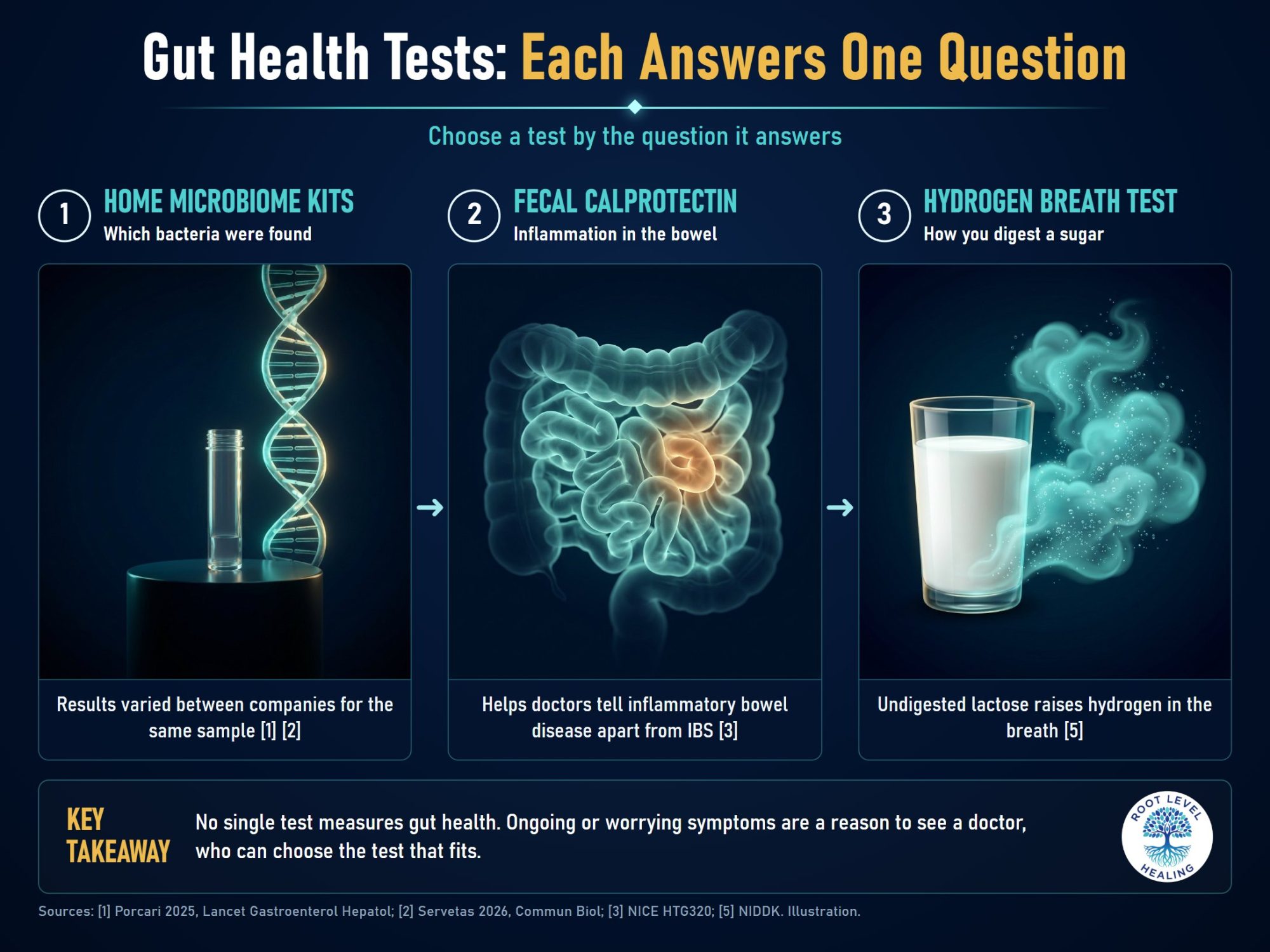
Each test answers a different question, so the right one depends on what you and your doctor want to know.
Tests Doctors Use, and the Question Each One Answers
Unlike most wellness kits, the tests below were developed for a specific purpose, and doctors use them within that purpose.
Fecal calprotectin
Calprotectin is a protein that's released into the gut in larger amounts when the bowel is inflamed, so a stool test for it can act as a marker of inflammation. In the UK, national guidance recommends a stool calprotectin test to help doctors tell inflammatory bowel disease (IBD) apart from irritable bowel syndrome (IBS) in adults with recent lower digestive symptoms, when cancer isn't suspected [3]. It answers a narrow question: is there inflammation that needs a closer look?
Stool blood tests for colorectal cancer screening
The fecal immunochemical test (FIT) looks for hidden blood in the stool. The U.S. Preventive Services Task Force recommends colorectal cancer screening for adults aged 45 to 75, and a yearly FIT is one of the screening options it lists [4]. This recommendation is for people without symptoms. If you have symptoms, talk to your doctor rather than relying on a screening kit.
Breath tests
A hydrogen breath test measures hydrogen in your breath after you drink a set amount of a sugar. With lactose, for example, undigested lactose raises the hydrogen in your breath, which helps doctors recognize lactose intolerance [5]. Breath tests are also used to look for bacterial overgrowth in the small intestine [6].
Blood tests for celiac disease
Blood tests for celiac disease look for levels of certain antibodies, and doctors use them together with small biopsies of the small intestine, taken during an endoscopy, to confirm or rule out the condition. Doctors don't recommend starting a gluten-free diet before testing [7], so if you suspect gluten is a problem, talk to your doctor before you cut it out.
| Test | What it measures | What it can't tell you |
|---|---|---|
| At-home microbiome kit | Which bacteria were found in one stool sample [2] | Whether your gut is "healthy"; results vary between providers [1] [2] |
| Fecal calprotectin | Inflammation in the bowel [3] | The cause of the inflammation; it points to a closer look |
| FIT (stool blood test) | Hidden blood in the stool, for screening [4] | Where the blood comes from; a positive result needs follow-up |
| Hydrogen breath test | How you digest a sugar such as lactose [5] | Your overall gut health |
| Celiac blood test | Antibodies linked with celiac disease [7] | A final result on its own; doctors pair it with biopsies, and advise against going gluten-free before testing |
Tests With Little Evidence Behind Them
IgG food sensitivity panels
These tests measure IgG antibodies to dozens of foods and label the "reactive" ones to avoid. The American Academy of Allergy, Asthma & Immunology explains that IgG to a food is most likely a normal response of the immune system to eating it, that the test has never been shown to do what it reports, and it advises against using IgG testing to identify food allergies or sensitivities [8]. Cutting out foods based on these results can make your diet narrower than it needs to be, so talk to an allergist or your doctor before making big changes.
Intestinal permeability tests
Tests that measure how much the gut lining lets through, such as sugar-absorption tests, are mainly used in research. A review in the journal Gut notes that results can vary with the method, the timing and the person [9]. Our article on leaky gut causes and signs explains what researchers have learned about the gut barrier.
Five Questions to Ask Before You Buy a Test
If you're considering a gut health test, these questions can help you decide whether it's worth it. I want to be clear that none of them is a reason to ignore symptoms; they're a way to spend your money wisely.
- What question will this test answer? If you can't name one, the report probably won't answer it either.
- Has the test been checked against that question? Medical tests are evaluated for a specific use; many wellness tests are not [1].
- Would the result change what I do? If you'd eat more fiber and sleep better whatever the report says, the test may not add much.
- Who will help me read it? A result is most useful when someone qualified can put it in context with your history.
- Should I talk to my doctor first? For ongoing symptoms, yes. Your doctor can choose a test that fits your situation.

Writing down your symptoms and questions first makes any conversation about testing more useful.
When to See a Doctor Instead
Some symptoms call for a medical assessment, not a home kit. Doctors look further when someone has bleeding from the rectum, bloody or black, tarry stools, anemia, or weight loss, or a family history of celiac disease, colon cancer or inflammatory bowel disease [6]. See a doctor promptly if any of these apply to you, and also if you have ongoing diarrhea or abdominal pain that's getting worse.
Testing isn't always the first step. With irritable bowel syndrome, for example, doctors usually don't need tests to recognize it; they rely on the pattern of your symptoms, your medical and family history and a physical exam, and use tests to check for other conditions [6]. A registered dietitian can help with food patterns, and our article on when diet changes alone don't seem to be enough looks at other factors that shape gut health.
Our Gut Health & Microbiome guide brings the everyday basics of gut health together in a step-by-step plan, none of which depends on a test. In our next article, we'll look at how stress and the vagus nerve connect your brain and your gut.
References
- Porcari, S., Mullish, B. H., Asnicar, F., et al. (2025). International consensus statement on microbiome testing in clinical practice. The Lancet Gastroenterology & Hepatology, 10(2), 154–167. https://doi.org/10.1016/S2468-1253(24)00311-X
- Servetas, S. L., Gierz, K. S., Hoffmann, D., Ravel, J., & Jackson, S. A. (2026). Evaluating the analytical performance of direct-to-consumer gut microbiome testing services. Communications Biology, 9, 269. https://doi.org/10.1038/s42003-025-09301-3
- National Institute for Health and Care Excellence (NICE). (2013). Faecal calprotectin diagnostic tests for inflammatory diseases of the bowel (HTG320, formerly DG11). https://www.nice.org.uk/guidance/htg320
- U.S. Preventive Services Task Force. (2021). Colorectal cancer: Screening. https://www.uspreventiveservicestaskforce.org/uspstf/recommendation/colorectal-cancer-screening
- National Institute of Diabetes and Digestive and Kidney Diseases (NIDDK). Diagnosis of lactose intolerance. https://www.niddk.nih.gov/health-information/digestive-diseases/lactose-intolerance/diagnosis
- National Institute of Diabetes and Digestive and Kidney Diseases (NIDDK). Diagnosis of irritable bowel syndrome. https://www.niddk.nih.gov/health-information/digestive-diseases/irritable-bowel-syndrome/diagnosis
- National Institute of Diabetes and Digestive and Kidney Diseases (NIDDK). Diagnosis of celiac disease. https://www.niddk.nih.gov/health-information/digestive-diseases/celiac-disease/diagnosis
- American Academy of Allergy, Asthma & Immunology (AAAAI). The myth of IgG food panel testing. https://www.aaaai.org/tools-for-the-public/conditions-library/allergies/igg-food-test
- Camilleri, M. (2019). Leaky gut: mechanisms, measurement and clinical implications in humans. Gut, 68(8), 1516–1526. https://doi.org/10.1136/gutjnl-2019-318427
Frequently Asked Questions
Q: Are at-home gut microbiome tests accurate?
A: Not reliably yet. In a 2026 study by the National Institute of Standards and Technology, seven testing services analyzed the same standardized stool material and reported widely different results, sometimes even within the same company. An international expert panel also found little evidence that microbiome tests are useful in clinical practice. A report can show which bacteria were found in one sample, but it can't reliably tell you whether your gut is healthy.
Q: Can a stool test tell me if my gut is healthy?
A: No single stool test can do that, because gut health isn't one measurement. Stool tests that doctors order answer specific questions instead: calprotectin looks for inflammation in the bowel, and a fecal immunochemical test (FIT) looks for hidden blood as part of colorectal cancer screening. If you have ongoing symptoms, your doctor can decide which question needs answering and which test fits.
Q: What is a calprotectin test?
A: It's a stool test for calprotectin, a protein released into the gut in larger amounts when the bowel is inflamed. In the UK, national guidance recommends it to help doctors tell inflammatory bowel disease apart from irritable bowel syndrome in adults with recent lower digestive symptoms, when cancer isn't suspected. It shows whether there's inflammation that needs a closer look, not what is causing it.
Q: Do food sensitivity (IgG) tests work?
A: No, not for finding food sensitivities. The American Academy of Allergy, Asthma & Immunology explains that IgG antibodies to a food are most likely a normal response to eating it, and advises against using IgG tests to identify food allergies or sensitivities. Avoiding foods based on these results can narrow your diet without need, so talk to an allergist or your doctor before making big changes.
Q: Who should have a FIT stool test?
A: It depends on your age and symptoms. The U.S. Preventive Services Task Force recommends colorectal cancer screening for adults aged 45 to 75 who have no symptoms, and a yearly fecal immunochemical test (FIT) is one of the options it lists. If you have symptoms, such as blood in your stool, don't rely on a screening kit: see your doctor, who can decide on the right tests.
Q: When should I see a doctor instead of buying a test?
A: See a doctor if you notice bleeding from the rectum, bloody or black stools, unexplained weight loss or signs of anemia, or if your symptoms are ongoing or getting worse. A family history of celiac disease, colon cancer or inflammatory bowel disease is also worth mentioning. A doctor can look at the whole picture and choose a test only when it answers a real question.
This article is part of our gut health and microbiome guide.

Ready to Discover Your Score?
This 2-minute quiz is the essential first step to understanding your body's current toxic load and identifying the root cause of how you feel.
Take The Toxicity QuizExplore More Articles
Dive deeper into topics like detoxification, gut health, and mental clarity on our blog. Knowledge is the key to taking control of your health.
Visit The Blog