Sleep and Gut Health: How Your Sleep and Your Gut Microbiome Talk to Each Other
Have you ever noticed that a run of bad nights seems to show up in your digestion too, or that a heavy late dinner leaves you tossing and turning? You're not imagining the connection. Sleep and gut health are linked in both directions: how you sleep may shape the bacteria living in your gut, and what happens in your gut, including what and when you eat, may shape how you sleep.
In this article, we'll look at what the research actually shows about sleep and the gut microbiome, where the evidence is still thin, why your gut bacteria keep their own daily rhythm, and the everyday habits that support both. If you've read our article on how your gut is the surprising epicenter of aging, this is another side of the same story.
Key Takeaways
- A two-way street: research suggests sleep and the gut microbiome influence each other, through the gut-brain axis, daily rhythms and diet.
- Early human research: the studies so far are small and partly conflicting, so they point to a connection without proving cause and effect.
- Your gut keeps time: gut bacteria follow a daily rhythm set largely by when you eat, and disrupted schedules like jet lag can unsettle it.
- Everyday habits support both: a regular sleep schedule, enough sleep, regular meal times and a fiber-rich diet are good for your sleep and your gut alike.
Sleep and Gut Health: A Quick Overview
Before we dive into the research, watch this quick overview of how sleep and your gut microbiome connect, what the studies show and why your gut keeps time.

In This Article:
How Sleep and Gut Health Are Connected
Your gut is home to trillions of bacteria, together called the gut microbiome. They don't just help digest food: they make compounds that act on your gut wall, your immune system and, through nerves and hormones, your brain. Researchers call this network the gut-brain axis, and it runs both ways [7].
Sleep fits into this picture in three ways. First, the gut microbiome follows a daily rhythm, rising and falling with your feeding and fasting cycle [5] [7]. Second, short or broken sleep activates the body's stress system, which can in turn affect the gut [7]. Third, compounds made by gut bacteria appear to feed back on the body's internal clock and on sleep itself, at least in animal research [7].
Think of it as a conversation rather than a one-way order: your sleep sends signals to your gut, and your gut sends signals back.
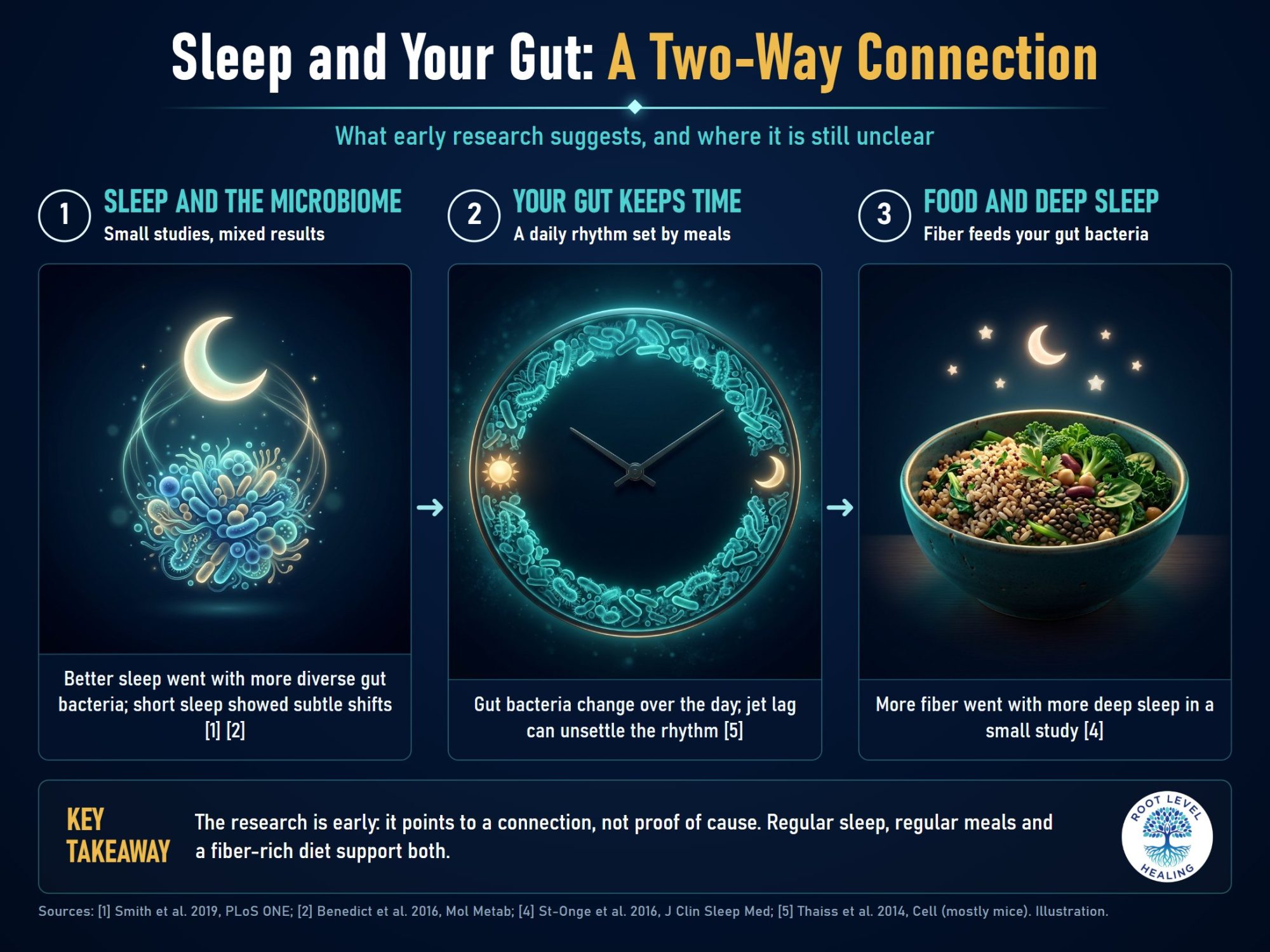 (opens a larger view)
The connection runs both ways, and most of the evidence comes from small or early studies.
What the Research Shows So Far
Here's where it's important to be honest about the evidence. The human studies so far are small, and they don't all agree.
Sleep quality and microbiome diversity
In a study of 26 young men who wore sleep trackers for 30 days, those with more diverse gut bacteria tended to sleep more efficiently and for longer, and to spend less time awake after first falling asleep [1]. The authors note that a correlation like this can't show which way the influence runs: better sleep might support a more diverse microbiome, or the other way around.
A few nights of short sleep
In a carefully controlled lab study, nine young men slept about four hours a night for two nights, and on another occasion slept normally. After the short nights, some groups of gut bacteria shifted, while the overall diversity didn't change [2]. The researchers described these effects as subtle.
Another research team found something different: in their human study of sleep restriction, there were no overt changes in the richness or composition of the gut microbiome, and they concluded it is largely resistant to short-term sleep loss [3].
| Study | Who and what | What it found |
|---|---|---|
| Smith et al., 2019 [1] | 26 young men, sleep tracked for 30 days | More diverse gut bacteria went with more efficient, longer sleep (a correlation, not proof of cause) |
| Benedict et al., 2016 [2] | 9 young men, two nights of about four hours | Subtle shifts in some groups of bacteria; overall diversity unchanged |
| Zhang et al., 2017 [3] | Adults in a sleep-restriction study (and rats) | No overt changes in the human microbiome |
So what can we take from this? Short-term sleep loss seems to have, at most, a modest effect on the gut microbiome, while longer-term sleep habits may matter more. Larger and longer studies are needed before anyone can say more, and that's worth remembering whenever you see a bold claim about sleep and gut bacteria.
Your Gut Keeps Time Too
You probably know that your body runs on a roughly 24-hour clock, the circadian rhythm. What's less well known is that your gut bacteria have a daily rhythm of their own. In research in both mice and people, the makeup and activity of gut bacteria changed over the course of a day, and the main thing setting that rhythm was when food arrived [5].
In the same research, jet lag disturbed these daily swings. In mice, that disturbance was linked with changes in how the body handled blood sugar; much of this work was done in animals, with only a small number of people studied [5]. A later review describes how persistent jet lag and irregular routines can dampen the gut's daily rhythm, and how regular eating windows may help keep it in step [7].
The practical takeaway is simple: your gut appreciates a regular schedule just as much as your brain does. Regular sleep and regular meals send the same steady signal.
Serotonin and the Gut: Clearing Up a Common Claim
You may have read that "most of your serotonin is made in your gut, so your gut controls your sleep." The first half has real research behind it: much of the body's serotonin is made in the gut, and gut bacteria help regulate how much [8].
The second half oversimplifies. In that research, the serotonin made in the gut worked mainly in the gut and the blood, helping move food along and affecting platelets [8]. The brain makes its own serotonin. The gut-brain conversation is real, but it runs through many signals at once, not one simple chemical pipeline.
If you're curious about the brain side of sleep, our article on REM sleep, acetylcholine and vivid dreams looks at one of the brain chemicals involved.
What You Eat and How You Sleep
Diet is one of the clearest bridges between your gut and your sleep. In a small inpatient study of 26 adults, eating more fiber during the day was linked with more deep (slow-wave) sleep that night. A higher share of calories from saturated fat was linked with less deep sleep, and more sugar with more awakenings [4].
This was a small study that found associations, not proof that changing your diet will change your sleep. Still, fiber is also what your gut bacteria feed on, so a fiber-rich dinner is a sensible choice for both your gut and your night.
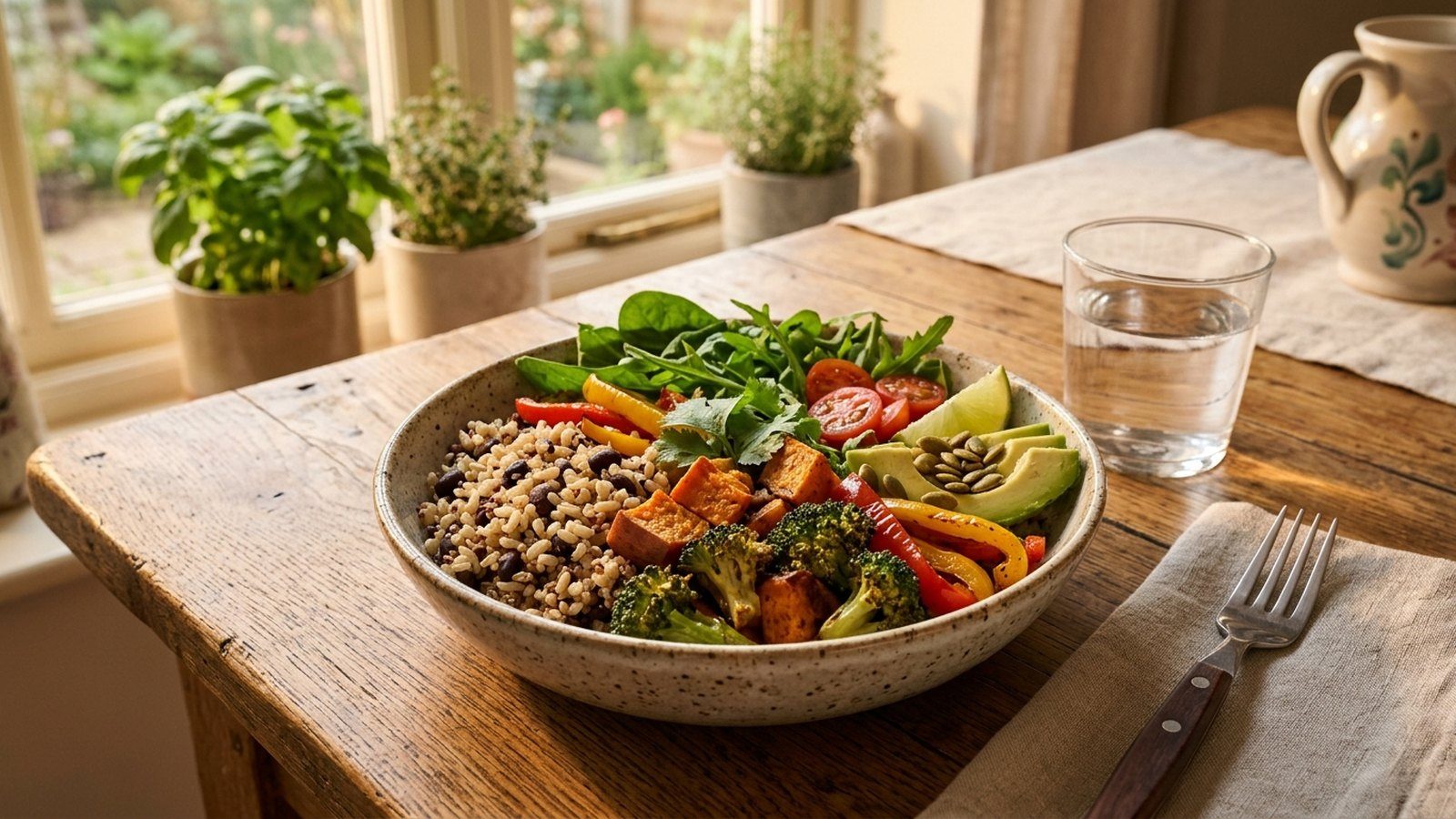
A simple dinner built on vegetables, beans and whole grains gives your gut bacteria the fiber they feed on.
Everyday Habits for Better Sleep and Gut Health
None of these habits is a quick fix, and they work best together. I want to be clear that they're about supporting your routine, not about promising any particular result:
- Aim for enough sleep. Sleep experts recommend that adults sleep 7 or more hours a night on a regular basis [6]. Regular, sufficient sleep is also one of the everyday habits in our article on leaky gut causes and signs.
- Keep a regular schedule. Going to bed and waking up at about the same time, weekends included, gives both your body clock and your gut's daily rhythm a steady signal [7].
- Eat at regular times. Meal timing helps set your gut bacteria's daily rhythm [5], so try to keep breakfast, lunch and dinner at roughly the same times each day.
- Build meals around fiber. Vegetables, beans, whole grains, nuts and seeds feed your gut bacteria and were linked with deeper sleep in the study above [4]. Our articles on three foods for gut health and fermented foods for gut health are good places to start.
- Go easy on sugary late-night snacks. More sugar was linked with more awakenings during the night [4].
- Make your bedroom calm and dark. A cool, quiet, dark room and a wind-down routine help your body recognize that it's time for sleep.
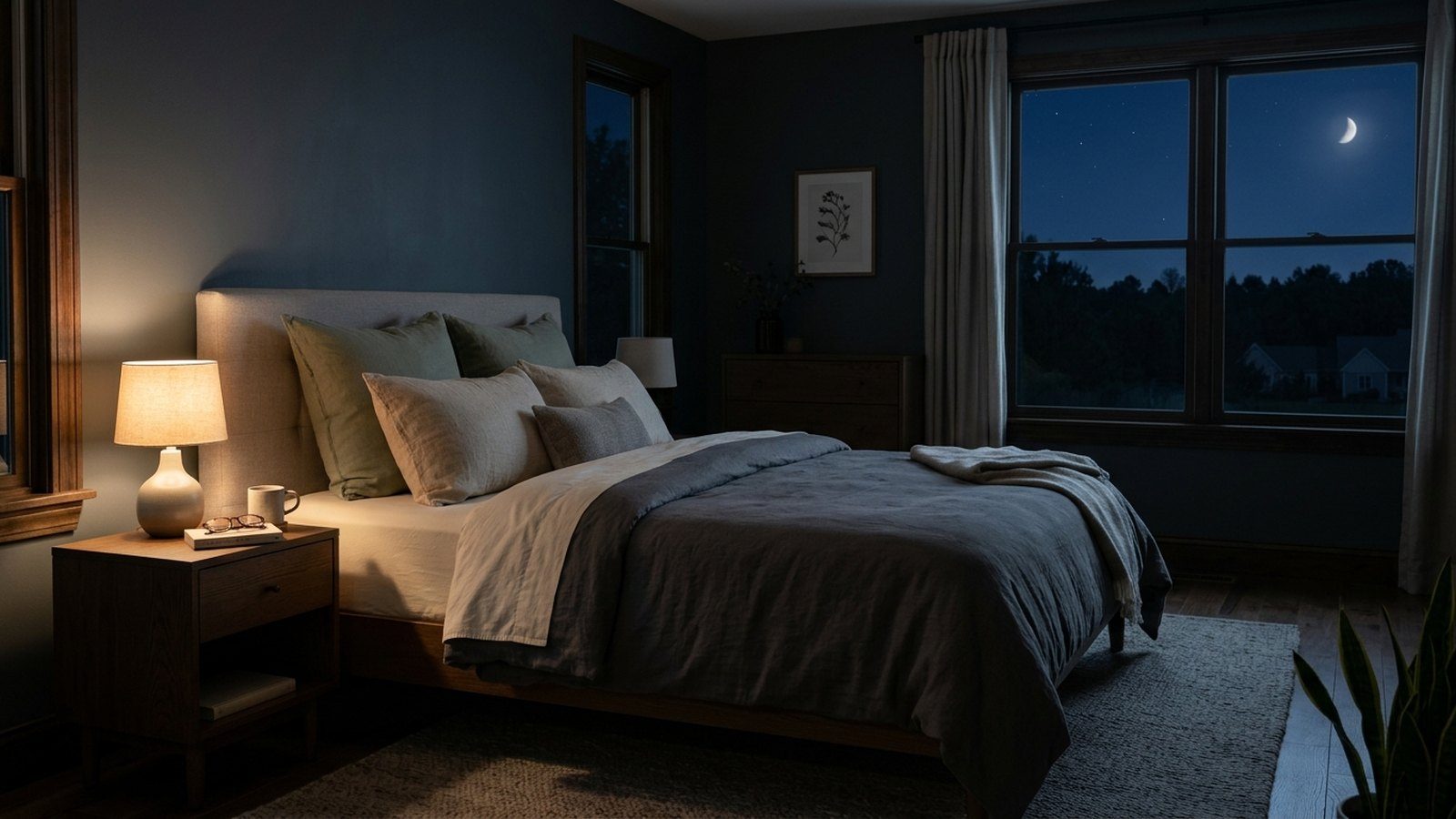
A regular bedtime in a calm, dark room sends the same steady signal to your body clock and your gut.
Our Gut Health & Microbiome guide brings these habits together into a step-by-step plan, and the connection between your gut and how clearly you think is explored in our article on brain fog and the gut-brain connection. The Toxicity Score Quiz is a free educational self-assessment that can help you see where to start; it's an educational tool only and doesn't replace a visit to your doctor.
When to Talk to a Doctor
Talk to a doctor if you have trouble falling or staying asleep most nights for weeks at a time, if you snore loudly or someone notices you stop breathing during sleep, or if you're very sleepy during the day despite enough time in bed. These can point to sleep conditions that deserve a proper assessment.
The same goes for your gut: see a doctor promptly for blood in your stool, unexplained weight loss, ongoing diarrhea, or severe or worsening abdominal pain. For milder ongoing symptoms, a doctor or a registered dietitian can help you work out what's going on and build a plan that fits you.
In our next article, we'll look more closely at fiber: how much you need, and which kinds your gut bacteria thrive on.
References
- Smith, R. P., Easson, C., Lyle, S. M., et al. (2019). Gut microbiome diversity is associated with sleep physiology in humans. PLoS ONE, 14(10), e0222394. https://doi.org/10.1371/journal.pone.0222394
- Benedict, C., Vogel, H., Jonas, W., et al. (2016). Gut microbiota and glucometabolic alterations in response to recurrent partial sleep deprivation in normal-weight young individuals. Molecular Metabolism, 5(12), 1175–1186. https://doi.org/10.1016/j.molmet.2016.10.003
- Zhang, S. L., Bai, L., Goel, N., et al. (2017). Human and rat gut microbiome composition is maintained following sleep restriction. Proceedings of the National Academy of Sciences, 114(8), E1564–E1571. https://doi.org/10.1073/pnas.1620673114
- St-Onge, M.-P., Roberts, A., Shechter, A., & Choudhury, A. R. (2016). Fiber and saturated fat are associated with sleep arousals and slow wave sleep. Journal of Clinical Sleep Medicine, 12(1), 19–24. https://doi.org/10.5664/jcsm.5384
- Thaiss, C. A., Zeevi, D., Levy, M., et al. (2014). Transkingdom control of microbiota diurnal oscillations promotes metabolic homeostasis. Cell, 159(3), 514–529. https://doi.org/10.1016/j.cell.2014.09.048
- Watson, N. F., Badr, M. S., Belenky, G., et al. (2015). Recommended amount of sleep for a healthy adult: a joint consensus statement of the American Academy of Sleep Medicine and Sleep Research Society. Journal of Clinical Sleep Medicine, 11(6), 591–592. https://doi.org/10.5664/jcsm.4758
- Matenchuk, B. A., Mandhane, P. J., & Kozyrskyj, A. L. (2020). Sleep, circadian rhythm, and gut microbiota. Sleep Medicine Reviews, 53, 101340. https://doi.org/10.1016/j.smrv.2020.101340
- Yano, J. M., Yu, K., Donaldson, G. P., et al. (2015). Indigenous bacteria from the gut microbiota regulate host serotonin biosynthesis. Cell, 161(2), 264–276. https://doi.org/10.1016/j.cell.2015.02.047
Frequently Asked Questions
Q: Does sleep affect gut health?
A: It may. Small human studies have linked better sleep with a more diverse gut microbiome, and a few nights of short sleep with subtle shifts in some gut bacteria, though another study found no clear change. The research is early, so it points to a connection rather than proving cause and effect. Regular, sufficient sleep is a sensible part of any gut-friendly routine.
Q: Can gut health affect sleep?
A: Research suggests it can, through the gut-brain axis and the body's daily rhythms. In a small study, eating more fiber was linked with more deep sleep, while more saturated fat and sugar were linked with lighter, more broken sleep. Most of the evidence on gut bacteria and sleep comes from animal studies and small human studies, so more research is needed.
Q: Do gut bacteria have a daily rhythm?
A: Yes. Research in mice and people has found that the makeup and activity of gut bacteria change over the course of a day, and that the main thing setting this rhythm is when you eat. Disrupted schedules such as jet lag can unsettle it, which is one reason regular meal and sleep times are good for your gut.
Q: Is it true that most serotonin is made in the gut?
A: Yes, much of the body's serotonin is made in the gut, and gut bacteria help regulate how much. But that serotonin works mainly in the gut and the blood, for example in moving food along. The brain makes its own serotonin, so the idea that your gut directly controls your sleep through serotonin is an oversimplification.
Q: What should I eat for better sleep and gut health?
A: A diet built around fiber-rich plant foods, such as vegetables, beans, whole grains, nuts and seeds, feeds your gut bacteria and was linked with deeper sleep in a small study. Going easy on sugary late-night snacks and heavy, high-fat late meals may also help. Eating at regular times supports your gut's daily rhythm.
Q: How much sleep do adults need?
A: Sleep experts from the American Academy of Sleep Medicine and the Sleep Research Society recommend that adults sleep 7 or more hours a night on a regular basis. A regular bedtime and wake time, weekends included, helps your body clock. If you regularly struggle to sleep or feel very sleepy in the day, talk to your doctor.
This article is part of our gut health and microbiome guide.

Ready to Discover Your Score?
This 2-minute quiz is the essential first step to understanding your body's current toxic load and identifying the root cause of how you feel.
Take The Toxicity QuizExplore More Articles
Dive deeper into topics like detoxification, gut health, and mental clarity on our blog. Knowledge is the key to taking control of your health.
Visit The Blog