
Prebiotic Foods: What They Are and How to Add Them
You've probably heard that your gut bacteria need feeding, but what do they actually eat? Much of what they eat comes from prebiotic foods: everyday foods like garlic, onions, leeks, asparagus, bananas and oats that carry fibers your body can't digest but some of your gut bacteria can. The good news is that you don't need special products to get them. Most of them are probably in your kitchen already.
In this article, we'll look at what prebiotic foods are, how they differ from probiotics, a short list of foods to start with, what research shows in healthy adults, and how to add them without the gas and bloating that can come from changing too much too fast. It's a natural next step after our article on fermented foods for gut health, which looks at the other side of the same story.
Key Takeaways
- Food for your gut bacteria: prebiotics are substances your gut bacteria use selectively, and experts only call something a prebiotic when a health benefit has been documented.
- Everyday foods count: garlic, onions, leeks, asparagus, bananas and whole grains like oats are among the easiest places to start.
- Research is real but specific: in healthy adults, fiber and prebiotics reliably increase certain gut bacteria, though that doesn't always change how people feel day to day.
- Go slowly: adding a lot at once can bring gas and bloating, so add one food at a time, in small amounts.
In This Article:
What Are Prebiotic Foods?
In 2017, an international panel of experts updated the definition of a prebiotic: "a substrate that is selectively utilized by host microorganisms conferring a health benefit." The panel also kept a high bar: beneficial health effects must be documented before a substance can be called a prebiotic [1]. In plain words, a prebiotic is food for some of your gut bacteria, and not every fiber qualifies.
Here's how it works. Simple sugars are absorbed quickly in the upper part of the small intestine, but many starches and fibers aren't easily digested. These fibers travel on to the large intestine, where your gut bacteria break them down [2]. As they ferment these fibers, gut bacteria make short-chain fatty acids, which the body can use as a nutrient source [2]. The fibers involved include inulin, resistant starches, gums, pectins and fructooligosaccharides [2].
Some of these have been studied more than others. A review in Nutrients describes inulin, oligofructose and resistant starch as meeting every part of the prebiotic definition, including stimulating Bifidobacterium, a group of bacteria researchers often look for in prebiotic studies [3].
Prebiotics are one part of the bigger fiber picture. If you'd like the basics first, such as how much fiber you need each day and the difference between soluble and insoluble fiber, our article on fiber for gut health and how much you need covers them; this article stays with the foods.
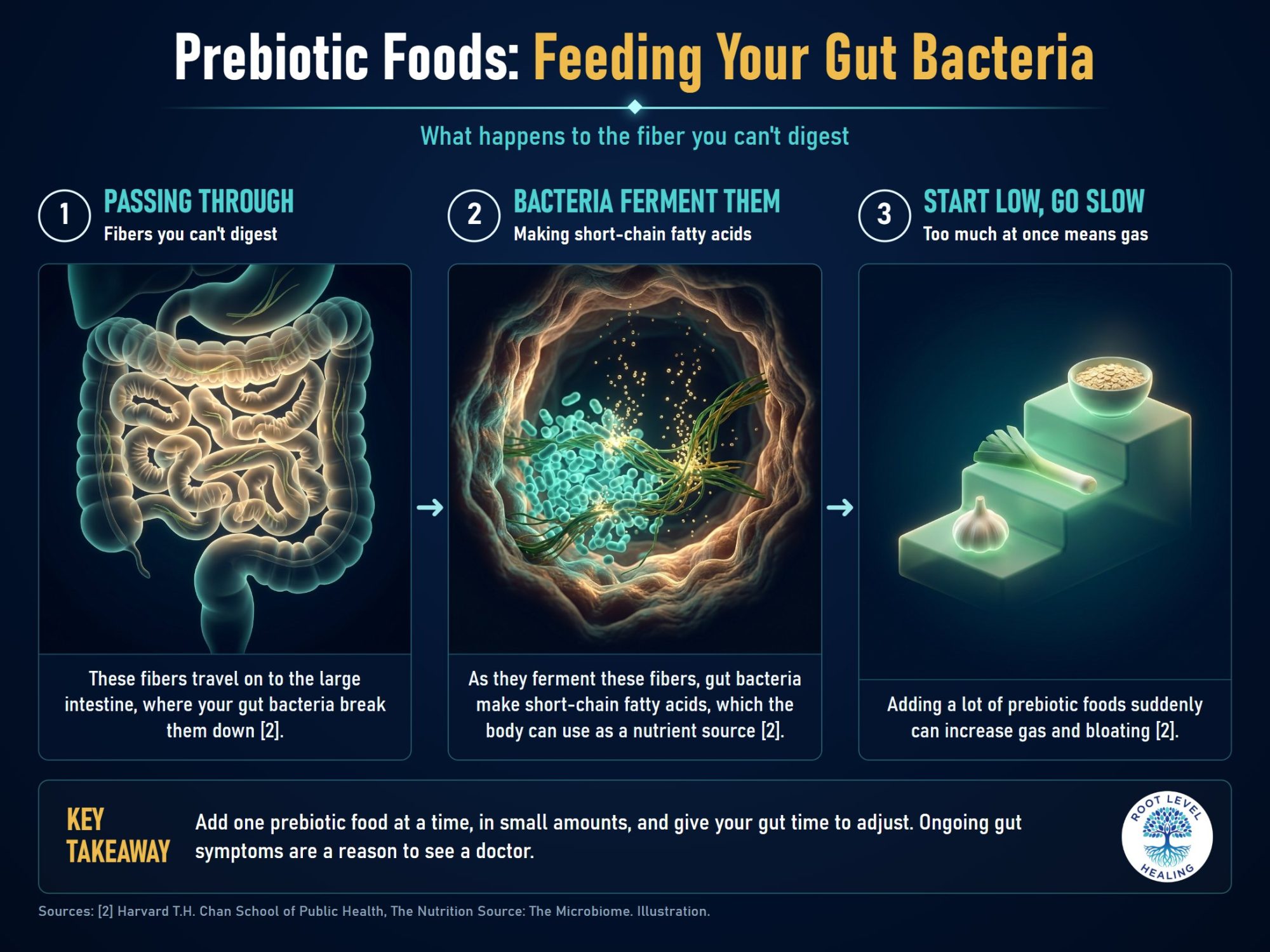
Prebiotic fibers pass through to the large intestine, where your gut bacteria put them to use.
Prebiotics vs. Probiotics: What's the Difference?
The two words sound alike, but they mean different things. Probiotics are "live microorganisms which when administered in adequate amounts confer a health benefit on the host," a definition an expert panel reaffirmed in 2014 [4]. Prebiotics aren't alive at all: they're the food that bacteria already living in your gut can use.
Some fermented foods, such as kefir, yogurt with live active cultures, kimchi, miso and sauerkraut, may contain beneficial live microbes [2]. Our article on fermented foods and how to start covers those. Prebiotic foods are the other half of the plate: the plant foods that feed the bacteria you already have.
A Prebiotic Foods List to Start With
According to the Harvard T.H. Chan School of Public Health, the highest amounts of prebiotics are found in raw versions of garlic, onions, leeks, asparagus, Jerusalem artichokes, dandelion greens, bananas and seaweed. In general, fruits, vegetables, beans and whole grains like wheat, oats and barley are all good sources of prebiotic fibers [2].
You don't need all of them. Six everyday foods make an easy start:
- Garlic and onions. Both are on the list of the richest sources, especially raw [2]. A little raw garlic in a dressing or thinly sliced red onion in a salad is an easy way in.
- Leeks. A milder relative of the onion, also among the richest sources [2]. Slice them thinly into soups, stir-fries or omelets.
- Asparagus. Another top source [2]. Shave it raw into a salad, or roast it as a side.
- Green bananas. The review in Nutrients lists banana among the foods with prebiotic effects [3], and a lab study of green bananas found substantial amounts of resistant starch and fiber, which produced short-chain fatty acids when fermented in the lab [5]. That was a lab study, not a study in people. Bananas that are still slightly green are a simple way to try them.
- Oats. A whole grain on the list of good sources [2]. In a randomized trial of 210 adults with mildly raised cholesterol, eating 80 grams of oats a day for 45 days increased several groups of gut bacteria, including Akkermansia and Roseburia [6].
| Food | What the sources say | Easy ways to add it |
|---|---|---|
| Garlic | Among the richest sources, especially raw [2] | A little raw garlic in dressings, dips or salsa |
| Onions | Among the richest sources, especially raw [2] | Thinly sliced in salads, sandwiches or tacos |
| Leeks | Among the richest sources, especially raw [2] | Sliced into soups, stir-fries or omelets |
| Asparagus | Among the richest sources, especially raw [2] | Shaved raw into salads, or roasted as a side |
| Green bananas | Rich in resistant starch and fiber (lab study) [5] | Sliced while still slightly green, or blended into a smoothie |
| Oats | A whole-grain source of prebiotic fibers [2] | Oatmeal, overnight oats, or a spoonful in a smoothie |

Most prebiotic foods are everyday kitchen staples you may already be buying.
What Research Shows About Prebiotics
The clearest finding is about the bacteria themselves. A meta-analysis of 64 randomized trials with 2,099 healthy adults found that fiber interventions led to more Bifidobacterium and Lactobacillus in stool samples than placebo or low-fiber comparisons. Fructans, the family of fibers that includes inulin, and galacto-oligosaccharides had the biggest effect. The same analysis found no change in overall bacterial diversity [7].
A change in bacteria doesn't automatically mean a change in how you feel, though. In a small randomized trial of 24 healthy adults, 10 grams a day of two prebiotic fibers taken in milk for four weeks increased Bifidobacterium, but didn't change markers of stress and inflammation, mental health symptoms, digestive function or sleep compared with plain milk [8]. I think that's worth knowing: prebiotics are a sensible part of everyday eating, not a quick fix for how you feel.
Researchers are also asking whether diet affects the gut lining. A systematic review of studies in healthy people found moderate-quality evidence that chicory inulin reduced intestinal barrier permeability in adults, but concluded that, overall, there was no strong evidence that diet increases or decreases permeability in healthy individuals [9]. Our article on leaky gut causes and signs explains what intestinal permeability is.
How to Add Prebiotic Foods: Start Low, Go Slow
Adding a lot of prebiotic foods suddenly can increase gas and bloating [2]. That's your gut bacteria doing exactly what they do: fermenting fiber. With continued use, tolerance may improve [2], which is why going slowly makes such a difference.
Research on purified prebiotic fibers gives a sense of scale. In a small randomized trial in 29 healthy adults, 5 and 7.5 grams a day of agave inulin led to only slight increases in bloating, gas and rumbling, and the higher amount also meant softer stools and more bowel movements [10]. A review of human studies noted that most people taking more than 15 grams of inulin a day had digestive side effects [11]. Those are amounts of a single purified fiber, not servings of food, but the lesson carries over: more isn't better all at once.
- Add one food at a time. Try a small portion of one food, such as a few slices of onion or half a cup of oatmeal, and give your gut time to adjust before adding the next.
- Mix raw and cooked. Raw versions carry the highest amounts [2], so if raw onion or garlic is too much, start with cooked and build up.
- Try cooked and cooled starches. In one study, cooked white rice cooled in the fridge for 24 hours and then reheated had more resistant starch than freshly cooked rice [12].
- Read labels. If you see inulin or fructooligosaccharides on a label, that's a prebiotic fiber added to the food; in the U.S., they count as fiber on food labels [3]. Going slowly applies to these too.
- Think variety. A mix of fruits, vegetables, beans and whole grains covers many prebiotic fibers at once [2].
Exploring a Greens Powder From ROOT
Whole foods are the heart of this article. If you also like a greens powder to add plant variety to your routine, this is how ROOT describes one:
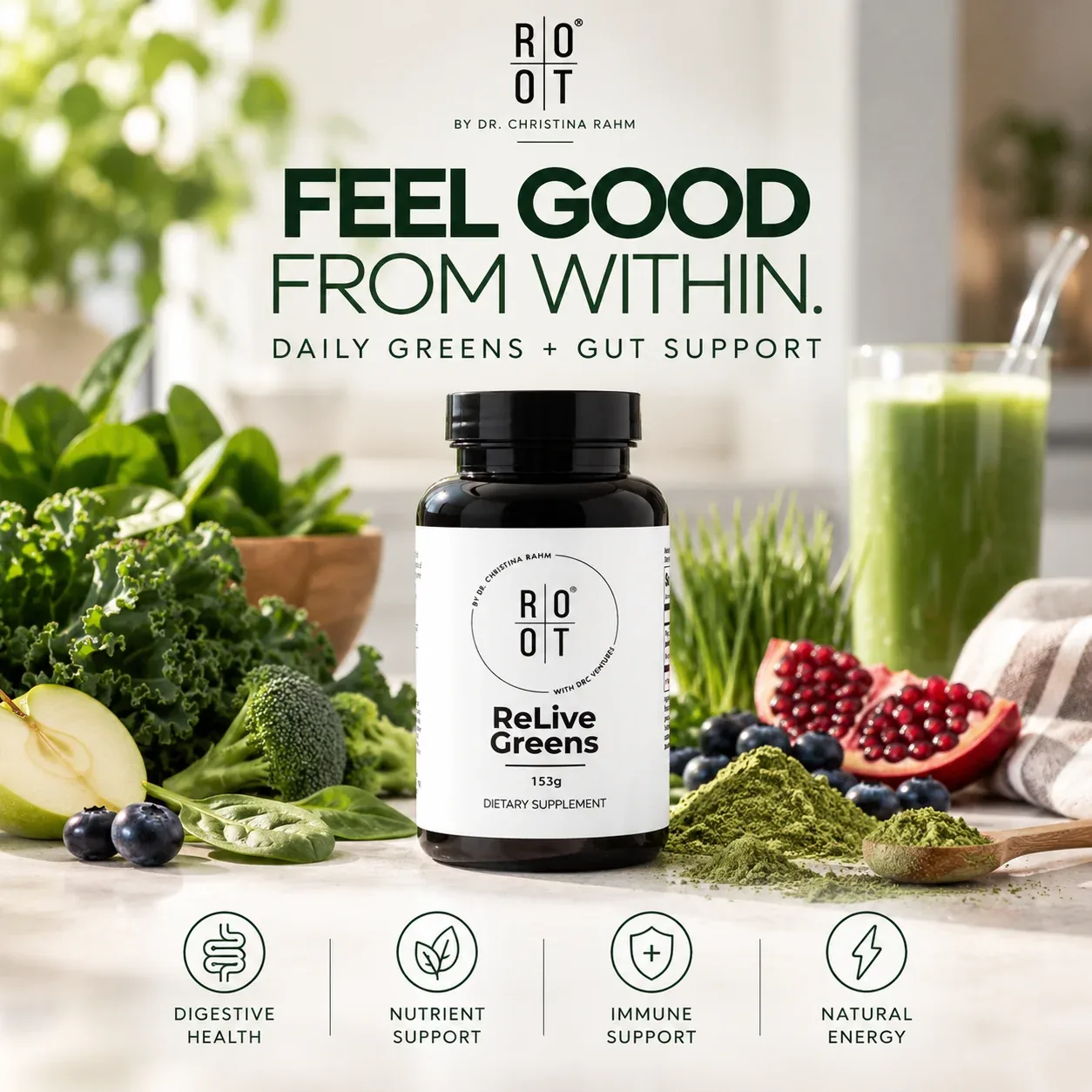
Relive Greens
"Relive Greens is a superfood greens powder that combines dark leafy greens, fruits, prebiotic fiber and probiotics in one convenient blend. This unflavored powder fits easily into smoothies and meals, making plant variety a simple part of your daily routine."
— The ROOT Brands
I am a Root Ambassador, and I may earn rewards from qualifying purchases.Referral code ROOTLEVELHEALING is applied automatically through this link.
Our Gut Health & Microbiome guide puts prebiotic foods into a step-by-step plan alongside the other everyday foundations of gut health. Sleep is one of them: our article on how sleep and your gut microbiome talk to each other looks at that research.
When to Talk to Your Doctor
Prebiotic foods are everyday foods, but they don't suit every gut at every moment. People with digestive sensitivities, such as irritable bowel syndrome, are advised to introduce these foods in small amounts first to see how they're tolerated [2]. If you have IBS or follow a diet your doctor or dietitian has recommended, check with them before making big changes.
And talk to your doctor if digestive symptoms are ongoing, getting worse, or come with warning signs such as blood in your stool or unexplained weight loss. A doctor can look at the whole picture, which a food list never can.
In our next article, we'll look at SIBO, small intestinal bacterial overgrowth: its causes, how it's tested, and the gut support strategies researchers are exploring.
References
- Gibson, G. R., Hutkins, R., Sanders, M. E., et al. (2017). Expert consensus document: The International Scientific Association for Probiotics and Prebiotics (ISAPP) consensus statement on the definition and scope of prebiotics. Nature Reviews Gastroenterology & Hepatology, 14(8), 491–502. https://doi.org/10.1038/nrgastro.2017.75
- Harvard T.H. Chan School of Public Health. The Microbiome. The Nutrition Source. https://nutritionsource.hsph.harvard.edu/microbiome/
- Slavin, J. (2013). Fiber and prebiotics: mechanisms and health benefits. Nutrients, 5(4), 1417–1435. https://doi.org/10.3390/nu5041417
- Hill, C., Guarner, F., Reid, G., et al. (2014). Expert consensus document: The International Scientific Association for Probiotics and Prebiotics consensus statement on the scope and appropriate use of the term probiotic. Nature Reviews Gastroenterology & Hepatology, 11(8), 506–514. https://doi.org/10.1038/nrgastro.2014.66
- Bashmil, Y. M., Dunshea, F. R., Appels, R., & Suleria, H. A. R. (2024). Bioaccessibility of phenolic compounds, resistant starch, and dietary fibers from Australian green banana during in vitro digestion and colonic fermentation. Molecules, 29(7), 1535. https://doi.org/10.3390/molecules29071535
- Xu, D., Feng, M., Chu, Y., et al. (2021). The prebiotic effects of oats on blood lipids, gut microbiota, and short-chain fatty acids in mildly hypercholesterolemic subjects compared with rice: a randomized, controlled trial. Frontiers in Immunology, 12, 787797. https://doi.org/10.3389/fimmu.2021.787797
- So, D., Whelan, K., Rossi, M., et al. (2018). Dietary fiber intervention on gut microbiota composition in healthy adults: a systematic review and meta-analysis. The American Journal of Clinical Nutrition, 107(6), 965–983. https://doi.org/10.1093/ajcn/nqy041
- Mysonhimer, A. R., Cannavale, C. N., Bailey, M. A., Khan, N. A., & Holscher, H. D. (2023). Prebiotic consumption alters microbiota but not biological markers of stress and inflammation or mental health symptoms in healthy adults: a randomized, controlled, crossover trial. The Journal of Nutrition, 153(4), 1283–1296. https://doi.org/10.1016/j.tjnut.2023.02.015
- Nascimento, D. S. M. D., Mota, A. C. C. C., Carvalho, M. C. D. C., et al. (2024). Can diet alter the intestinal barrier permeability in healthy people? A systematic review. Nutrients, 16(12), 1871. https://doi.org/10.3390/nu16121871
- Holscher, H. D., Doligale, J. L., Bauer, L. L., et al. (2014). Gastrointestinal tolerance and utilization of agave inulin by healthy adults. Food & Function, 5(6), 1142–1149. https://doi.org/10.1039/c3fo60666j
- Williams, C. M., & Jackson, K. G. (2002). Inulin and oligofructose: effects on lipid metabolism from human studies. British Journal of Nutrition, 87(Suppl 2), S261–S264. https://doi.org/10.1079/BJNBJN/2002546
- Sonia, S., Witjaksono, F., & Ridwan, R. (2015). Effect of cooling of cooked white rice on resistant starch content and glycemic response. Asia Pacific Journal of Clinical Nutrition, 24(4), 620–625. https://doi.org/10.6133/apjcn.2015.24.4.13
Frequently Asked Questions
Q: What are prebiotic foods?
A: They're foods that carry fibers your body can't digest but some of your gut bacteria can use. Experts define a prebiotic as "a substrate that is selectively utilized by host microorganisms conferring a health benefit." The highest amounts are found in raw garlic, onions, leeks, asparagus, Jerusalem artichokes, dandelion greens, bananas and seaweed, and whole grains like oats are good sources too.
Q: What's the difference between prebiotics and probiotics?
A: Probiotics are live microorganisms that, in adequate amounts, confer a health benefit; prebiotics aren't alive at all. They're the food that bacteria already living in your gut can use. Some fermented foods, such as kefir, yogurt with live active cultures, kimchi and sauerkraut, may contain live microbes, while prebiotic foods feed the bacteria you already have.
Q: Which prebiotic foods should I start with?
A: Start with everyday foods you already like. Garlic, onions, leeks and asparagus are among the richest sources, especially raw, and oats and slightly green bananas are easy additions to breakfast. Add one at a time, in a small portion, rather than all of them at once.
Q: How much prebiotic fiber should I eat?
A: There's no single number for prebiotic foods, so start small and build up. Research on purified fibers gives a sense of scale: in a small trial in healthy adults, 5 to 7.5 grams a day of agave inulin caused only slight increases in gas and bloating, while a review noted that most people taking more than 15 grams of inulin a day had digestive side effects.
Q: Why do prebiotic foods make me gassy?
A: Because your gut bacteria ferment them. Adding a lot of prebiotic foods suddenly can increase gas and bloating, and with continued use, tolerance may improve. Adding one food at a time, in small amounts, gives your gut time to adjust.
Q: Should I avoid prebiotic foods if I have IBS or a sensitive gut?
A: Not necessarily, but go carefully. People with digestive sensitivities such as irritable bowel syndrome are advised to introduce these foods in small amounts first to see how they're tolerated. If you have IBS or follow a diet your doctor or dietitian recommended, check with them first, and see your doctor if symptoms are ongoing or come with warning signs.
This article is part of our gut health and microbiome guide.

Ready to Discover Your Score?
This 2-minute quiz is the essential first step to understanding your body's current toxic load and identifying the root cause of how you feel.
Take The Toxicity QuizExplore More Articles
Dive deeper into topics like detoxification, gut health, and mental clarity on our blog. Knowledge is the key to taking control of your health.
Visit The Blog