
Stress, the Vagus Nerve and Gut Health: What Research Shows
Have you ever felt your stomach tighten before a big meeting, or lost your appetite during a stressful week? That's not your imagination. Your brain and your gut are in constant conversation, and one of the main lines they use is a long nerve called the vagus nerve. Understanding the link between the vagus nerve and gut health can help explain why stress so often shows up in your digestion.
In this article, we'll look at what the vagus nerve is, how stress affects the gut, what research shows about the vagus nerve and your gut bacteria, what "vagal tone" means and how it's measured, and the everyday habits that support a calmer stress response. It's a natural companion to our article on the root cause of brain fog, which explores the gut-brain connection from the other side.
Key Takeaways
- A two-way line: the vagus nerve connects your brain and your digestive tract, and most of its fibers carry information from the body up to the brain.
- Stress reaches the gut: reviews describe how stress affects gut movement, sensitivity, secretion, the gut barrier and gut bacteria, and how it dampens vagus nerve activity.
- Gut bacteria may use the vagus nerve too: animal studies suggest some gut bacteria send signals to the brain through it, though research in people is still early.
- Everyday habits matter: slow breathing, sleep, movement and a fiber-rich diet are simple ways to support how your body handles stress.
In This Article:
What Is the Vagus Nerve?
The vagus nerve is the main nerve of the parasympathetic nervous system, the "rest and digest" side of your nervous system. It runs from the brainstem down through the neck and chest into the abdomen, and it helps oversee a wide range of body functions, including digestion, heart rate, immune responses and mood [1].
Think of it as a busy two-way phone line between your brain and your gut. What surprises many people is which direction most of the calls go. About 80% of the vagus nerve's fibers carry information from the body up to the brain, and only about 20% carry signals from the brain down [2]. In other words, your gut is constantly reporting to your brain on what's happening inside you.
How Stress Shows Up in Your Gut
Stress isn't only something you feel in your head. A review of how stress affects the digestive system describes several effects: changes in how quickly food moves through the gut, a gut that feels more sensitive, changes in digestive secretions, a more permeable gut lining, and effects on gut bacteria [3].
One of these has been measured directly in people. In a study of healthy volunteers, the stress of preparing for a public speech increased the permeability of the small intestine [4]. Our article on leaky gut causes and signs explains what intestinal permeability is and what else research links to it.
The vagus nerve sits right in the middle of this. Researchers describe stress as inhibiting the vagus nerve, with knock-on effects on the gut and its bacteria [2]. That's one reason stress care is part of gut care.
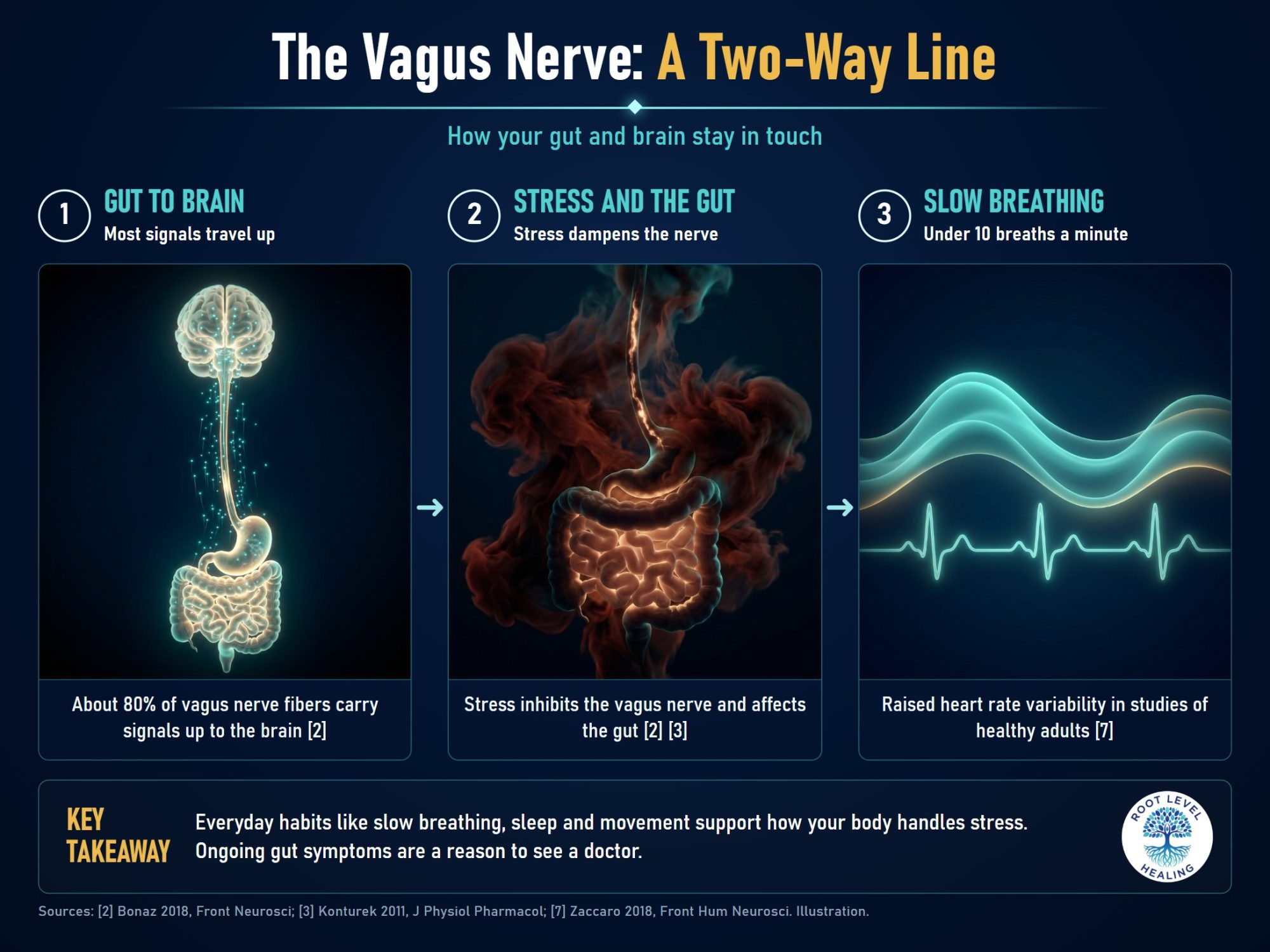
The vagus nerve carries signals both ways, and most of them travel from the gut up to the brain.
The Vagus Nerve and Gut Health: What Research Shows
Your gut bacteria produce a wide range of compounds as they break down food. Researchers describe how the vagus nerve can sense some of these compounds through its fibers in the gut wall, pass that information to the brain, and help shape the body's response [2].
Some of the clearest evidence comes from animals. In a study in mice, feeding a Lactobacillus strain changed stress-related behavior and stress-hormone levels, and those changes didn't happen in mice whose vagus nerve had been cut [5]. This was a mouse study, so it can't tell us what happens in people, but it suggests the vagus nerve is one route by which gut bacteria and the brain communicate.
In people, the research is earlier. A review describes preliminary evidence that gut bacteria may influence mood, partly by affecting the activity of the vagus nerve [1]. I want to be clear that "preliminary" is the right word here: it's an active, promising area of research, not a settled one.
Vagal Tone: What It Means and How It's Measured
"Vagal tone" describes how active the vagus nerve is in its calming role. A review in Frontiers in Psychiatry notes that vagal tone is linked with the capacity to regulate stress responses, and that it can be influenced by breathing [1].
Researchers usually estimate it from heart rate variability (HRV), the small, natural changes in time between heartbeats. HRV is easy and painless to record, which makes it popular, but a methods review cautions that HRV findings are easily misread without careful measurement [6]. If you track HRV with a watch or ring, it's best read as a general trend over weeks, not as a daily score of your gut health.
Everyday Habits That Support Your Stress Response
You don't need special equipment to support the gut-brain connection. These everyday habits are simple, low-risk and good for you anyway:
- Slow your breathing. A systematic review of slow-breathing techniques, under 10 breaths a minute, found that they increased heart rate variability and were linked with feeling more relaxed and comfortable in healthy adults [7]. Try breathing in gently through your nose for about four seconds and out for about six, for a few minutes.
- Make room for calming practices. Researchers suggest that meditation and yoga, which slow the breath, likely contribute to resilience to stress [1].
- Protect your sleep. Sleep and the gut are closely connected; our article on sleep and gut health looks at what the research shows.
- Feed your gut bacteria. A varied, fiber-rich diet supports the gut bacteria that are part of this conversation. Our article on fermented foods for gut health and how to start looks at another way to add variety.
- Move regularly. A daily walk is one of the simplest ways to ease stress and keep digestion moving.
| What research looked at | What it found | Study type |
|---|---|---|
| Public-speech stress | Increased small-intestinal permeability [4] | Human study (healthy volunteers) |
| A Lactobacillus strain and stress behavior | Changes that didn't happen when the vagus nerve was cut [5] | Animal study (mice) |
| Slow breathing (under 10 breaths a minute) | Higher heart rate variability; more relaxed, comfortable feelings [7] | Systematic review (healthy adults) |
| Stress and the gut | Effects on gut movement, sensitivity, secretion, permeability and bacteria [3] | Review |

A few minutes of slow breathing in a quiet spot is one of the simplest stress habits to build.
Exploring Gut Support From ROOT
Everyday habits come first. If you're also curious about supplements for the gut side of the gut-brain connection, this is one ROOT describes for digestive wellness:

Restore
"Formulated with Black Cumin Seed Oil (Nigella sativa), Turmeric, Resveratrol, Aloe Vera, Raspberry Extract, Apple Cider Vinegar, and D-Ribose, RESTORE brings together ingredients studied for their roles in antioxidant activity, digestive wellness, and cellular energy metabolism."
— The ROOT Brands
I am a Root Ambassador, and I may earn rewards from qualifying purchases.Referral code ROOTLEVELHEALING is applied automatically through this link.
Our Gut Health & Microbiome guide brings these everyday foundations together in a step-by-step plan, and our Brain Chemistry guide looks more closely at the gut-brain connection.
When Stress Needs More Support
Everyday habits help, but they aren't a substitute for care when you need it. Talk to your doctor if digestive symptoms are ongoing, getting worse, or come with warning signs such as blood in your stool or unexplained weight loss. And if stress, worry or low mood is affecting your daily life, a doctor or a mental health professional can help. Reaching out is a sign of strength, not weakness.
In our next article, we'll look at prebiotic foods: what they are, and simple ways to add more of them to your plate.
References
- Breit, S., Kupferberg, A., Rogler, G., & Hasler, G. (2018). Vagus nerve as modulator of the brain-gut axis in psychiatric and inflammatory disorders. Frontiers in Psychiatry, 9, 44. https://doi.org/10.3389/fpsyt.2018.00044
- Bonaz, B., Bazin, T., & Pellissier, S. (2018). The vagus nerve at the interface of the microbiota-gut-brain axis. Frontiers in Neuroscience, 12, 49. https://doi.org/10.3389/fnins.2018.00049
- Konturek, P. C., Brzozowski, T., & Konturek, S. J. (2011). Stress and the gut: pathophysiology, clinical consequences, diagnostic approach and treatment options. Journal of Physiology and Pharmacology, 62(6), 591–599. https://pubmed.ncbi.nlm.nih.gov/22314561/
- Vanuytsel, T., van Wanrooy, S., Vanheel, H., et al. (2014). Psychological stress and corticotropin-releasing hormone increase intestinal permeability in humans by a mast cell-dependent mechanism. Gut, 63(8), 1293–1299. https://doi.org/10.1136/gutjnl-2013-305690
- Bravo, J. A., Forsythe, P., Chew, M. V., et al. (2011). Ingestion of Lactobacillus strain regulates emotional behavior and central GABA receptor expression in a mouse via the vagus nerve. Proceedings of the National Academy of Sciences, 108(38), 16050–16055. https://doi.org/10.1073/pnas.1102999108
- Laborde, S., Mosley, E., & Thayer, J. F. (2017). Heart rate variability and cardiac vagal tone in psychophysiological research: recommendations for experiment planning, data analysis, and data reporting. Frontiers in Psychology, 8, 213. https://doi.org/10.3389/fpsyg.2017.00213
- Zaccaro, A., Piarulli, A., Laurino, M., et al. (2018). How breath-control can change your life: a systematic review on psycho-physiological correlates of slow breathing. Frontiers in Human Neuroscience, 12, 353. https://doi.org/10.3389/fnhum.2018.00353
Frequently Asked Questions
Q: What does the vagus nerve do for the gut?
A: It carries signals both ways between your brain and your digestive tract. As the main nerve of the body's "rest and digest" system, it helps oversee digestion, and about 80% of its fibers carry information from the gut and other organs up to the brain. That makes it one of the main ways your brain and gut stay in touch.
Q: Can stress really affect my digestion?
A: Yes. Reviews describe how stress can change how quickly food moves through the gut, make the gut more sensitive, change digestive secretions and affect gut bacteria. In a study of healthy volunteers, the stress of preparing for a public speech also made the small intestine more permeable.
Q: What is vagal tone?
A: Vagal tone describes how active the vagus nerve is in its calming role. Researchers link it with the capacity to regulate stress responses, and they usually estimate it from heart rate variability (HRV), the small natural changes in time between heartbeats.
Q: Does my watch's HRV score tell me about my gut health?
A: Not directly. HRV is a rough window on vagal activity, and researchers caution that HRV findings are easily misread without careful measurement. A wearable's HRV is best read as a general trend over weeks, not as a daily score of your gut health.
Q: How can I support my vagus nerve every day?
A: Simple habits help. In a review of studies in healthy adults, slow breathing under 10 breaths a minute increased heart rate variability and was linked with feeling more relaxed. Meditation, yoga, good sleep, regular movement and a varied, fiber-rich diet are all low-risk ways to support how your body handles stress.
Q: When should I see a doctor about stress and gut symptoms?
A: See your doctor if digestive symptoms are ongoing or getting worse, or come with warning signs such as blood in your stool or unexplained weight loss. If stress, worry or low mood is affecting your daily life, a doctor or a mental health professional can help.
This article is part of our gut health and microbiome guide.

Ready to Discover Your Score?
This 2-minute quiz is the essential first step to understanding your body's current toxic load and identifying the root cause of how you feel.
Take The Toxicity QuizExplore More Articles
Dive deeper into topics like detoxification, gut health, and mental clarity on our blog. Knowledge is the key to taking control of your health.
Visit The Blog