
SIBO Causes, Testing and Gut Support: What the Research Shows
Bloating that shows up after nearly every meal, gas that doesn't settle, a belly that still feels full hours after you've eaten. If that sounds familiar, you may have come across SIBO, small intestinal bacterial overgrowth, while trying to make sense of it. Understanding the common SIBO causes is a useful place to start, because researchers describe SIBO as something that usually develops when one of the body's own safeguards isn't working as it should.
In this article, we'll look at what SIBO is, how your small intestine normally keeps bacteria in check, the causes and risk factors research links to it, how doctors test for it and what those tests can't tell you, and what the research shows about gut support. If you've read our article on what each gut health test can and can't tell you, this goes deeper into one of the tests it mentions, the breath test.
Key Takeaways
- The small intestine, not the large one: SIBO describes too many bacteria, or a changed mix of them, in the small intestine, where their numbers are normally low, along with digestive symptoms.
- It usually has a cause: researchers describe slower gut movement, low stomach acid, changes in the gut's structure and some medicines as common SIBO causes.
- Testing has limits: breath tests are the most common way to look for SIBO, but experts note that they're indirect and still need standardization.
- Gut support starts with your doctor: care focuses on finding the underlying cause, and the evidence for diets, probiotics and herbs is still limited.
In This Article:
What Is SIBO?
The American College of Gastroenterology defines small intestinal bacterial overgrowth as the presence of excessive numbers of bacteria in the small bowel, causing digestive symptoms [1]. That's different from your large intestine, which is home to most of your gut bacteria. Most of the time, the small intestine doesn't have a large number of bacteria, and excess bacteria there may use up nutrients the body needs [2].
The symptoms most often linked to SIBO are bloating, diarrhea and abdominal pain or discomfort [3]. The trouble is that these symptoms are common to many other gut problems, and a review notes that they don't predict a positive test [4]. In other words, you can't tell from symptoms alone whether SIBO is behind them.
Even the definition is still being worked out. An expert review from the American Gastroenterological Association (AGA) notes that the definition of SIBO lacks precision and consistency, so its true prevalence is undefined [3]. Newer research is refining the picture. A 2025 review describes at least three types of overgrowth: SIBO itself, intestinal methanogen overgrowth (IMO), linked with methane-producing microbes, and intestinal sulfide overproduction (ISO). It also reports that sequencing points to an overgrowth of a few kinds of bacteria, such as Escherichia coli and Klebsiella, rather than colon bacteria simply moving up into the small intestine [5].
How Your Small Intestine Keeps Bacteria in Check
Your body has several built-in safeguards that keep bacteria from building up in the small intestine. A review in the World Journal of Gastroenterology lists them [6]:
- Stomach acid, which acts as a first filter for what passes on into the intestine.
- Gut movement (motility), which keeps the contents of the small intestine moving along.
- The ileocecal valve, the gate between the small and large intestine.
- Antibodies (immunoglobulins) in the intestine's own secretions.
- Pancreatic juices and bile, which slow the growth of bacteria.
One of these deserves a closer look. Between meals, your stomach and small intestine run a recurring pattern of movement called the migrating motor complex (MMC). It happens while you're fasting, eating interrupts it, and its most active phase is a burst of contractions that travels along the gut [7]. Think of it as a housekeeping wave that sweeps through between meals. Its role isn't fully understood, but its absence has been associated with SIBO [7].
When one or more of these safeguards isn't working well, bacteria have more of a chance to build up. That's why SIBO often develops secondary to another underlying condition [8].
Common SIBO Causes and Risk Factors
A 2024 review describes the main mechanisms behind SIBO: reduced gut movement, changes in the gut's anatomy, reduced stomach acid or pancreatic enzymes, changes in bile acids, and immune defects [8]. In some people, more than one factor is involved [6].
Slower gut movement
The development of SIBO is often associated with slower transit through the small intestine. A slowdown in gut transit reduces the normal clearance of bacteria from the small intestine [9]. Researchers link this slowdown with nerve changes from diabetes, with lower thyroid hormone activity and with other conditions that affect how the gut moves [9]. Scleroderma, damage from radiation and intestinal pseudo-obstruction are other examples of conditions that slow the gut [6].
Low stomach acid and acid-reducing medicines
Very low stomach acid is one of the recognized SIBO causes [6]. Cleveland Clinic lists H. pylori infection, long-term use of antacids and proton pump inhibitors (PPIs), and gastric bypass surgery as factors that can lower stomach acid [10].
PPIs have been studied the most, and the results are mixed. A 2013 meta-analysis of 11 studies found higher odds of SIBO in people taking PPIs, but only in studies that measured SIBO by culturing fluid from the small intestine, not in those that used a glucose breath test [11]. A larger meta-analysis concluded that PPI use moderately increases the risk of SIBO [12]. Among people with irritable bowel syndrome (IBS), though, a systematic review didn't find a link between PPIs and SIBO [13].
I want to be clear: none of this is a reason to stop a medicine you've been prescribed. PPIs are prescribed for good reasons, so if you take one and have questions about it, talk to your doctor before you change anything.
Changes from surgery or disease
Changes in the gut's structure can create places where bacteria collect. These include narrowings and blockages of the small intestine, small pouches in its wall (diverticula), a surgical blind loop and surgery that removed the ileocecal valve [6]. Complications of Crohn disease and short bowel syndrome after surgery are other examples [2].
Gastric bypass is one of the best-studied examples. In a meta-analysis of eight studies with 893 patients, SIBO was found in 29% of patients within three years of a Roux-en-Y gastric bypass. After gastric bypass surgery, SIBO was found in 53% of patients followed for more than three years [14].
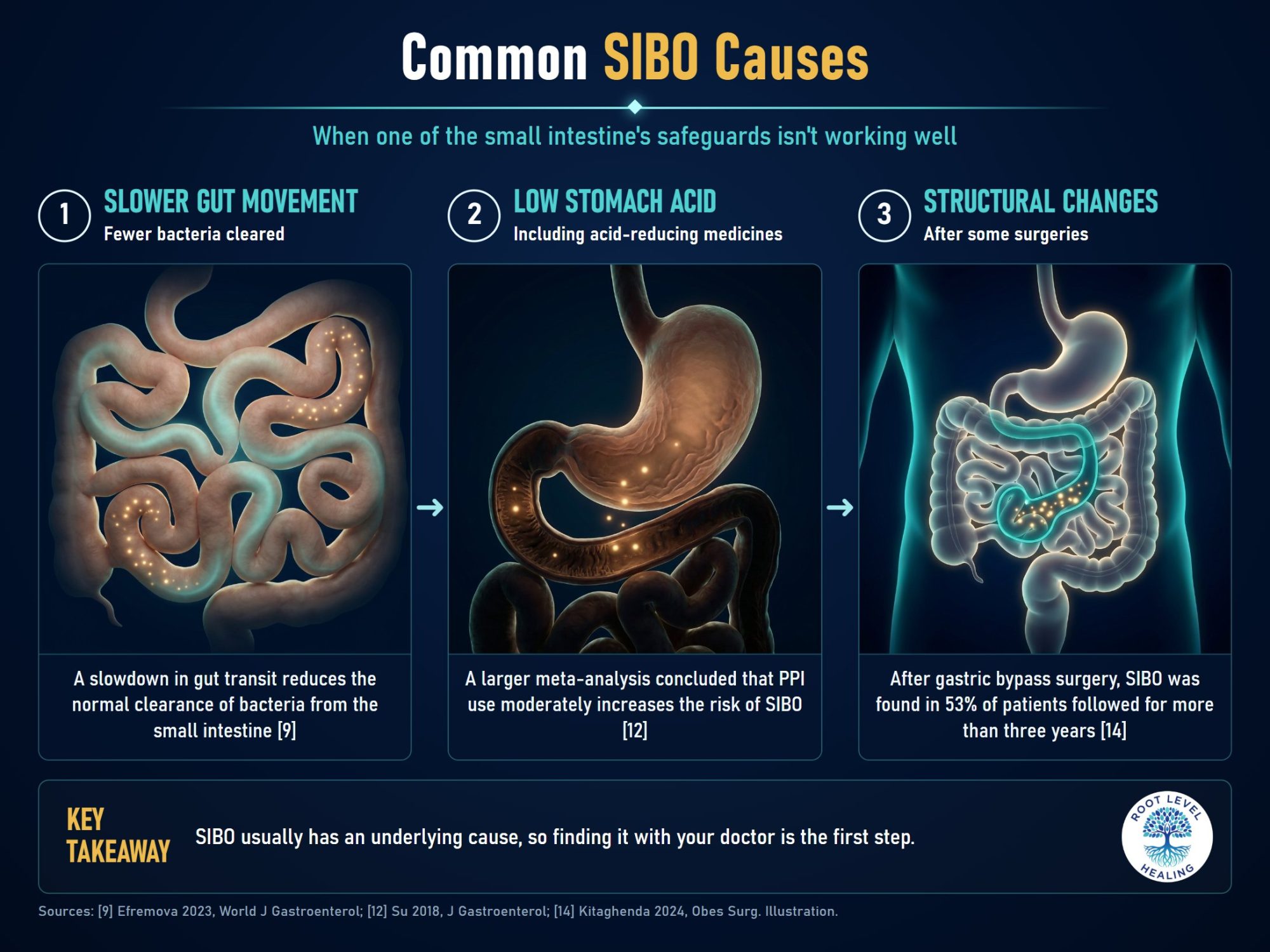
Many SIBO causes come down to one of the body's safeguards not working as it should.
Other medicines
Besides acid-reducing medicines, a review lists opioids among the factors that predispose to SIBO [4]. Cleveland Clinic also mentions overuse of antibiotics, which can upset the normal balance of gut bacteria [10]. As with PPIs, review any medicine with your doctor rather than stopping it on your own.
Age and other health conditions
In a 2023 review, SIBO was detected in 33.8% of people with digestive complaints who had a breath test. In that research, SIBO was linked with smoking, and its risk increased with age but didn't depend on gender or race [9]. Immune deficiencies are another recognized factor [2] [6].
The link with IBS gets the most attention. A systematic review of 25 studies found higher odds of SIBO in people with IBS than in people without it, but it rated the overall quality of the evidence as low, partly because the tests have limited accuracy [13]. The AGA expert review notes that the role of SIBO in IBS symptoms remains controversial [3]. A link in research isn't the same as one causing the other.
| Risk factor | What research found | Study type |
|---|---|---|
| Slower gut movement | Less clearance of bacteria from the small intestine [9]; the absence of the MMC associated with SIBO [7] | Reviews |
| Proton pump inhibitors (PPIs) | Higher odds of SIBO, clearest when tested by culture [11] [12] | Meta-analyses |
| Gastric bypass surgery | SIBO in 29% within three years and 53% after more than three years [14] | Systematic review and meta-analysis |
| Irritable bowel syndrome | Higher odds of SIBO than in controls; overall evidence quality low [13] | Systematic review of case-control studies |
| Older age and smoking | Linked with SIBO in people having breath tests [9] | Review |
How SIBO Is Tested, and What Tests Can't Tell You
Growing a culture from fluid taken from the small intestine is generally accepted as the best method, but it's invasive. Glucose or lactulose breath tests are noninvasive, but they're an indirect method that still needs further standardization and validation [4].
How a breath test works
The bacteria in your gut make hydrogen and, in some people, methane as they ferment sugars, and those gases show up in your breath [10]. For a breath test, you drink a set amount of a sugar, and your breath is sampled over time. A North American expert consensus set the doses at 10 grams of lactulose or 75 grams of glucose, and considered a rise in hydrogen of 20 parts per million (ppm) or more within 90 minutes positive. A methane level of 10 ppm or more was considered methane-positive [15].
The limits of breath testing
Breath tests aren't perfect. In the systematic review on IBS, the lactulose breath test found SIBO 3.6 times as often as the glucose breath test in people with IBS, and 7.6 times as often in people without it [13]. A review in Gastroenterology notes that issues with the specificity of breath tests have clouded their interpretation and raised some skepticism about the wider role given to SIBO [16]. For bloating, an AGA expert review suggests that breath testing may be used in a small subset of at-risk patients, not for everyone [17].
Other tests have their own place. The AGA review on SIBO found insufficient evidence for using inflammation markers such as fecal calprotectin to detect SIBO, and notes that blood tests can show nutritional changes, such as a high folate level or, less often, low vitamin B12 [3]. Doctors may also look for the underlying cause with imaging or other tests [10]. Our article on gut health testing and what each test can tell you explains how these tests differ from at-home kits.
Gut Support Strategies: What the Research Shows
Because SIBO usually has a cause, the AGA expert review advises that care focus on identifying and correcting underlying causes where possible, correcting nutritional deficiencies, and antibiotics. It also notes that there's limited research to guide antibiotic choices, so the approach is still largely based on clinical experience [3]. Cleveland Clinic adds that symptoms often return several months after a course of antibiotics, especially when an underlying condition remains [10]. That's why the cause matters so much.
Working out the underlying cause
This is detective work for you and your doctor. It may mean reviewing your medicines, managing a related condition more closely, or looking for a structural change that needs attention [10]. Bringing a clear history of your symptoms, medicines and any past surgery makes that conversation more useful.
Diet and eating plans
Diet shapes the gut's bacteria, and food intolerances are common in people with SIBO, but a 2024 review notes that both have been insufficiently investigated in SIBO. It lists elemental diets and carbohydrate-reduced diets among the options being explored [8]. An elemental diet is a liquid plan of pre-digested formulas that providers prescribe only for short-term use, and the many low-carbohydrate plans proposed for SIBO vary, as do people's results [10].
Restrictive plans can make your diet narrower than it needs to be. The AGA advises that when diet changes such as a low-FODMAP diet are needed, a gastroenterology dietitian should preferably monitor them [17].

Notes on your meals, symptoms and medicines can make a visit with your doctor or dietitian more useful.
Probiotics and herbal supplements
Many people ask about supplements, and the honest answer is that the research is early. A 2024 systematic review found low-quality evidence in favor of probiotics compared with placebo in SIBO [18]. A systematic review of probiotics, diets and herbal preparations found preliminary evidence, mostly from small studies without standardized formulations, and called for large, placebo-controlled trials [19]. For bloating and distention in general, the AGA advises against using probiotics [17]. If you're considering any supplement, talk to your doctor first, especially if you take other medicines.
The everyday basics
The everyday foundations of gut health still matter, like regular movement, good sleep and time to unwind. Our articles on how sleep and your gut microbiome talk to each other and on stress, the vagus nerve and gut health look at that research. With SIBO, though, which foods suit you is best worked out with your doctor or a dietitian rather than from a general rule. For general background, our articles on fiber for gut health and how much you need, prebiotic foods and how to add them and fermented foods and what the research shows are a starting point to discuss with your dietitian. Our article on why diet changes alone sometimes aren't enough looks at other factors that shape gut health, and our article on leaky gut causes and signs looks at the gut lining.
Our Gut Health & Microbiome guide brings the everyday foundations of gut health together in a step-by-step plan. And the Toxicity Score Quiz at the end of this article is a short educational self-assessment, not a medical test, that can help you think through the factors in your daily life.
When to See a Doctor
Ongoing digestive symptoms deserve a proper look, not a guess. Working it out on your own is tricky, because so many gut symptoms overlap, and medical testing can help sort out their causes [10]. See your doctor if bloating, diarrhea or abdominal pain is ongoing or getting worse.
Weight loss and fatty stools can also come with SIBO, and severe cases lead to malnutrition [2]. So tell your doctor about unexplained weight loss, oily or floating stools, or unusual tiredness [10]. The AGA advises imaging and endoscopy for people with alarm features, recently worsening symptoms or an abnormal exam [17], and your doctor can decide which tests you need. Seek care promptly if you see blood in your stool.
In our next article, on Friday, November 27, we'll look at heavy metals and gut health and what the research shows.
References
- Pimentel, M., Saad, R. J., Long, M. D., & Rao, S. S. C. (2020). ACG clinical guideline: Small intestinal bacterial overgrowth. The American Journal of Gastroenterology, 115(2), 165–178. https://doi.org/10.14309/ajg.0000000000000501
- MedlinePlus Medical Encyclopedia. (2026). Small bowel bacterial overgrowth. https://medlineplus.gov/ency/article/000222.htm
- Quigley, E. M. M., Murray, J. A., & Pimentel, M. (2020). AGA clinical practice update on small intestinal bacterial overgrowth: Expert review. Gastroenterology, 159(4), 1526–1532. https://doi.org/10.1053/j.gastro.2020.06.090
- Rao, S. S. C., & Bhagatwala, J. (2019). Small intestinal bacterial overgrowth: Clinical features and therapeutic management. Clinical and Translational Gastroenterology, 10(10), e00078. https://doi.org/10.14309/ctg.0000000000000078
- Barlow, G. M., & Pimentel, M. (2025). Modern concepts of small intestinal bacterial overgrowth. Current Opinion in Gastroenterology, 41(6), 399–408. https://doi.org/10.1097/MOG.0000000000001135
- Bures, J., Cyrany, J., Kohoutova, D., et al. (2010). Small intestinal bacterial overgrowth syndrome. World Journal of Gastroenterology, 16(24), 2978–2990. https://doi.org/10.3748/wjg.v16.i24.2978
- Deloose, E., Janssen, P., Depoortere, I., & Tack, J. (2012). The migrating motor complex: control mechanisms and its role in health and disease. Nature Reviews Gastroenterology & Hepatology, 9(5), 271–285. https://doi.org/10.1038/nrgastro.2012.57
- Sellge, G., & Ockenga, J. (2024). Small intestinal bacterial overgrowth (SIBO): therapy, nutrition, microbiome [article in German]. Deutsche Medizinische Wochenschrift, 149(18), 1071–1079. https://doi.org/10.1055/a-2205-5794
- Efremova, I., Maslennikov, R., Poluektova, E., et al. (2023). Epidemiology of small intestinal bacterial overgrowth. World Journal of Gastroenterology, 29(22), 3400–3421. https://doi.org/10.3748/wjg.v29.i22.3400
- Cleveland Clinic. (2024). SIBO (small intestinal bacterial overgrowth). https://my.clevelandclinic.org/health/diseases/21820-small-intestinal-bacterial-overgrowth-sibo
- Lo, W. K., & Chan, W. W. (2013). Proton pump inhibitor use and the risk of small intestinal bacterial overgrowth: a meta-analysis. Clinical Gastroenterology and Hepatology, 11(5), 483–490. https://doi.org/10.1016/j.cgh.2012.12.011
- Su, T., Lai, S., Lee, A., He, X., & Chen, S. (2018). Meta-analysis: proton pump inhibitors moderately increase the risk of small intestinal bacterial overgrowth. Journal of Gastroenterology, 53(1), 27–36. https://doi.org/10.1007/s00535-017-1371-9
- Shah, A., Talley, N. J., Jones, M., et al. (2020). Small intestinal bacterial overgrowth in irritable bowel syndrome: A systematic review and meta-analysis of case-control studies. The American Journal of Gastroenterology, 115(2), 190–201. https://doi.org/10.14309/ajg.0000000000000504
- Kitaghenda, F. K., Hong, J., Shao, Y., Yao, L., & Zhu, X. (2024). The prevalence of small intestinal bacterial overgrowth after Roux-en-Y gastric bypass (RYGB): a systematic review and meta-analysis. Obesity Surgery, 34(1), 250–257. https://doi.org/10.1007/s11695-023-06974-9
- Rezaie, A., Buresi, M., Lembo, A., et al. (2017). Hydrogen and methane-based breath testing in gastrointestinal disorders: The North American consensus. The American Journal of Gastroenterology, 112(5), 775–784. https://doi.org/10.1038/ajg.2017.46
- Bushyhead, D., & Quigley, E. M. M. (2022). Small intestinal bacterial overgrowth: pathophysiology and its implications for definition and management. Gastroenterology, 163(3), 593–607. https://doi.org/10.1053/j.gastro.2022.04.002
- Moshiree, B., Drossman, D., & Shaukat, A. (2023). AGA clinical practice update on evaluation and management of belching, abdominal bloating, and distention: Expert review. Gastroenterology, 165(3), 791–800.e3. https://doi.org/10.1053/j.gastro.2023.04.039
- Fernando Niño, S., Santiesteban, M., & Muñoz Valencia, G. (2024). Efficacy of probiotics in the treatment of small intestinal bacterial overgrowth: systematic review and meta-analysis [article in Spanish]. Revista de Gastroenterología del Perú, 44(3), 245–251. https://pubmed.ncbi.nlm.nih.gov/39538392/
- Nickles, M. A., Hasan, A., Shakhbazova, A., et al. (2021). Alternative treatment approaches to small intestinal bacterial overgrowth: A systematic review. Journal of Alternative and Complementary Medicine, 27(2), 108–119. https://doi.org/10.1089/acm.2020.0275
Frequently Asked Questions
Q: What causes SIBO?
A: Usually, a problem with one of the body's own safeguards. Researchers describe slower gut movement, low stomach acid, changes in the gut's structure from surgery or disease, and some medicines, such as acid-reducing drugs and opioids, as common SIBO causes. In some people more than one factor is involved, which is why care focuses on finding the underlying cause.
Q: Do proton pump inhibitors (PPIs) cause SIBO?
A: They're linked with it, but the picture is mixed. Meta-analyses have found higher odds of SIBO in people taking PPIs, most clearly when SIBO was measured by culturing fluid from the small intestine rather than by a breath test, and studies in people with IBS haven't found the same link. Don't stop a prescribed PPI on your own; talk to your doctor if you have questions.
Q: How is SIBO tested?
A: Most often with a breath test. You drink a set amount of glucose or lactulose, and your breath is checked for hydrogen and methane over time; a North American expert consensus considered a hydrogen rise of 20 parts per million or more within 90 minutes positive. Culturing fluid from the small intestine is generally seen as the best method, but it's invasive, and breath tests are indirect and still need standardization.
Q: Is SIBO linked to IBS?
A: Research suggests a link, but it isn't settled. A systematic review of 25 studies found higher odds of SIBO in people with IBS than in people without it, but rated the overall quality of the evidence as low, partly because the tests have limited accuracy. An AGA expert review notes that the role of SIBO in IBS symptoms remains controversial.
Q: What does research say about diet, probiotics and herbs for SIBO?
A: The evidence is still limited. A 2024 review notes that diet has been insufficiently investigated in SIBO, a systematic review rated the evidence for probiotics as low quality, and another called the evidence for probiotics, diets and herbal preparations preliminary. A restrictive eating plan is best done with a dietitian, and any supplement is worth discussing with your doctor first.
Q: When should I see a doctor about possible SIBO symptoms?
A: See your doctor if bloating, diarrhea or abdominal pain is ongoing or getting worse, or if you notice unexplained weight loss, oily or floating stools or unusual tiredness. Severe cases of SIBO can lead to malnutrition, so these are worth mentioning. Seek care promptly if you see blood in your stool. A doctor can look for the underlying cause and decide which tests you need.
This article is part of our gut health and microbiome guide.

Ready to Discover Your Score?
This 2-minute quiz is the essential first step to understanding your body's current toxic load and identifying the root cause of how you feel.
Take The Toxicity QuizExplore More Articles
Dive deeper into topics like detoxification, gut health, and mental clarity on our blog. Knowledge is the key to taking control of your health.
Visit The Blog