
Heavy Metals and Gut Health: What the Research Shows
You filter your water, you read labels, and you've probably wondered at some point what everyday traces of lead, mercury or arsenic actually do once they're inside you. It's a fair question, and the first place most of them meet your body is your gut. Researchers are now looking closely at the link between heavy metals and gut health: how these metals may affect the bacteria living in your digestive tract, and how those bacteria may shape what happens to the metals in turn.
In this article, we'll look at what heavy metals are and where everyday exposure comes from, why the gut matters, what human, lab and animal studies show, how the gut barrier fits in, and simple steps that lower exposure and support your gut. It builds on our beginner's guide to detoxing from heavy metals, which covers the basics of how the body handles them.
Key Takeaways
- Mostly swallowed: everyday exposure to lead, mercury, arsenic and cadmium comes largely through water, food, dust and soil, so the gut is where many of these metals meet the body first.
- Gut bacteria shift: a systematic review of 12 human studies found that heavy metal exposure was linked with changes in the makeup of gut bacteria.
- It works both ways: lab and mouse studies suggest gut bacteria can bind and change arsenic, and that a disrupted gut barrier may let more metal through, though research in people is still early.
- Exposure comes first: safe drinking water, attention to old pipes and paint, and smart fish choices lower exposure, and a fiber-rich diet feeds the gut bacteria that are part of the picture.
In This Article:
- Heavy Metals: What They Are and Where Exposure Comes From
- Why Your Gut Is on the Front Line
- Heavy Metals and Gut Health: What the Research Shows
- It Works Both Ways: How Gut Bacteria Handle Metals
- The Gut Barrier and How Much Metal Gets Through
- Everyday Steps: Lower Exposure, Feed Your Gut
- When to Talk to Your Doctor
- Frequently Asked Questions
Heavy Metals: What They Are and Where Exposure Comes From
Heavy metals are found naturally in the environment, and they also turn up in some foods, medicines and supplements and in chemicals used in industry and farming. Because they're just about everywhere, it's normal to have some level of them in your body; the concern is when that level gets too high [1]. Our heavy metal detoxification guide introduces the most common ones. Here's where the four studied most often in gut research usually come from:
- Lead. People take in lead mainly by breathing in lead particles or by swallowing contaminated dust, soil, water or food, and lead can get into drinking water from pipes, solder and fittings [2]. The World Health Organization notes that there's no level of lead exposure known to be without harmful effects [2].
- Mercury. People are exposed to methylmercury mainly when they eat fish and shellfish, and large predatory fish are more likely to have high levels [3].
- Arsenic. Contaminated water used for drinking, cooking and irrigating crops is the greatest public health threat from arsenic [4]. The inorganic form is the highly toxic one; in seafood, arsenic is mostly in a less toxic organic form [4].
- Cadmium. Researchers describe rice as a major source of human exposure to both cadmium and arsenic [5].
Why Your Gut Is on the Front Line
Look at that list again and you'll notice a pattern: much of everyday exposure is swallowed. That puts your digestive tract at the meeting point, and the World Health Organization lists the digestive system among the systems mercury may harm [3].
Your gut isn't a passive pipe, though. Its lining acts as a barrier that protects the body against gut microbes, food antigens and toxins in the digestive tract [6]. Think of it as a careful border checkpoint. A review in Trends in Endocrinology and Metabolism notes that this barrier can be affected by many everyday factors, including a Western-style diet, antibiotics, alcohol, disrupted sleep rhythms, psychological stress and aging [6].
Living alongside that barrier are your gut bacteria. They help with immune development, metabolism, nutrition and defense against harmful germs, and they can be sensitive to outside substances, including drugs, diet and environmental pollutants such as heavy metals [7].
Heavy Metals and Gut Health: What the Research Shows
The clearest summary in people comes from a 2025 systematic review that gathered human observational studies on heavy metals and the gut microbiota. The authors found 12 studies covering arsenic, lead, mercury and cadmium, and none that met their criteria for aluminum [7].
In a review of 12 human studies, heavy metal exposure was linked with shifts in gut bacteria [7]. The authors concluded that exposure disturbs the makeup of the gut microbiota and can lead to dysbiosis, an imbalance in gut bacteria. They also reported that higher exposure to arsenic, lead and mercury was linked with more Collinsella, a group of bacteria they describe as potentially harmful, and that they connect with a leakier gut and oxidative stress [7].
I want to be clear about what this kind of evidence can and can't tell us. Observational studies show that two things tend to go together; they can't prove that the metals caused the change in gut bacteria. Still, a consistent pattern across several metals is a good reason to keep paying attention.
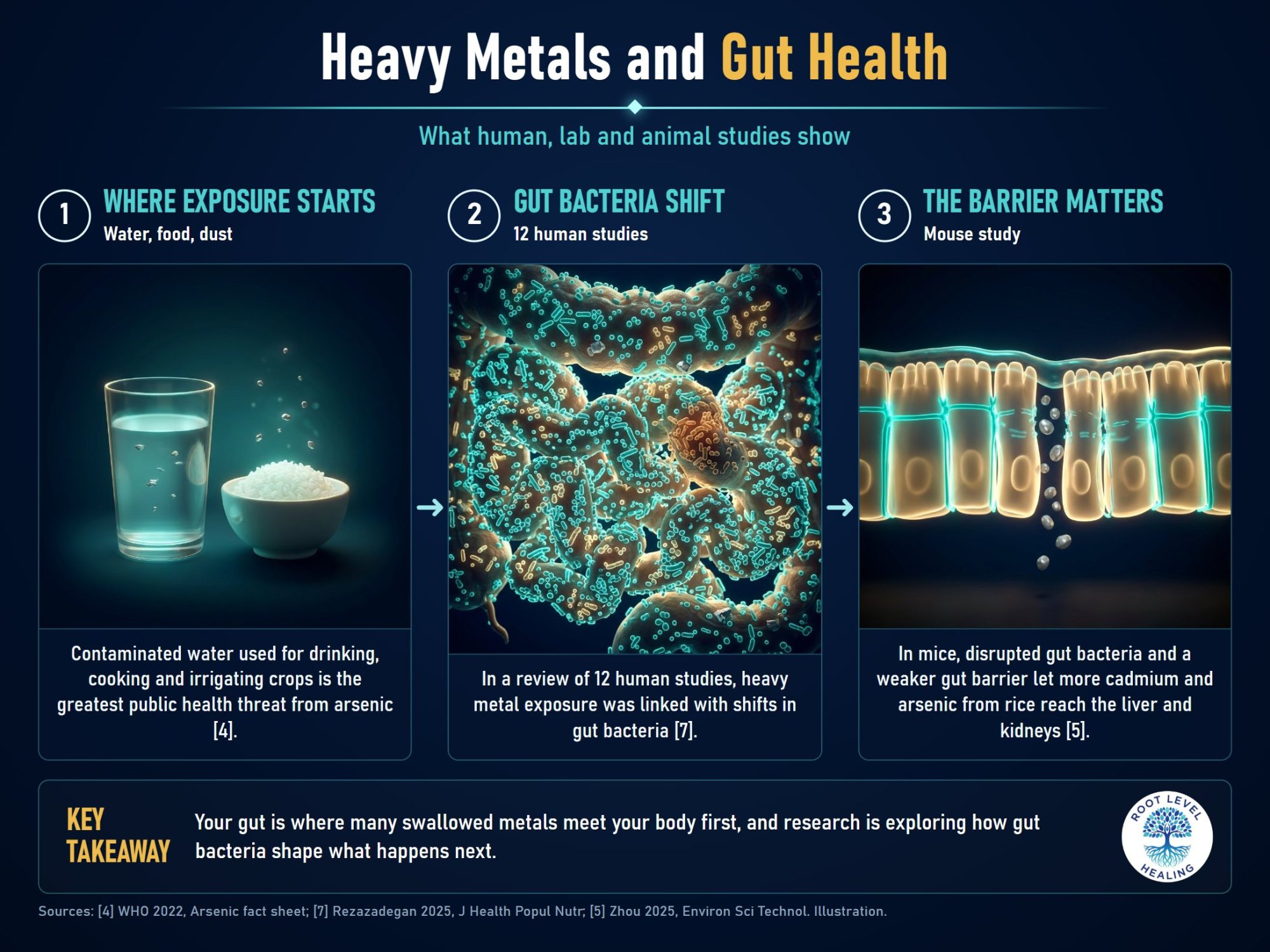
From exposure to gut bacteria to the gut barrier: three steps research is exploring.
It Works Both Ways: How Gut Bacteria Handle Metals
Here's the part that surprises most people: the relationship isn't one-way. A review of arsenic research describes how gut bacteria can influence what happens to arsenic in the body. They can change arsenic's chemical form directly, and they can also affect how much is absorbed [8]. Much of that evidence comes from mice.
A lab study tested 21 strains of human gut bacteria in dishes. Seven of them bound between 20.1% and 29.8% of the arsenic they were exposed to, and six of those seven could also change arsenic from one chemical form to another [9]. That's a lab result, not a measurement inside a person, but it shows that some gut bacteria can hold on to arsenic.
Animal studies point the same way, with a catch. In a study in mice, animals whose gut bacteria had been wiped out with antibiotics built up more arsenic in their tissues than mice with normal gut bacteria, and their liver and kidneys showed more damage [10]. The same paper notes that earlier research has found gut bacteria both lessening and worsening arsenic's effects, so the picture isn't settled [10].
Researchers are also measuring how well lactic acid bacteria, the kind used as probiotics and found in many fermented foods, bind metals such as cadmium, lead, arsenic and mercury in the lab [11]. This is early, lab-based work. It doesn't show that eating fermented foods for gut health lowers metal levels in people.
The Gut Barrier and How Much Metal Gets Through
If the gut lining is a checkpoint, what happens when it's weaker? A 2025 mouse study looked at exactly that. Mice ate rice contaminated with both cadmium and arsenic for three weeks. Mice whose gut bacteria had been disrupted by an antibiotic ended up with 30.9% to 119% more cadmium and 30.0% to 100% more arsenic in their liver and kidneys than mice with normal gut bacteria [5].
The researchers traced the difference to the gut barrier: a damaged mucus layer and fewer of the tight junctions that seal the gaps between gut cells, which made the gut more permeable. In mice given probiotics and prebiotics after the antibiotic, the barrier was rebuilt and tissue levels were 34.3% to 74.3% lower for cadmium and 25.0% to 75.0% lower for arsenic [5]. In mice, disrupted gut bacteria and a weaker gut barrier let more cadmium and arsenic from rice reach the liver and kidneys [5].
This was a mouse study, so it can't tell us what happens in people. It does show why researchers think the gut barrier may matter for how much of a swallowed metal reaches the rest of the body. Our article on leaky gut causes and signs explains what intestinal permeability is and what else research links to it.
| What research looked at | What it found | Study type |
|---|---|---|
| Heavy metal exposure and gut bacteria | Shifts in gut bacteria; more Collinsella with higher arsenic, lead and mercury exposure [7] | Systematic review (12 human observational studies) |
| Human gut bacteria and arsenic | 7 of 21 strains bound 20.1% to 29.8% of the arsenic [9] | Lab study (bacteria in dishes) |
| No gut bacteria and arsenic | More arsenic built up in tissues [10] | Animal study (mice) |
| Disrupted gut bacteria and contaminated rice | More cadmium and arsenic in the liver and kidneys; less once the barrier was rebuilt [5] | Animal study (mice) |
Everyday Steps: Lower Exposure, Feed Your Gut
The research on gut bacteria is fascinating, but the most practical step is still the simplest one: take in less. These habits are low-risk and sensible for everyone:
- Know your water. For arsenic, the World Health Organization calls a safe water supply for drinking, cooking and watering crops the most important action, and testing water is one way to tell high-arsenic sources from low ones [4]. If you're on a private well, the EPA advises testing it every year, testing for anything else you suspect, and asking your local health department what is common in your area's groundwater [13].
- Mind old pipes and paint. Lead can enter drinking water from older plumbing, and homes built before 1978 may have lead in household dust from chipping or peeling paint [1].
- Choose fish thoughtfully. Large predatory fish are more likely to carry high levels of mercury [3]. The FDA and EPA advise choosing a variety of fish that are lower in mercury, and their chart shows which ones those are [14].
- Eat well, especially for children. The World Health Organization notes that children absorb more lead when they're short on other nutrients, especially calcium or iron [2].
- Feed your gut bacteria. The authors of the 2025 systematic review suggest that nutrition strategies, such as high fiber intake and an antioxidant-rich diet, should be considered for people exposed to heavy metals [7]. Dietary fiber interacts directly with gut bacteria and leads to the production of short-chain fatty acids [12]. Our article on fiber for gut health covers how much you need and which kinds your gut bacteria use, and our list of prebiotic foods and how to add them turns that into everyday meals.

Clean drinking water and a varied, fiber-rich plate are two everyday basics for your gut.
One mineral often discussed in detox research is clinoptilolite, a natural zeolite that can swap the positively charged ions held in its pores for others around it (ion exchange); a 2018 review looked at its use in detoxification research [15]. That review is not a study of any one product. For the full science behind the supplement below, see our Clean Slate review and our article on the role of binders in detox.
Exploring Everyday Detox Support From ROOT
Lowering exposure and eating well come first. If you're also curious about a supplement, here's how ROOT describes this one:

Clean Slate
"ROOT Clean Slate is a liquid mineral supplement featuring bioavailable silica, trace minerals, and vitamin C. Designed for everyday wellness, Clean Slate provides a convenient liquid formula to support the body's natural cleansing pathways and overall wellness routine."
— The ROOT Brands
ROOT lists "Systemic Passive Cleansing" and "Maximum Bioavailability" among its features. It's here because Dr. Christina Rahm's granted patents describe the water-soluble clinoptilolite fragments [16] and silicon dioxide formulation [17] behind Clean Slate, from the zeolite family described above. In a July 2026 article, ROOT writes that the goal of its patented process is "to support better interaction within the body while maintaining clinoptilolite's natural ability to bind certain unwanted substances."
I am a Root Ambassador, and I may earn rewards from qualifying purchases.Referral code ROOTLEVELHEALING is applied automatically through this link.
Our Heavy Metal Detoxification guide walks through the body's natural detoxification pathways step by step, and our article on the role of binders in detox explains how binders are meant to work. For the gut side of the story, our Gut Health & Microbiome guide brings the everyday foundations together.
When to Talk to Your Doctor
Everyday habits are a good foundation, but they aren't a substitute for medical care. Talk to your doctor if you think you've been exposed to heavy metals, at work, at home or through your water, or if you have symptoms such as nausea, vomiting, belly pain, diarrhea, tingling in your hands and feet, muscle weakness, or changes in memory or behavior [1]. A doctor can order heavy metal testing, usually of blood or urine, and will read the results together with your symptoms and exposure history [1]. If you're having a test, it's worth knowing that some fish and shellfish are high in mercury, so you may be asked to avoid seafood for 48 hours beforehand [1]. Gut tests are a separate topic; our guide to gut health testing and what each test can and can't tell you walks through them.
For lead, the World Health Organization's guidelines say that when a blood test shows 5 µg/dL or more, the source of exposure should be found and stopped [2]. If you have young children, especially in an older home, ask their doctor about lead testing. And if a doctor ever recommends prescription chelation, know that it can have serious side effects, so it's a decision to weigh carefully with them, never something to try on your own [1].
In our next article, we'll look at choosing a probiotic: what the labels mean, and what to look for before you buy.
References
- MedlinePlus. Heavy metal testing. U.S. National Library of Medicine. https://medlineplus.gov/lab-tests/heavy-metal-blood-test/
- World Health Organization. (2026). Lead poisoning (fact sheet). https://www.who.int/news-room/fact-sheets/detail/lead-poisoning-and-health
- World Health Organization. (2024). Mercury (fact sheet). https://www.who.int/news-room/fact-sheets/detail/mercury-and-health
- World Health Organization. (2022). Arsenic (fact sheet). https://www.who.int/news-room/fact-sheets/detail/arsenic
- Zhou, L., Chen, S. Z., Li, Y. Y., et al. (2025). Gut dysbiosis exacerbates intestinal absorption of cadmium and arsenic from cocontaminated rice in mice due to impaired intestinal barrier functions. Environmental Science & Technology, 59(7), 3459–3471. https://doi.org/10.1021/acs.est.5c00817
- Martel, J., Chang, S. H., Ko, Y. F., et al. (2022). Gut barrier disruption and chronic disease. Trends in Endocrinology and Metabolism, 33(4), 247–265. https://doi.org/10.1016/j.tem.2022.01.002
- Rezazadegan, M., Forootani, B., Hoveyda, Y., Rezazadegan, N., & Amani, R. (2025). Major heavy metals and human gut microbiota composition: a systematic review with nutritional approach. Journal of Health, Population, and Nutrition, 44(1), 21. https://doi.org/10.1186/s41043-025-00750-4
- Yang, Y., Chi, L., Lai, Y., et al. (2021). The gut microbiome and arsenic-induced disease: iAs metabolism in mice. Current Environmental Health Reports, 8(2), 89–97. https://doi.org/10.1007/s40572-021-00305-9
- Wang, P., Du, H., Fu, Y., et al. (2022). Role of human gut bacteria in arsenic biosorption and biotransformation. Environment International, 165, 107314. https://doi.org/10.1016/j.envint.2022.107314
- Liu, Q., Liu, Y., Zhang, J., et al. (2024). Gut microbiota deficiency aggravates arsenic-induced toxicity by affecting bioaccumulation and biotransformation in C57BL/6J mice. Food and Chemical Toxicology, 186, 114564. https://doi.org/10.1016/j.fct.2024.114564
- Kinoshita, H. (2024). Biosorption of heavy metals by lactic acid bacteria for detoxification. Methods in Molecular Biology, 2851, 201–212. https://doi.org/10.1007/978-1-0716-4096-8_18
- Makki, K., Deehan, E. C., Walter, J., & Bäckhed, F. (2018). The impact of dietary fiber on gut microbiota in host health and disease. Cell Host & Microbe, 23(6), 705–715. https://doi.org/10.1016/j.chom.2018.05.012
- U.S. Environmental Protection Agency. (2026). Protect your home's water. https://www.epa.gov/privatewells/protect-your-homes-water
- U.S. Food and Drug Administration. (2024). Advice about eating fish. https://www.fda.gov/food/consumers/advice-about-eating-fish
- Pavelić, S. K., Simović Medica, J., Gumbarević, D., Filošević, A., Pržulj, N., & Pavelić, K. (2018). Critical review on zeolite clinoptilolite safety and medical applications in vivo. Frontiers in Pharmacology, 9, 1350. https://doi.org/10.3389/fphar.2018.01350
- Cook, C. R. (2021). Water-soluble electrolyzed/solvolyzed clinoptilolite fragments and nutraceutical, pharmaceutical, and environmental products based thereon (U.S. Patent No. 10,894,721 B2). https://patents.google.com/patent/US10894721B2/en
- Cook, C. R. (2026). Water soluble electrolyzed silicon dioxide formulation and method of manufacture (U.S. Patent No. 12,582,671 B1). https://patents.google.com/patent/US12582671B1/en
Frequently Asked Questions
Q: How do heavy metals get into the body?
A: Mostly through what you swallow and breathe: contaminated water, food, dust and soil. Lead can come from older pipes, paint and dust, mercury mainly from fish and shellfish, and arsenic mainly from contaminated water used for drinking, cooking and irrigating crops. Researchers also describe rice as a major source of both cadmium and arsenic.
Q: Can heavy metals affect gut bacteria?
A: Research suggests they can. A 2025 systematic review of 12 human observational studies found that exposure to arsenic, lead, mercury and cadmium was linked with changes in gut bacteria, including more Collinsella with higher arsenic, lead and mercury exposure. Observational studies can't prove cause, so this is an association, not proof.
Q: Do gut bacteria bind heavy metals?
A: Some can, at least in the lab. In one lab study, 7 of 21 strains of human gut bacteria bound 20.1% to 29.8% of the arsenic they were exposed to, and in a mouse study, animals without gut bacteria built up more arsenic in their tissues. These are lab and animal results, so they don't show what happens in people.
Q: Does a weaker gut barrier let in more heavy metals?
A: It may, but the evidence so far comes from mice. In a 2025 study, mice with disrupted gut bacteria and a weaker gut barrier had 30.9% to 119% more cadmium and 30.0% to 100% more arsenic in their liver and kidneys after eating contaminated rice. Whether the same happens in people isn't known yet.
Q: How can I lower my heavy metal exposure?
A: Start with your water, pipes, paint and fish choices. A safe water supply is the most important step for arsenic, older plumbing and homes built before 1978 can be sources of lead, and large predatory fish are more likely to be high in mercury. Eating plenty of fiber also feeds your gut bacteria.
Q: When should I talk to a doctor about heavy metals?
A: Talk to your doctor if you think you've been exposed, or if you have symptoms such as nausea, belly pain, diarrhea, tingling in your hands and feet, muscle weakness, or changes in memory or behavior. A doctor can order heavy metal testing, usually of blood or urine, and will read the results together with your symptoms and exposure history.
This article is part of our heavy metal detoxification guide.

Ready to Discover Your Score?
This 2-minute quiz is the essential first step to understanding your body's current toxic load and identifying the root cause of how you feel.
Take The Toxicity QuizExplore More Articles
Dive deeper into topics like detoxification, gut health, and mental clarity on our blog. Knowledge is the key to taking control of your health.
Visit The Blog